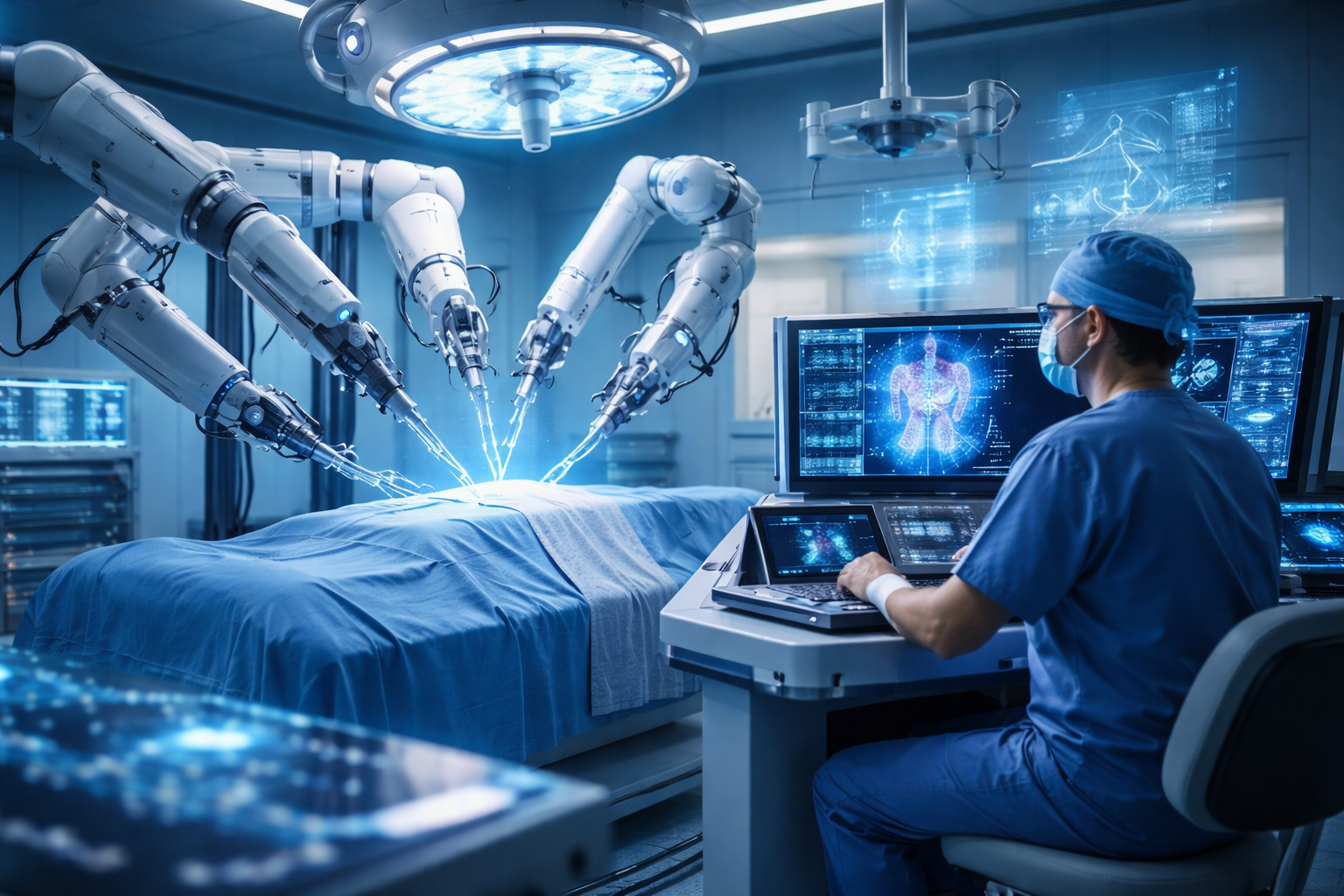
Automation has moved well beyond factories and assembly lines. Today, it is changing how surgeons operate, how patients recover, and how hospitals deliver care. Surgical robotics is one of the most significant shifts in modern medicine, bringing a new level of precision to procedures that once carried higher risks and longer recovery times.
What Is Surgical Robotics?
Surgical robotic systems are advanced medical platforms that help surgeons perform complex procedures with greater accuracy and control. These systems do not replace the surgeon — they work as an extension of the surgeon’s hands, translating natural hand movements into smaller, more precise robotic motions inside the patient’s body.
A typical surgical robotic system includes the following components:
- Robotic arms fitted with specialized surgical instruments
- A high-definition 3D camera system for magnified visualization
- A surgeon control console from which the doctor operates
- Real-time data processing software that manages motion and feedback
One of the most widely adopted platforms globally is the da Vinci Surgical System, developed by Intuitive Surgical. Hospitals across the world have integrated this system into their operating rooms for a wide range of procedures.
Key Benefits of Robotic Surgery for Patients and Surgeons
Robotic surgery offers clear advantages over traditional open surgery in many clinical situations. Here is a comparison of robotic surgery versus conventional open surgery:
| Factor | Robotic Surgery | Traditional Open Surgery |
|---|---|---|
| Incision Size | Small, minimally invasive | Larger incisions required |
| Recovery Time | Faster recovery | Longer hospital stay |
| Precision | Micro-movements, tremor filtering | Limited by human hand steadiness |
| Visualization | 3D HD magnified imaging | Standard direct or 2D view |
| Post-op Pain | Generally lower | Higher due to larger wounds |
The ability to filter out natural hand tremors and perform micro-movements beyond normal human capability makes robotic systems particularly valuable in delicate or high-risk procedures.
Where Robotic Surgery Is Being Used Today
Robotic assistance is now applied across multiple medical specialties. Common areas include:
- Cardiac surgery — procedures on the heart with reduced chest trauma
- Urology — including prostate surgeries where precision is critical
- Gynecological surgery — such as hysterectomies and fibroid removal
- Orthopedic operations — joint replacements with improved alignment accuracy
- General laparoscopic surgery — abdominal procedures with minimal scarring
Robotic platforms are especially useful in procedures that require working in tight anatomical spaces or near sensitive structures like nerves and blood vessels.
The Technology Powering Robotic Operating Rooms
Behind every robotic surgery system is a combination of sophisticated engineering and software. Key technologies include:
- Motion scaling algorithms that convert large hand movements into tiny, precise instrument actions
- Force feedback systems that give surgeons a sense of tissue resistance
- Precision servo motors for smooth and stable instrument control
- Real-time control systems that process commands with minimal delay
- Imaging-assisted analysis that helps identify tissue types and surgical landmarks
Next-generation systems are beginning to integrate machine learning capabilities, allowing the software to assist in recognizing tissue boundaries and flagging critical anatomical structures during live procedures.
Challenges Limiting Wider Adoption
Despite its clear clinical benefits, surgical robotics still faces real-world barriers that slow its adoption, especially in lower-resource settings:
- High equipment costs — robotic systems require significant capital investment from hospitals
- Extensive surgeon training — operating these systems requires dedicated learning and certification
- Ongoing maintenance expenses — servicing and updating robotic platforms adds to operational costs
- Regulatory approvals — new systems must pass rigorous safety evaluations before clinical use
Access to robotic surgery remains uneven. Smaller hospitals and healthcare facilities in rural or developing regions often cannot afford these systems, creating a gap in care quality between well-funded and under-resourced institutions.
What the Future Holds for Surgical Robotics
The next phase of surgical robotics is focused on expanding capability while reducing cost and complexity. Emerging developments include:
- Semi-autonomous procedures guided by advanced imaging and decision-support tools
- Remote robotic surgery performed over high-speed networks, enabling specialists to operate on patients in distant locations
- Miniaturized robotic instruments for even less invasive access
- Augmented reality overlays that project surgical maps directly into the surgeon’s field of view
The long-term direction is toward safer, faster, and more accessible operations — with robotic systems handling more of the mechanical precision while surgeons focus on clinical judgment and decision-making.
As robotic platforms become more affordable and training programs expand, more hospitals around the world — including those in India — are expected to integrate these systems into routine surgical care.