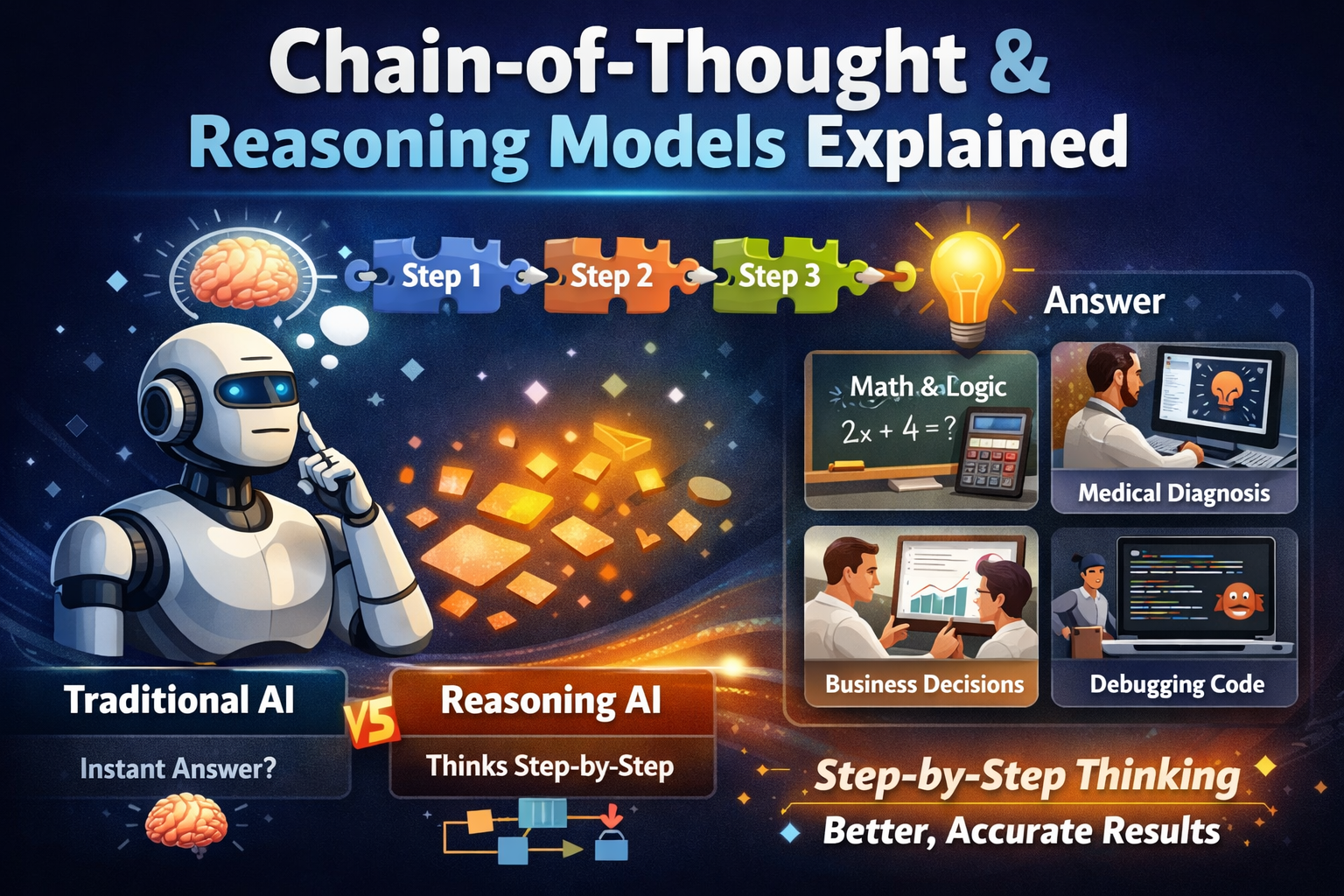
Artificial intelligence has come a long way from simply matching patterns and retrieving quick answers. A newer approach called Chain-of-Thought reasoning is changing how AI models handle complex problems — by thinking through them one step at a time, much like a human would.
What Is Chain-of-Thought Reasoning?
Chain-of-Thought (CoT) reasoning is a method where an AI model does not jump straight to a final answer. Instead, it breaks a problem into smaller steps, works through each one logically, and then combines those steps to reach a conclusion.
Think of it like solving a math problem on paper. Rather than guessing the answer, you write out each calculation. CoT-based AI follows the same logic — it works through a problem methodically before responding.
This approach makes AI responses more accurate, especially for questions that require multiple steps, logical thinking, or in-depth understanding of context.
Why Traditional AI Models Fell Short
Earlier AI systems were built primarily on pattern recognition. They worked well when a question closely matched something they had seen before in training data. But when a question required logic, multi-step reasoning, or explanation, these models often failed.
- They could not handle questions with multiple connected steps.
- They lacked the ability to justify their answers.
- They sometimes gave confident but wrong responses — a problem known as hallucination.
- They struggled with tasks like coding puzzles, logical riddles, and complex decision-making.
Chain-of-Thought reasoning directly addresses these weaknesses by building structured thinking into the AI response process.
How Reasoning Models Actually Work
Reasoning models are a category of AI systems specifically trained to think logically before producing an output. When you ask such a model a question, it follows a clear internal process:
- Step 1: Understand the question fully.
- Step 2: Break it into smaller, manageable parts.
- Step 3: Solve each part individually.
- Step 4: Combine the results to form a complete and accurate answer.
Some reasoning models show this thinking process openly, so users can see exactly how the answer was reached. Others perform the reasoning internally and only show the final output — but the step-by-step logic still happens behind the scenes.
| Feature | Traditional AI | Reasoning AI (CoT) |
|---|---|---|
| Response Speed | Very fast | Slightly slower due to thinking steps |
| Accuracy on Complex Tasks | Often limited | Significantly higher |
| Explainability | Low | High (can show reasoning steps) |
| Hallucination Risk | Higher | Reduced through logical checks |
| Best Use Cases | Simple queries, FAQs | Math, coding, medical, legal analysis |
Real-World Applications of Chain-of-Thought AI
Chain-of-Thought reasoning is already being used across several important fields:
- Education: Helps students understand how a solution was reached, not just what the answer is. This supports deeper learning rather than rote memorization.
- Healthcare: Assists in evaluating medical data, symptoms, and treatment options by working through clinical information step by step.
- Software Development: Explains code logic, identifies bugs, and suggests fixes with clear reasoning behind each recommendation.
- Business Intelligence: Supports decision-making by logically weighing risks, outcomes, and data before presenting conclusions.
- Legal and Research Fields: Helps analyze complex documents and arguments by breaking them into structured, logical components.
Making AI More Trustworthy and Transparent
One of the biggest concerns with AI has always been trust. When a model gives a wrong answer confidently, it can cause real harm — especially in sensitive areas like medicine or finance.
Chain-of-Thought reasoning reduces this risk. By forcing the model to work through a problem logically, it becomes easier to spot errors in the reasoning chain before a wrong conclusion is reached. When the steps are visible, users can verify the logic themselves.
This transparency is a major step toward building AI systems that are not just powerful, but also reliable and accountable. Researchers and developers consider explainable AI — where the reasoning is visible — a key goal for responsible AI development.
The Road Ahead for Step-by-Step AI Reasoning
As AI technology continues to advance, step-by-step reasoning is expected to become a standard feature rather than a specialty. Future models are likely to be better at long-term planning, self-correction, and working alongside humans on complex tasks.
Industries like scientific research, automation, education technology, and enterprise software are already exploring how reasoning-based AI can improve outcomes. The ability to think through problems — rather than just pattern-match — makes these models far more useful in the real world.
In conclusion, Chain-of-Thought reasoning marks a meaningful shift in how AI approaches problems. By thinking step by step, these models produce more accurate answers, reduce errors, and offer greater transparency. As this technology matures, it will play a central role in making AI genuinely useful, trustworthy, and capable of handling the complexity of real-world challenges.