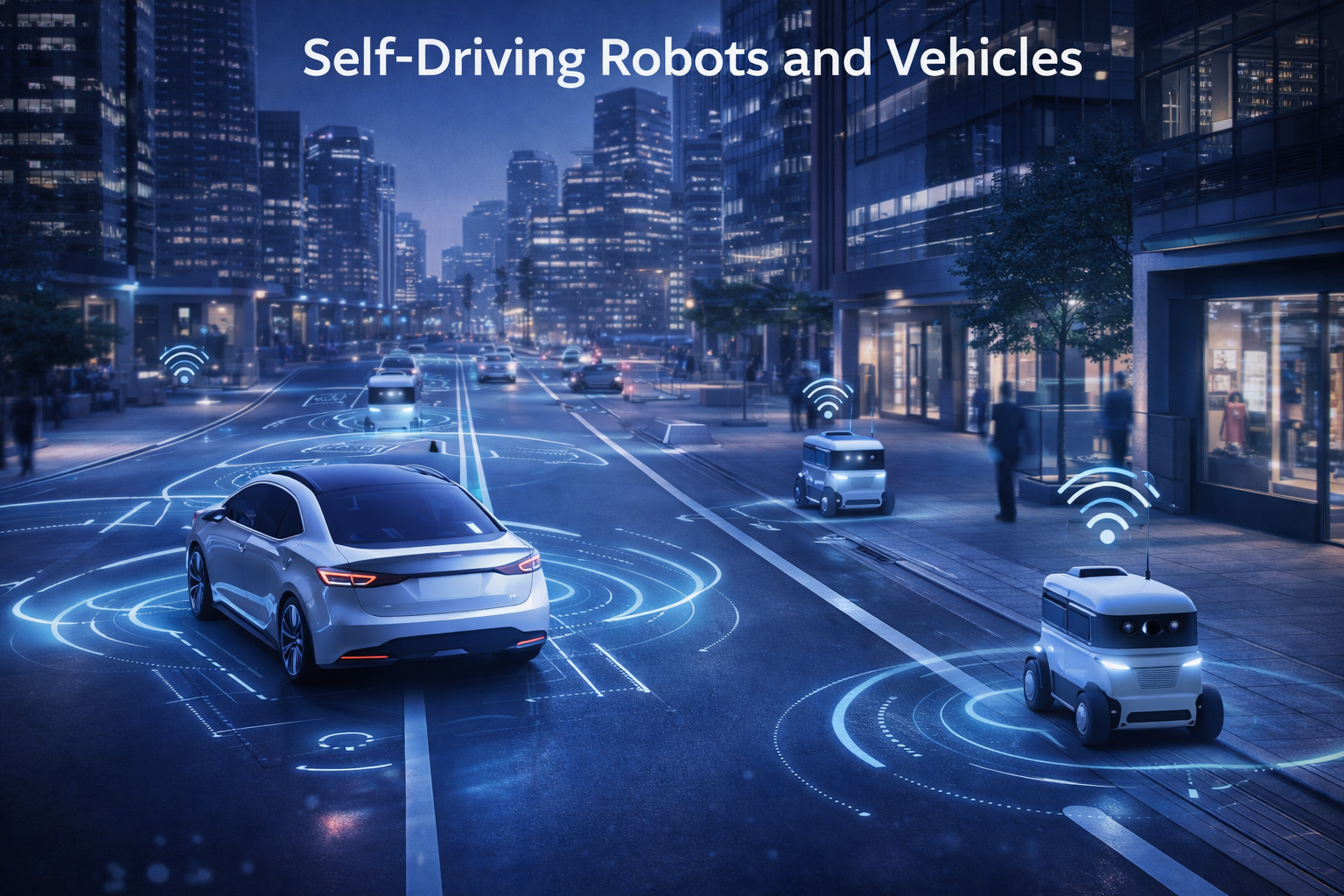
Self-driving robots and vehicles are no longer a distant dream. From delivery bots navigating city streets to driverless taxis being tested in major cities, autonomous technology is quietly reshaping how people move, work, and receive goods. Here is a clear look at what this technology is, how it works, where it is being used, and what challenges still lie ahead.
What Self-Driving Robots and Vehicles Actually Mean
Self-driving robots and vehicles are machines capable of operating without direct human control. They use a combination of sensors, cameras, GPS, and artificial intelligence to understand their environment and make decisions in real time.
Think of it this way — these machines can effectively “see” what is around them, process that information, and then act accordingly. A self-driving car, for instance, can read traffic signals, detect pedestrians, and navigate roads without a human behind the wheel.
The level of autonomy can vary. Some vehicles still need a human to take over in complex situations, while others are designed to operate fully independently under specific conditions.
How the Technology Behind These Machines Works
The core of any self-driving system relies on several technologies working together:
- Cameras: Capture visual information about the surroundings, including road markings, signs, and obstacles.
- LiDAR and radar sensors: Measure distances and detect objects even in low-light conditions.
- Artificial intelligence software: Processes all incoming data and decides the best course of action within milliseconds.
- GPS and mapping systems: Help the vehicle understand its exact location and plan the most efficient route.
When an obstacle suddenly appears in front of a delivery robot, the system detects it instantly and either stops or reroutes — all without any human input. This speed and precision is what makes autonomous systems attractive for both businesses and public use.
Where Self-Driving Technology Is Already Being Used
Autonomous robots and vehicles are not just in labs anymore. They are already active in several real-world settings:
- Delivery robots: Companies are deploying small ground robots to deliver food and packages in residential areas and campuses.
- Warehouses and logistics: Large facilities use autonomous robots to sort, carry, and stack goods, significantly speeding up operations.
- Driverless taxis and buses: Cities in the United States, China, and parts of Europe are running pilot programmes with fully autonomous passenger vehicles.
- Agriculture: Self-driving tractors and harvesting machines are being used on farms to plant crops, spray fields, and collect produce with minimal human involvement.
- Healthcare and hospitality: Robots are being used in hospitals to deliver medicines and in hotels to carry luggage or room service items.
| Sector | Use Case | Benefit |
|---|---|---|
| Logistics | Warehouse robots | Faster sorting and delivery |
| Transport | Driverless taxis | Reduced driver costs, 24/7 availability |
| Agriculture | Autonomous tractors | Precision farming, less labour |
| Healthcare | Medicine delivery robots | Reduced human contact, faster service |
Why Businesses and Cities Are Adopting This Technology
The appeal of autonomous systems is straightforward. These machines do not get tired, do not need breaks, and can operate around the clock. For businesses, this translates directly into lower operational costs and higher productivity.
From a safety perspective, human error is one of the leading causes of road accidents. Autonomous vehicles, when functioning correctly, follow traffic rules consistently and react faster than any human driver. This has the potential to significantly reduce accidents over time.
For cities, autonomous public transport could mean fewer traffic jams, lower emissions, and more efficient use of road infrastructure.
Challenges and Concerns That Still Need Addressing
Despite the progress, several important challenges remain:
- Weather limitations: Sensors and cameras can struggle in heavy rain, fog, or snow, reducing the reliability of autonomous systems in difficult conditions.
- Complex traffic situations: Unpredictable human behaviour on roads — like jaywalking or sudden lane changes — can still confuse autonomous systems.
- Public trust: Many people remain uncomfortable with the idea of riding in or sharing roads with driverless vehicles. Building confidence takes time and consistent safety records.
- Regulatory gaps: Laws governing autonomous vehicles are still being developed in most countries, including India. Without clear legal frameworks, large-scale deployment remains limited.
- Cybersecurity risks: Connected autonomous systems can be vulnerable to hacking, raising serious safety and privacy concerns.
These are not small hurdles. Governments, technology companies, and regulators need to work together to address them before autonomous systems can become truly mainstream.
What the Road Ahead Looks Like
The trajectory for self-driving robots and vehicles points clearly upward. As sensor technology improves and software becomes more reliable, these machines will handle increasingly complex tasks with greater accuracy.
In the coming years, we could see entire urban transport networks running on autonomous vehicles, with smart traffic systems coordinating movement across cities. Deliveries could become fully automated from warehouse to doorstep. Rural areas, which often lack adequate public transport, could benefit from affordable driverless services.
India, with its rapidly growing tech sector and increasing investment in smart city infrastructure, is also beginning to explore autonomous vehicle pilots and robotics applications in logistics and agriculture.
The shift will not happen overnight, but the direction is clear — autonomous technology will become a standard part of how cities function and how goods and people move.
Self-driving robots and vehicles represent one of the most significant technological shifts of this generation. While challenges around safety, regulation, and public acceptance still need to be worked through, the benefits in efficiency, cost savings, and safety are hard to ignore. As the technology matures, it will gradually become a normal and trusted part of everyday life — on roads, in warehouses, on farms, and beyond.