
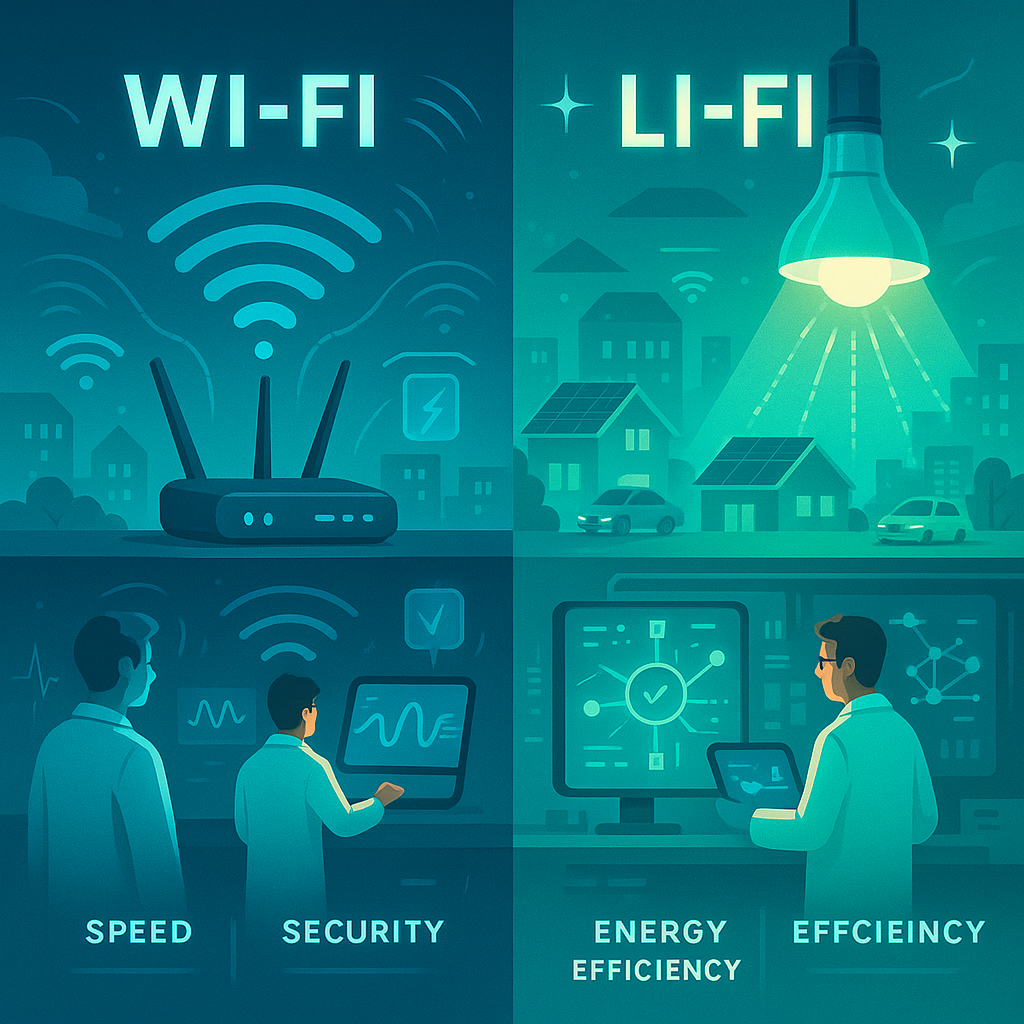
Wireless communication has come a long way, and for most of us, Wi-Fi has been the backbone of our internet experience. But a newer technology called Li-Fi is gaining serious attention among engineers and researchers for its remarkable speed and security advantages. Here is a clear breakdown of both technologies, how they differ, and what the future might look like for wireless data.
What Is Wi-Fi and How Does It Work?
Wi-Fi, short for Wireless Fidelity, transmits data using radio waves. A router broadcasts these waves, and your devices — phones, laptops, smart TVs — pick them up to connect to the internet without any physical cables.
Wi-Fi has become the standard for wireless connectivity because of its wide compatibility and ease of use. Key characteristics include:
- Speed: Modern Wi-Fi standards like Wi-Fi 6 can reach speeds up to 10 Gbps under ideal conditions.
- Range: Radio waves pass through walls and cover large areas, making Wi-Fi suitable for homes, offices, and public spaces.
- Device Support: Almost every modern device supports Wi-Fi out of the box.
- Use Cases: Homes, workplaces, airports, cafes, and public hotspots.
Its widespread adoption and infrastructure make Wi-Fi difficult to replace in everyday settings.
What Is Li-Fi and How Is It Different?
Li-Fi, which stands for Light Fidelity, takes a completely different approach. Instead of radio waves, it uses LED light waves — including visible and infrared light — to transmit data. The LED bulb flickers at extremely high frequencies, millions of times per second, far too fast for the human eye to detect. These rapid flickers carry encoded data to a receiver.
The concept was first introduced by Professor Harald Haas at the University of Edinburgh in 2011, and research has advanced significantly since then.
Key characteristics of Li-Fi include:
- Speed: Li-Fi can theoretically reach speeds of up to 100 Gbps, far exceeding current Wi-Fi capabilities.
- Medium: Uses visible light or infrared light from LED sources.
- Security: Light cannot pass through walls, which means the signal stays confined to a room.
- Use Cases: Hospitals, aircraft cabins, research facilities, and high-security environments.
Li-Fi vs. Wi-Fi: A Side-by-Side Comparison
To understand how these two technologies compare, here is a direct feature-by-feature breakdown:
| Feature | Wi-Fi | Li-Fi |
|---|---|---|
| Signal Type | Radio waves | Light waves (visible or infrared) |
| Speed | Up to 10 Gbps | Up to 100 Gbps (theoretical) |
| Coverage | Works through walls | Requires line of sight |
| Security | Can be intercepted remotely | High — signal stays in one room |
| Interference | Affected by other RF devices | No RF interference |
| Practical Use | Homes, offices, public areas | Hospitals, aircraft, secure facilities |
Why Engineers Are Paying Close Attention to Li-Fi
Li-Fi is not just a theoretical concept anymore. Researchers and engineers are actively testing it in real-world environments. Here is why it is generating genuine excitement in technical communities:
- Safe for Sensitive Environments: Li-Fi does not use radio frequency signals, so it poses no interference risk to medical equipment in hospitals or navigation systems in aircraft. This makes it a strong candidate for environments where Wi-Fi is restricted or risky.
- Superior Data Security: Because light cannot penetrate walls, a Li-Fi signal is physically contained within a room. This makes unauthorized interception significantly harder compared to Wi-Fi, which can be accessed from outside a building.
- High-Speed Data Transfer: Engineers working with real-time systems, large data sets, or bandwidth-intensive applications can benefit from Li-Fi’s theoretical speeds of 100 Gbps, which is roughly ten times faster than current Wi-Fi standards.
- Reduced Radio Frequency Congestion: As more devices connect to the internet, the radio frequency spectrum is becoming increasingly crowded. Li-Fi uses the optical spectrum, which is far less congested and offers much more bandwidth potential.
Challenges Holding Li-Fi Back
Despite its impressive potential, Li-Fi faces real-world limitations that engineers and developers must address before it sees widespread adoption:
- Requires Constant Light: Li-Fi only works when the LED light source is active. In dark conditions or when the light path is blocked, the connection drops entirely.
- No Wall Penetration: The same security feature that makes Li-Fi attractive also limits its range. A single Li-Fi setup covers only one room, requiring multiple installations for broader coverage.
- Limited Device Support: Unlike Wi-Fi, which is built into virtually every modern device, Li-Fi requires specialized hardware. Consumer-grade Li-Fi devices are still limited in availability.
- Still in Development: Li-Fi has not yet reached the maturity level of Wi-Fi in terms of standardization, infrastructure, or widespread commercial deployment.
Researchers are actively working on these challenges. One promising direction is a hybrid Li-Fi and Wi-Fi system, where devices automatically switch between the two based on location, speed requirements, and security needs.
What the Future of Wireless Data Could Look Like
Li-Fi is unlikely to replace Wi-Fi entirely in the near future. The two technologies serve different strengths and are better viewed as complementary rather than competing. Wi-Fi will continue to dominate open, large-area coverage, while Li-Fi could take over in high-security or high-speed indoor environments.
Imagine a smart building where your device connects via Wi-Fi in common areas and automatically switches to Li-Fi inside a secure server room or operating theatre. This kind of intelligent, hybrid wireless infrastructure is where the industry appears to be heading.
As LED lighting becomes more common in homes and offices, the infrastructure for Li-Fi could naturally expand alongside it, potentially making the transition more practical and cost-effective over time.
For engineers and technology professionals, staying informed about Li-Fi developments is increasingly important. Whether it is designing secure communication systems, building IoT networks, or planning smart infrastructure, understanding both technologies will be a valuable skill in the years ahead.