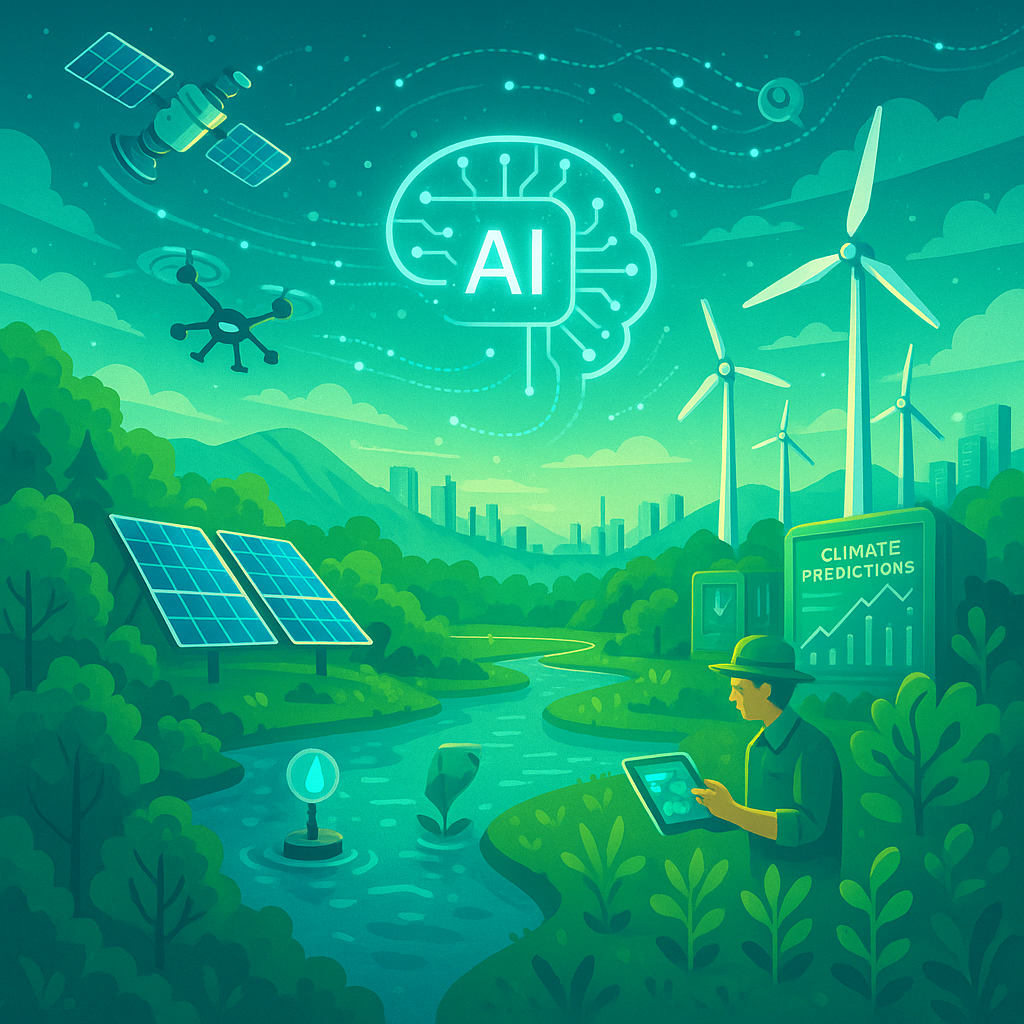
Climate change is one of the most pressing challenges of our time. Rising temperatures, extreme weather events, and widespread pollution are pushing scientists and governments to find smarter solutions. Artificial Intelligence is now playing a significant role in helping researchers understand climate patterns, protect ecosystems, and build a more sustainable future.
What Is Climate Modeling and Why Does It Matter?
Climate modeling is the process of using large volumes of environmental data — including temperature records, greenhouse gas concentrations, and ocean current measurements — to simulate how Earth’s climate may change over decades.
These models are critical because they help us:
- Prepare for extreme weather events like floods, droughts, and hurricanes
- Design effective environmental policies and regulations
- Protect vulnerable communities and fragile ecosystems
Traditional climate models are powerful but demand enormous computing resources and can take days or weeks to run. This is where AI steps in to speed things up and improve accuracy significantly.
How AI Makes Climate Predictions More Accurate and Faster
AI systems are exceptionally good at identifying patterns within massive datasets. When applied to climate science, they offer several advantages over conventional methods:
- Faster Simulations: AI can run complex climate simulations far quicker than older approaches, giving scientists more time to respond to early warning signs of disasters such as floods or cyclones.
- Greater Precision: Machine learning algorithms detect subtle patterns that human analysts might miss, leading to more reliable forecasts about sea-level rise, temperature shifts, and extreme weather frequency.
- Global Data Processing: AI tools can analyze satellite imagery, weather station data, and sensor readings from across the world simultaneously, providing a comprehensive picture of Earth’s changing climate.
This combination of speed and accuracy makes AI an invaluable partner for climate scientists working under tight timelines and with limited resources.
Practical Ways AI Is Protecting the Environment Right Now
Beyond forecasting, AI is being actively deployed to address real-world environmental problems. Here are some of the most impactful applications:
- Fighting Pollution: AI-powered tools can detect dangerous air and water pollutants in real time, allowing cities and industries to address contamination before it becomes a serious public health threat.
- Saving Forests: By analyzing satellite images, AI can identify illegal deforestation and land degradation, enabling authorities to intervene quickly and protect threatened ecosystems.
- Smarter Water Management: Farmers are using AI to determine the optimal timing and quantity of irrigation, significantly reducing water waste while improving crop yields.
- Boosting Renewable Energy: AI helps manage solar panels, wind farms, and energy storage systems more efficiently, making clean energy sources more reliable and cost-effective.
| Application Area | AI Role | Key Benefit |
|---|---|---|
| Climate Modeling | Faster simulations and pattern detection | More accurate long-term forecasts |
| Pollution Monitoring | Real-time detection of pollutants | Early warning for public health risks |
| Forest Protection | Satellite image analysis | Faster detection of illegal deforestation |
| Water Management | Precision irrigation guidance | Reduced water waste in agriculture |
| Renewable Energy | Grid and storage optimization | More stable and efficient clean energy |
Real-World Examples: Companies Already Making a Difference
Several leading technology companies are already putting AI to work for environmental causes:
- Google DeepMind has improved wind energy output predictions, helping power grids better manage the supply of clean electricity and reduce dependence on fossil fuels.
- IBM’s AI tools are being used to forecast pollution levels in major cities, supporting urban planners and public health officials in making data-driven decisions.
- Microsoft’s AI for Earth program funds projects that apply AI to improve sustainable farming practices, protect wildlife habitats, and reduce environmental damage across the globe.
These real-world deployments show that AI is not just a theoretical tool — it is already delivering measurable environmental benefits at scale.
Why AI Gives Us a Better Chance at Protecting the Planet
Earth’s climate system is extraordinarily complex, with thousands of interacting variables changing constantly. Human analysts alone cannot process this volume of information quickly enough to keep up with the pace of change. AI fills this gap by processing vast amounts of data rapidly, identifying trends early, and helping decision-makers act before problems escalate.
From predicting the next major flood to optimizing a solar farm’s energy output, AI is becoming an essential part of the global response to climate change. It does not replace human judgment or political will, but it gives scientists, governments, and businesses the tools they need to make smarter, faster, and more informed environmental decisions.
As climate challenges grow more urgent, the partnership between human expertise and AI-driven analysis will be central to any meaningful progress in protecting our planet for future generations.