The global push for cleaner energy is driving engineers and scientists to think beyond traditional power plants. Two technologies — floating solar farms and hydrokinetic turbines — are gaining serious attention for their ability to generate electricity without consuming land or building large dams. Together, they represent a practical and eco-friendly path toward a more sustainable energy future.
What Are Floating Solar Farms?
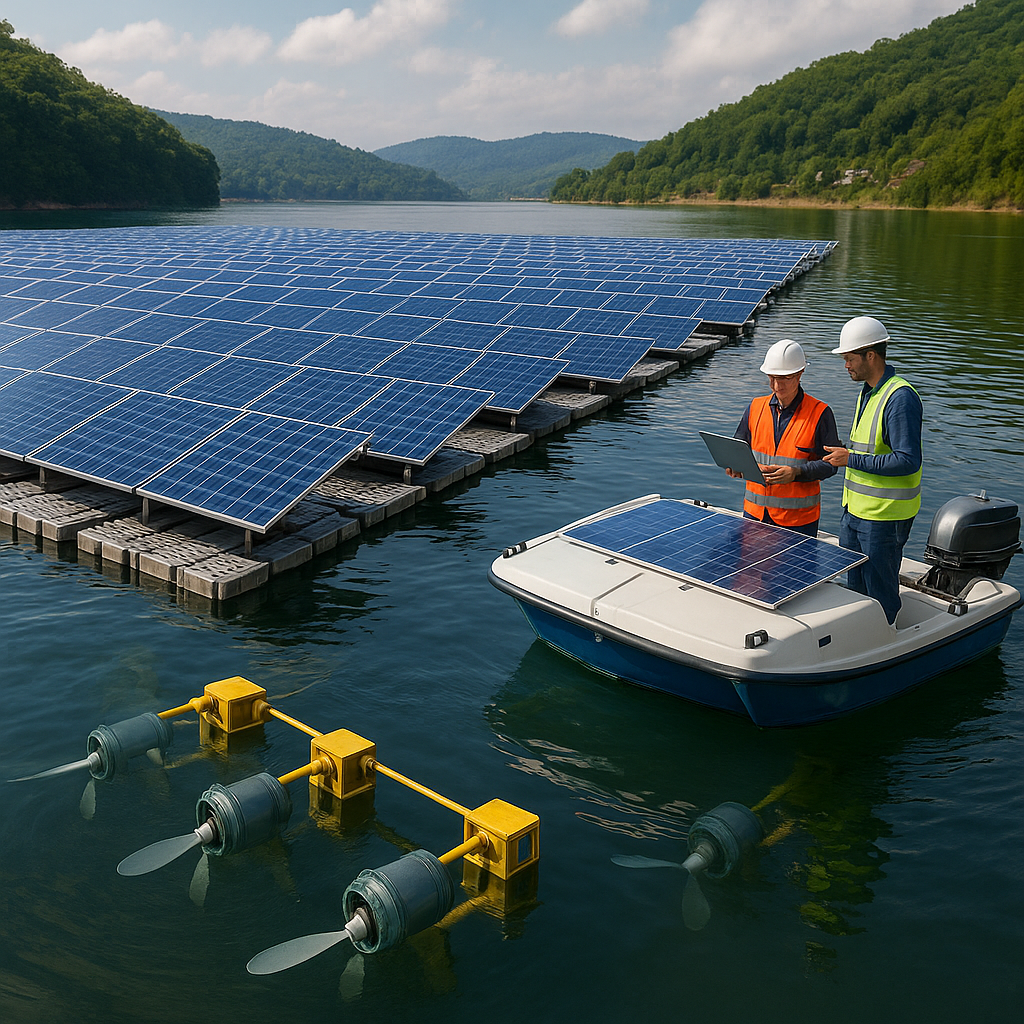
Floating solar farms are solar panel systems installed on water bodies such as lakes, reservoirs, and ponds. They work exactly like land-based solar panels — capturing sunlight and converting it into electricity — but with several added advantages.
Countries like India, Japan, and China, where land is limited and energy demand is high, have already embraced this technology at scale. The concept is simple but effective: instead of clearing land for solar installations, panels are mounted on buoyant platforms that float on existing water surfaces.
Key benefits of floating solar farms include:
- No land required — frees up valuable space for agriculture or construction
- Improved panel efficiency — cooler water temperatures help solar panels perform better
- Reduced water evaporation — the panels shade the water surface, conserving water in reservoirs
- Less dust accumulation — panels over water stay cleaner, receiving more direct sunlight
How Floating Solar Systems Are Built
A floating solar installation is more than just panels on water. Each system includes several carefully engineered components that work together to ensure safety, durability, and efficiency.
- Solar panels — the primary units that capture sunlight
- Floating platforms — made from high-density plastic or metal to keep panels buoyant
- Anchoring systems — cables and anchors that hold the structure in position
- Inverters and underwater cables — convert and transmit electricity to the shore grid
These systems are designed to be weather-resistant and environmentally safe. With proper installation, they can last as long as traditional land-based solar setups — typically 25 years or more.
What Are Hydrokinetic Turbines and How Do They Work?
Hydrokinetic turbines generate electricity by capturing the energy of naturally moving water — including river currents, tidal flows, and ocean waves. Unlike conventional hydropower, they do not require dams or large infrastructure. Think of them as underwater wind turbines that spin with the force of flowing water instead of air.
These turbines are typically installed:
- In rivers, canals, or tidal channels where water flows consistently
- On the riverbed or ocean floor, sometimes anchored with ropes or frames
- Connected to power grids through underwater electrical cables
As water passes through the turbine blades, it creates rotational motion. A generator then converts that motion into electricity — quietly, cleanly, and without any emissions.
Major advantages of hydrokinetic turbines include:
- No dam construction needed — minimal environmental disruption
- 24/7 power generation — water flows regardless of sunlight or wind conditions
- Ideal for remote areas — perfect for off-grid communities near rivers or coastlines
- Low noise and zero pollution — operates silently underwater
Real-World Projects Already Making an Impact
These technologies are not just theoretical — they are already powering homes and communities around the world.
| Project | Location | Technology | Significance |
|---|---|---|---|
| Ramagundam Floating Solar Plant | India | Floating Solar | Powers thousands of homes |
| Yamakura Dam Project | Japan | Floating Solar | One of the world’s largest floating solar systems |
| RivGen® Project | Alaska, USA | Hydrokinetic Turbine | Supplies electricity to remote villages |
India’s Ramagundam Floating Solar Plant in Telangana is one of the country’s flagship renewable energy projects, demonstrating how water bodies near thermal power stations can be repurposed for clean energy generation. Japan’s Yamakura Dam Project covers a large portion of the dam’s reservoir and feeds power directly into the local grid. In Alaska, the RivGen® hydrokinetic system developed by ORPC provides reliable electricity to isolated communities that would otherwise depend on expensive diesel generators.
What the Future Holds for These Technologies
As global demand for renewable energy grows, both floating solar and hydrokinetic technologies are expected to scale rapidly. Researchers and energy companies are already working on next-generation solutions, including:
- Offshore floating solar farms — designed to operate in open ocean environments
- Smarter turbine systems — using sensors and automation to improve efficiency and adapt to changing water conditions
- Hybrid energy systems — combining floating solar panels with hydrokinetic turbines at the same site for round-the-clock power generation
These advances are expected to bring down costs significantly, making clean energy more accessible to developing nations and rural communities that currently lack reliable power infrastructure.
In conclusion, floating solar farms and hydrokinetic turbines are two of the most promising and practical innovations in renewable energy today. They make smart use of natural resources — water surfaces and flowing currents — without damaging ecosystems or consuming precious land. As more countries invest in these technologies, they will play a key role in meeting global energy needs while reducing dependence on fossil fuels.