
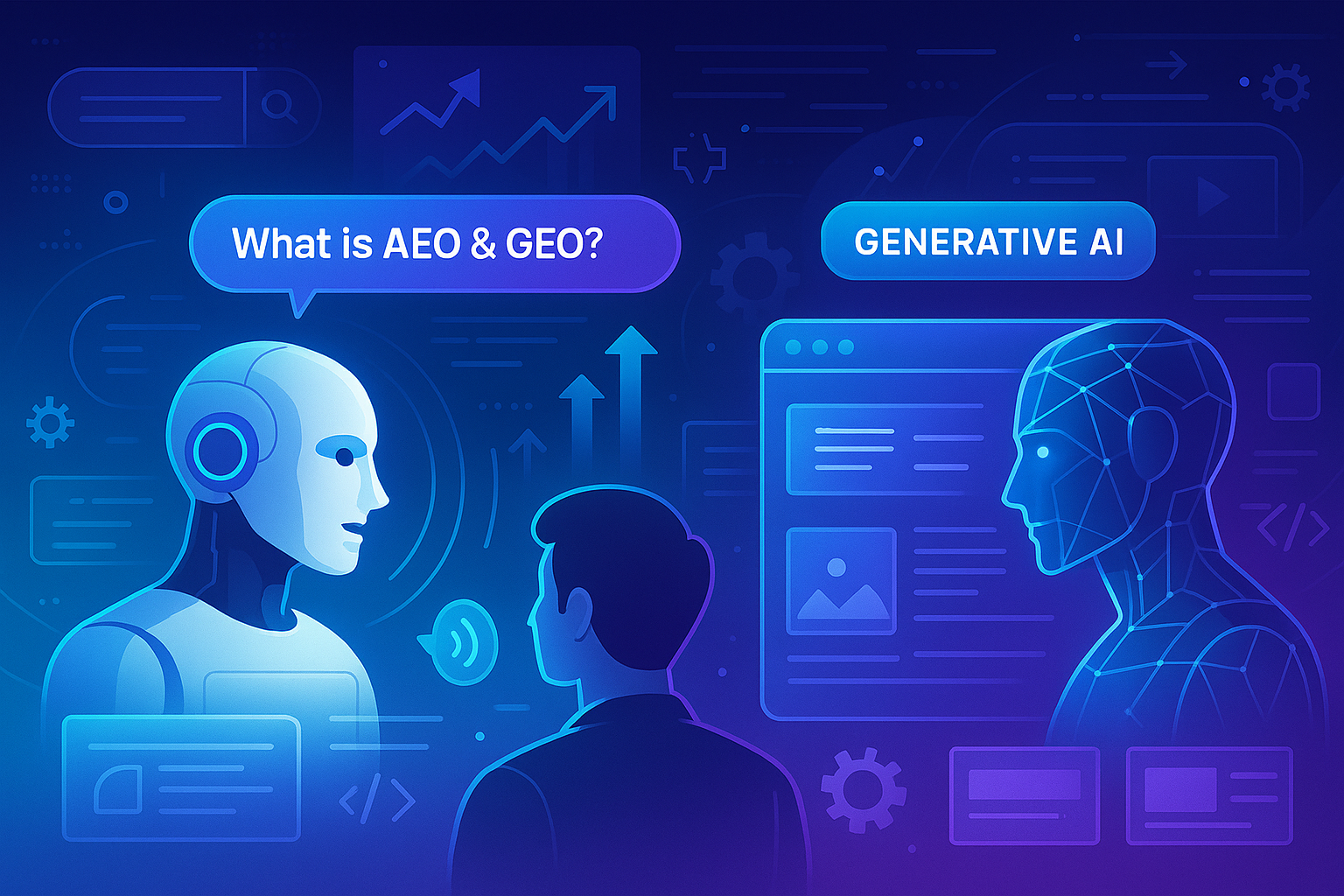
Search is no longer just about typing keywords into Google. People now ask questions to voice assistants like Siri, use tools like ChatGPT, and get answers from Google’s AI-powered search. This shift is changing how websites need to be built and how content needs to be written. Two important concepts are shaping this new era: Answer Engine Optimization (AEO) and Generative Engine Optimization (GEO). Understanding both can make a real difference in how your website performs online.
What is Answer Engine Optimization (AEO)?
Answer Engine Optimization (AEO) is the practice of writing content in a way that directly answers specific questions. The goal is to get your content picked up by voice assistants, Google’s featured snippets, or answer boxes at the top of search results.
Think of it this way: when someone asks Siri, “What is the capital of India?” and Siri replies “New Delhi,” that answer came from a website that was optimized for AEO. The content was clear, direct, and structured in a way that made it easy for the assistant to pull the answer.
AEO is especially important for mobile users and voice search, where people want fast, accurate answers without scrolling through long pages.
How to Optimize Your Content for AEO
Getting your content ready for AEO does not require a complete overhaul. A few focused changes can go a long way:
- Write content in a question-and-answer format, similar to an FAQ section.
- Use short, clear sentences that get straight to the point.
- Add schema markup to your pages so Google can better understand your content structure.
- Use bullet points and numbered lists to make information easy to scan.
- Keep your answers accurate, trustworthy, and specific.
When your content matches what a voice assistant or Google’s answer box is looking for, your website becomes the source of that answer. This increases your visibility without requiring users to even click a link.
What is Generative Engine Optimization (GEO)?
Generative Engine Optimization (GEO) is a newer concept. It focuses on making your content good enough to be referenced or cited by AI tools like ChatGPT, Perplexity, Google SGE (Search Generative Experience), and Bing Copilot.
These tools do not show a list of blue links like traditional search engines. Instead, they generate a full written answer using information gathered from across the web. If your content is well-written, factual, and comprehensive, these AI tools may list your website as a source at the end of their response.
For example, if someone asks ChatGPT, “What is digital marketing?” and ChatGPT generates an answer that links to your blog as a reference, that is GEO working in your favour.
How to Optimize Your Content for GEO
GEO requires a different approach compared to AEO. Here is what works:
- Write in-depth, well-researched content that covers a topic thoroughly, not just at a surface level.
- Include real facts, examples, and data wherever possible to build credibility.
- Use clear headings and subheadings to structure your content logically.
- Build internal links within your site and earn backlinks from trusted external sources.
- Write in plain, readable language that both humans and AI tools can easily process.
The key idea behind GEO is that AI tools prefer content that is authoritative, well-organized, and genuinely useful. If your content meets that standard, it stands a strong chance of being referenced in AI-generated responses.
AEO vs GEO: Key Differences at a Glance
Both AEO and GEO serve different purposes and work best on different platforms. Here is a simple comparison:
| Feature | AEO – Answer Engine Optimization | GEO – Generative Engine Optimization |
|---|---|---|
| Goal | Provide short, direct answers | Be cited as a source in AI-generated content |
| Platform | Voice assistants, featured snippets, FAQs | ChatGPT, Google SGE, Perplexity, Bing Copilot |
| Content Type | Short-form: definitions, FAQs, quick answers | Long-form: detailed guides, full-topic articles |
| Format | Q&A format, lists, schema markup | Well-structured, factual, in-depth writing |
Why AEO and GEO Matter for Your Website’s Future
Voice assistants and AI-powered search tools are becoming the first stop for millions of users. Traditional Google search is still important, but it is no longer the only game in town. Here is why AEO and GEO deserve your attention:
- Websites with strong AEO content get featured as instant answers, putting them ahead of competitors in search results.
- Sites optimized for GEO get referenced by AI tools, bringing in traffic without paid advertising.
- Being cited by AI assistants builds brand trust and authority over time.
- Both strategies support long-term organic growth as search behaviour continues to shift.
To succeed in this new environment, your content strategy should combine both approaches. Include an FAQ section for AEO, write detailed and well-researched articles for GEO, use clear headings and internal links throughout, and always focus on solving real problems for your readers.
The websites that adapt to these changes early will be the ones that stay visible and relevant as search continues to change.