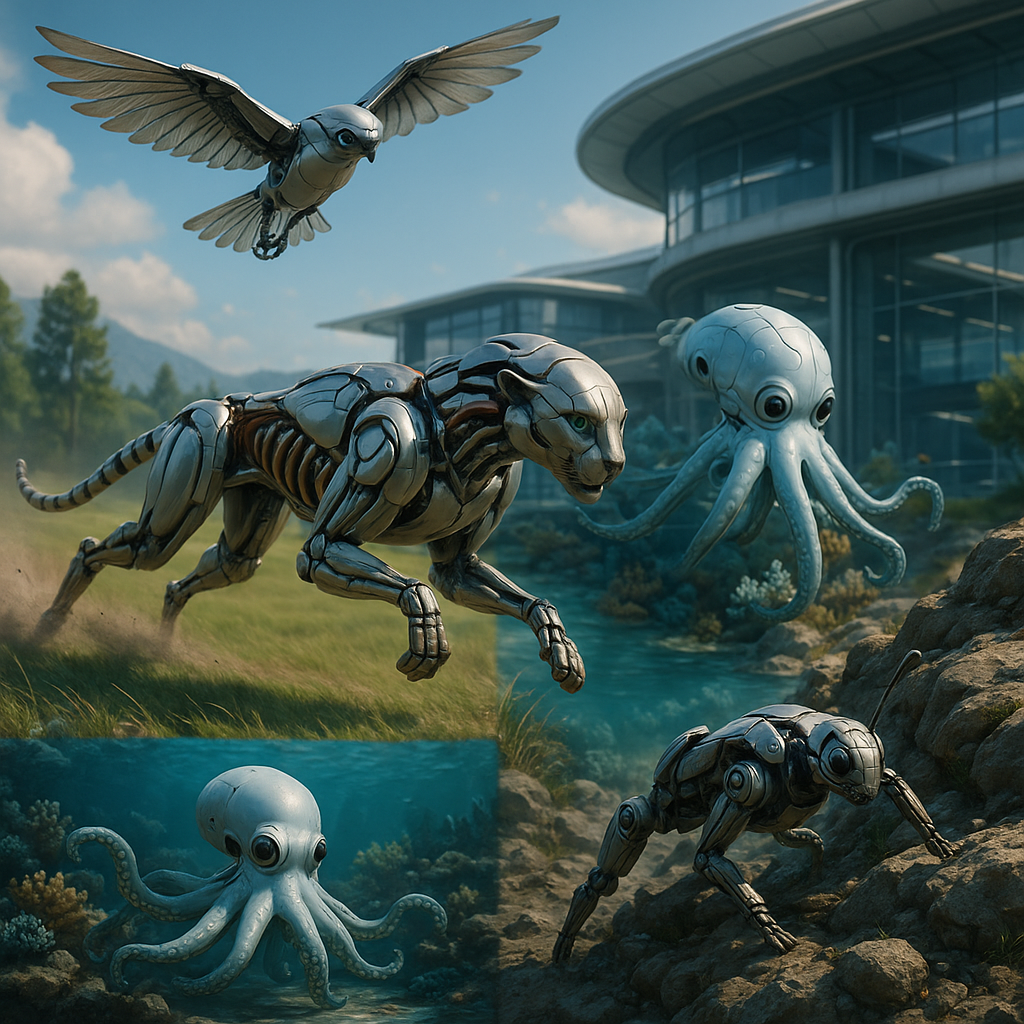
Nature has spent millions of years perfecting movement, structure, and survival. Engineers are now borrowing these time-tested designs to build robots that move more efficiently, consume less energy, and perform in environments where traditional machines struggle. This approach — known as biomimicry — is quietly reshaping the future of robotics.
What Is Biomimicry in Robotics?
Biomimicry is the practice of studying nature’s designs and applying them to solve human engineering challenges. In robotics, this means building machines that mimic how animals move, sense their surroundings, and adapt to changing conditions.
Instead of starting from scratch, engineers study how a cheetah sprints, how a snake navigates tight spaces, or how a gecko sticks to a wall. These observations become the foundation for robot designs that are both practical and highly effective.
The core idea is simple: if nature has already solved a problem over millions of years of evolution, why not use that solution?
Why Engineers Turn to Nature for Inspiration
Animals and plants have developed features that engineers find extremely useful to replicate. Some of the most valuable traits include:
- Energy-efficient movement — Animals move with minimal energy waste, a quality that helps extend a robot’s battery life.
- Lightweight yet strong structures — Bird bones and insect exoskeletons offer strength without bulk.
- Fast reflexes and sensory response — Many animals react to their environment in milliseconds, a model for responsive robot control systems.
- Adaptability to terrain — Creatures like crabs and lizards navigate rough, uneven ground with ease.
By studying these natural systems, engineers can design robots that use less power, move more fluidly, and handle real-world conditions far better than conventional machines.
Real-World Robots Inspired by Animals
Several impressive robots already exist that draw directly from nature’s playbook:
- Fish-Like Robots: These underwater machines mimic the swimming motion of real fish. They are used to explore underwater environments, inspect pipelines, and monitor coral reefs without disturbing marine life.
- Robot Dogs: Boston Dynamics’ Spot is one of the most well-known examples. Inspired by the movement of four-legged animals, Spot can walk, run, climb stairs, and carry equipment. It is already being used at construction sites, factories, and by emergency response teams.
- Wall-Climbing Robots: Geckos can cling to smooth surfaces using microscopic adhesive pads on their feet. Engineers have replicated this mechanism to build robots capable of scaling glass walls and vertical surfaces — useful for building inspections and cleaning high-rise structures.
- Insect Drones: Tiny flying robots modeled after bees and dragonflies can navigate confined or hazardous spaces. Their applications include detecting gas leaks, searching through collapsed buildings during rescue operations, and assisting with crop pollination.
| Robot Type | Inspired By | Key Application |
|---|---|---|
| Fish-Like Robot | Fish swimming motion | Underwater exploration, pipeline inspection |
| Robot Dog (Spot) | Four-legged animal gait | Construction, emergency response |
| Wall-Climbing Robot | Gecko adhesion | Building inspection, surface cleaning |
| Insect Drone | Bee and dragonfly flight | Search and rescue, crop pollination |
Why Nature-Inspired Robots Perform Better
Copying nature is not just an aesthetic choice — it delivers measurable performance benefits:
- Lower Energy Consumption: Biomimetic robots move in ways that naturally reduce energy use, extending operational time between charges.
- Greater Flexibility: Soft and articulated designs allow these robots to bend, twist, and squeeze through spaces that rigid machines cannot reach.
- Improved Sensing and Navigation: Nature-based designs help robots detect obstacles and respond to their environment more intuitively.
- Versatility Across Environments: From ocean floors to disaster zones and even outer space, these robots can be adapted for a wide range of conditions.
Challenges Facing Biomimetic Robotics
Despite its promise, biomimicry in robotics comes with real hurdles that researchers are still working to overcome:
- Complexity of Replication: Some animal behaviors and movements are extraordinarily difficult to reproduce with current materials and technology.
- Higher Manufacturing Costs: Flexible, bio-inspired structures often require specialized materials that are more expensive to produce at scale.
- Advanced Programming Requirements: Making a robot behave like a living creature demands sophisticated software, precise sensors, and complex control systems.
Ongoing research across universities and technology companies is steadily addressing these challenges, making biomimetic robots more accessible and affordable over time.
What the Future Holds for Nature-Inspired Robots
As robotics technology advances, nature-inspired machines are expected to take on increasingly important roles across multiple sectors. Future applications could include:
- Disaster response — navigating rubble and dangerous terrain to locate survivors
- Deep-sea and space exploration — operating in extreme environments where humans cannot go
- Healthcare — assisting elderly patients and supporting medical procedures
- Agriculture and manufacturing — performing precise, repetitive tasks with greater efficiency
The natural world has always been the most sophisticated engineering lab on the planet. As researchers continue to study it more closely, the robots of tomorrow will likely look, move, and behave in ways that feel surprisingly familiar.
Biomimicry reminds us that the best solutions are often already out there — we just need to pay closer attention to the world around us.
Frequently Asked Questions
Biomimicry in robotics refers to the practice of designing robots by studying and replicating the movement, structure, and behavior of animals and plants. Engineers use these natural models to build machines that are more efficient, adaptable, and capable of handling complex real-world environments.
Well-known examples include Boston Dynamics' Spot, a robot dog inspired by four-legged animal movement; fish-like underwater robots used for pipeline inspection; gecko-inspired wall-climbing robots for building maintenance; and insect drones modeled after bees and dragonflies for search and rescue or crop pollination.
The key challenges include the difficulty of accurately replicating complex animal movements, the higher cost of flexible and specialized materials, and the need for advanced software and control systems to make robots behave like living creatures. Researchers are actively working to reduce these barriers.