3D printing, also known as additive manufacturing, has moved well beyond making simple prototypes. Today, it is reshaping entire industries — from healthcare and aerospace to fashion and construction — and quietly changing how everyday products are designed, made, and used.
What Is 3D Printing and How Does It Work?
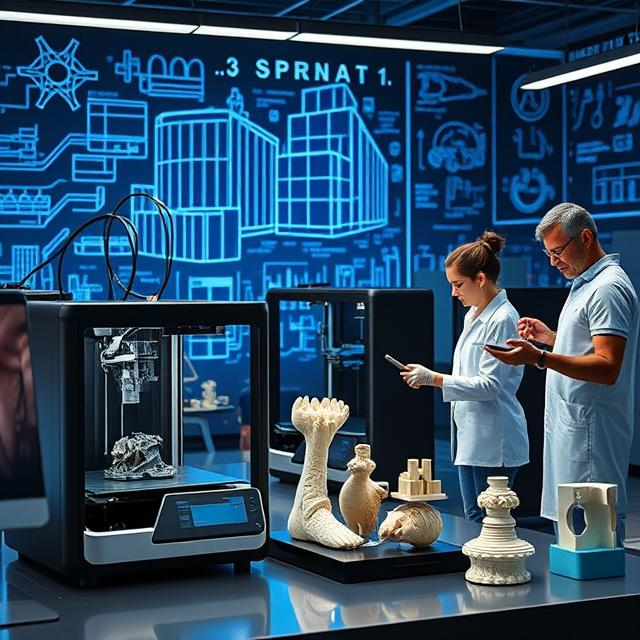
3D printing builds solid, three-dimensional objects from digital blueprints by depositing material in thin, precise layers. This is fundamentally different from traditional manufacturing, which typically cuts or carves material away from a larger block.
Because material is added only where needed, the process produces far less waste. It also allows manufacturers to create highly complex shapes that would be difficult or impossible to achieve with conventional methods. The result is a technology that offers greater design freedom, faster production cycles, and the ability to make products tailored to individual needs.
Key Benefits of 3D Printing
- Customization: Products can be made to exact personal specifications — from medical implants shaped to a patient’s anatomy to clothing designed for a perfect fit.
- Cost-Effectiveness: For small production runs, 3D printing eliminates the need for expensive molds and tooling, significantly reducing upfront costs.
- Rapid Prototyping: Engineers and designers can test and refine ideas quickly, shortening the time it takes to bring new products to market.
- Sustainability: The process generates less material waste compared to traditional methods. Some 3D printers can also use recycled materials, supporting a circular economy.
- On-Demand Production: Items can be printed as and when needed, reducing the need for large inventories and long supply chains.
How Different Industries Are Using 3D Printing
The applications of 3D printing span a wide range of sectors. Here is a look at where it is making the most significant impact:
| Industry | Key Applications | Main Benefit |
|---|---|---|
| Healthcare | Custom prosthetics, implants, surgical models, bioprinted organs | Better patient outcomes, personalised treatment |
| Aerospace | Lightweight structural parts, complex components | Reduced aircraft weight, improved fuel efficiency |
| Automotive | Custom parts, tools, rapid prototypes | Faster design testing, efficient production |
| Fashion and Jewelry | Tailored clothing, intricate jewelry designs | Unique, one-of-a-kind creations at scale |
| Construction | Architectural models, building components, full structures | Less material waste, faster build times |
A Closer Look at Industry Applications
Healthcare: 3D printing has had a profound effect on medicine. Surgeons now use 3D-printed anatomical models to plan complex operations, improving precision and reducing risks. Custom prosthetics and implants can be designed to match a patient’s exact body structure. Research into bioprinting — printing living tissue and organs — is also advancing steadily, with the potential to address organ shortages in the future.
Aerospace: Aircraft manufacturers use 3D printing to produce parts that are both lighter and stronger than those made through traditional methods. Lighter components mean better fuel efficiency, which reduces operating costs and lowers carbon emissions. The technology also makes it possible to manufacture intricate geometries that conventional machining cannot achieve.
Automotive: Car manufacturers rely on 3D printing to speed up the design process. Prototype parts can be printed and tested within days rather than weeks. The technology is also used to produce specialised tools and low-volume custom components for performance and luxury vehicles.
Fashion and Jewelry: Designers are using 3D printing to push creative boundaries. Intricate jewelry pieces with complex lattice structures, and fashion items with unusual textures or forms, can now be produced with a level of detail that traditional manufacturing struggles to match. This opens the door to truly personalised fashion at a commercial scale.
Construction: The construction sector is experimenting with large-scale 3D printing to build entire structures. This approach can significantly cut material waste, reduce labour costs, and speed up project timelines. Several pilot projects around the world have already demonstrated that 3D-printed homes and commercial buildings are a practical reality.
What the Future Holds for 3D Printing
The outlook for 3D printing is strong. Ongoing advances are expanding what the technology can do. Key developments on the horizon include:
- Multi-material printing: The ability to print objects using several different materials simultaneously, enabling more complex and functional products.
- Faster production speeds: New printing techniques are dramatically reducing the time it takes to produce parts, making the technology more competitive for mass manufacturing.
- Improved material properties: Researchers are developing new printable materials with enhanced strength, flexibility, heat resistance, and biocompatibility.
- On-demand and distributed manufacturing: Rather than centralised factories, products could be printed locally or even at home, reducing shipping costs and supply chain dependencies.
As these advances continue, 3D printing is set to become a standard tool for sustainable, affordable, and highly personalised manufacturing across virtually every sector of the economy.
The technology is no longer a novelty reserved for research labs. It is already part of hospitals, car plants, fashion studios, and construction sites — and its role in daily life is only going to grow.