
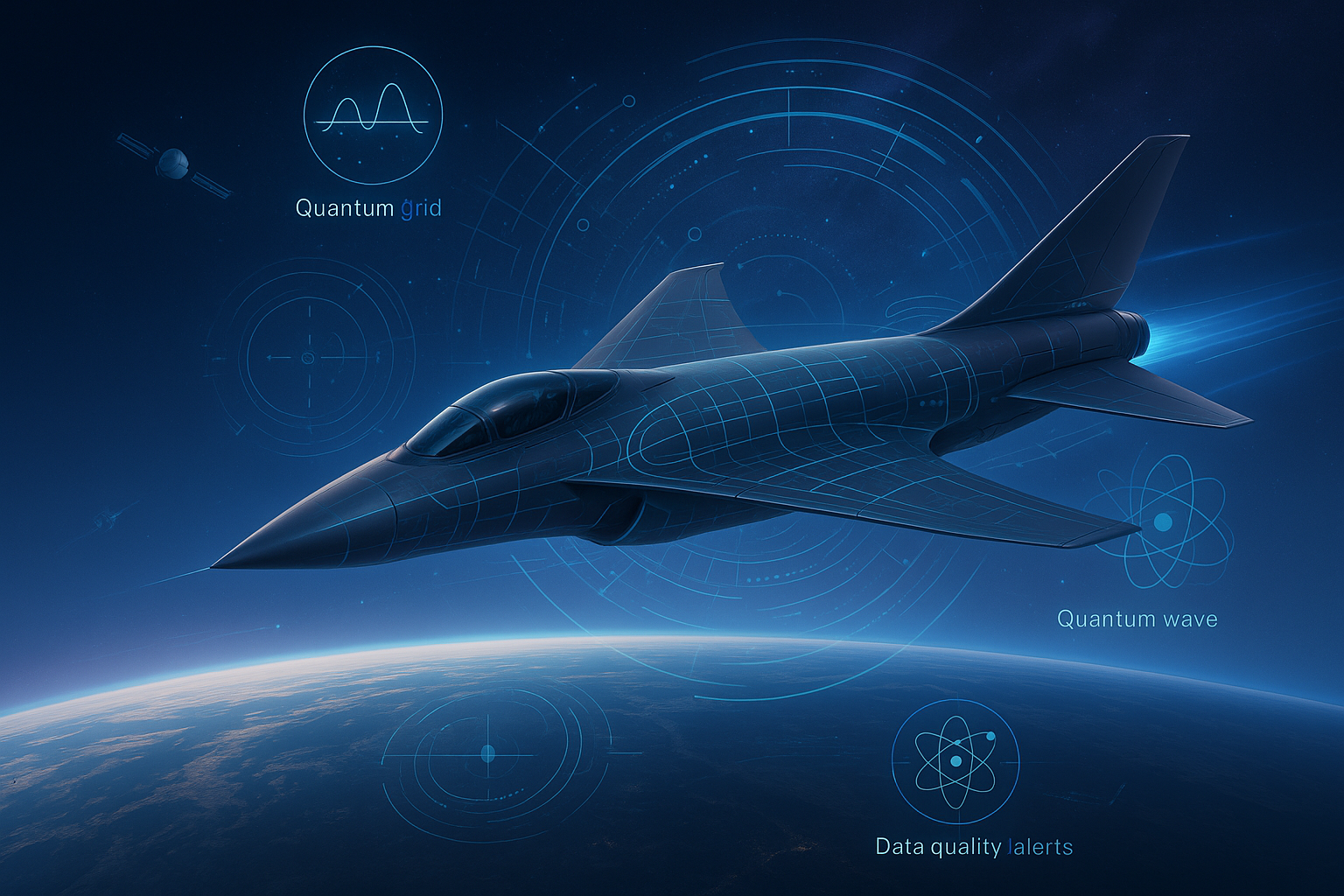
Aircraft, submarines, and spacecraft demand extreme precision. A small error in navigation can lead to catastrophic outcomes. Quantum sensing is emerging as a powerful solution — offering accuracy and reliability that traditional sensors and even GPS cannot match. Here is a closer look at what this technology does, how it works, and why it matters for the future of navigation and aerospace.
What Is Quantum Sensing?
Quantum sensing applies the principles of quantum physics to measure physical quantities with extraordinary precision. Unlike conventional sensors, quantum sensors use subatomic particles — such as atoms or electrons — that respond to even the tiniest changes in their environment.
These sensors can detect:
- Minute changes in gravitational fields
- Tiny shifts in motion or direction
- Extremely weak magnetic fields
Because they operate at the quantum level, these sensors pick up signals that standard instruments simply cannot register. This makes them far more sensitive and dependable in demanding conditions.
Why Navigation Systems Need Quantum Sensing
The world’s navigation infrastructure relies heavily on GPS (Global Positioning System). While GPS works well in open environments, it has clear limitations. In tunnels, underwater, underground, or during military jamming operations, GPS signals can be blocked or disrupted entirely.
Quantum sensing addresses these gaps directly:
- It enables satellite-free navigation using only onboard sensors
- It delivers significantly higher precision and consistency
- It is far more resistant to interference and spoofing
This makes quantum navigation systems especially valuable for ships, commercial aircraft, military vehicles, and autonomous systems that must maintain accurate positioning at all times — regardless of external signal availability.
Real-World Applications in Aerospace
Quantum sensing is already being tested and integrated into aerospace systems to improve safety, efficiency, and operational intelligence. Key applications include:
- Enhanced Inertial Navigation: Quantum accelerometers and gyroscopes allow aircraft and spacecraft to calculate their position using only internal measurements, without relying on any external signal. This is especially critical during long-haul flights and deep-space missions.
- Improved Planetary Landing: Quantum gravity sensors help spacecraft assess surface conditions and identify safe landing zones on other planets, reducing mission risk significantly.
- High-Precision Earth Observation: Satellites equipped with quantum sensors can detect subtle variations in Earth’s gravitational and magnetic fields, enabling more accurate environmental monitoring and geophysical research.
| Feature | Traditional Sensors | Quantum Sensors |
|---|---|---|
| GPS Dependency | High | None required |
| Precision Level | Moderate | Extremely High |
| Jamming Resistance | Low | High |
| Use in Deep Space | Limited | Well-suited |
Strategic Importance for Military and Defense
Defense organizations worldwide are paying close attention to quantum sensing. Its ability to operate independently of GPS makes it a strategic asset in contested environments. Military applications include:
- GPS-denied navigation in enemy-controlled or signal-jammed territories
- Submarine detection by identifying gravitational anomalies caused by underwater vessels
- Secure communications that are extremely difficult to intercept or decode
These capabilities improve operational security, mission accuracy, and strategic planning — all while being significantly harder for adversaries to disrupt or counter.
Current Challenges and the Road Ahead
Despite its promise, quantum sensing still faces practical hurdles before it can be widely deployed:
- High cost and complexity of the equipment involved
- Extreme temperature requirements — some quantum systems need near-absolute-zero conditions to function
- Sensitivity to environmental noise, which can affect measurement accuracy
Researchers and engineers are actively working to overcome these barriers. As the technology matures, quantum sensors are expected to become smaller, more affordable, and suitable for a broader range of real-world environments.
Looking ahead, the possibilities are significant. Future developments may include aircraft with built-in quantum navigation that continues functioning even when GPS fails, spacecraft using quantum tools for smoother planetary landings and deep-space exploration, and commercial and military drones capable of flying with pinpoint accuracy in any condition. Experts widely expect quantum sensing to move from research laboratories into mainstream products across aerospace, defense, transportation, and beyond.
Quantum sensing represents a meaningful shift in how navigation and aerospace systems will operate. As the technology becomes more accessible, its impact will extend well beyond specialized military or space applications — shaping how every aircraft, ship, and autonomous vehicle finds its way in the world.