Collaborative robots, widely known as cobots, are changing the way businesses approach automation. What once required expert engineers and complex coding knowledge can now be handled by factory workers and small business owners using simple, no-code programming interfaces. This shift is opening doors for faster, more affordable automation across industries of all sizes.
What Are Collaborative Robots and How Are They Different?
Cobots are robots specifically designed to work alongside humans, not replace them. Unlike traditional industrial robots that operate behind safety cages in isolated zones, cobots are compact, flexible, and safe enough to work right next to people on the shop floor.
Key features that set cobots apart from conventional robots include:
- Built-in safety sensors that stop movement when a human is nearby
- Lightweight and portable design that allows easy repositioning
- Ability to handle multiple tasks without complex reconfiguration
- Lower upfront cost compared to large industrial robots
These qualities make cobots a practical choice for small and medium-sized businesses that want to automate without heavy investment.
What No-Code Programming Actually Means
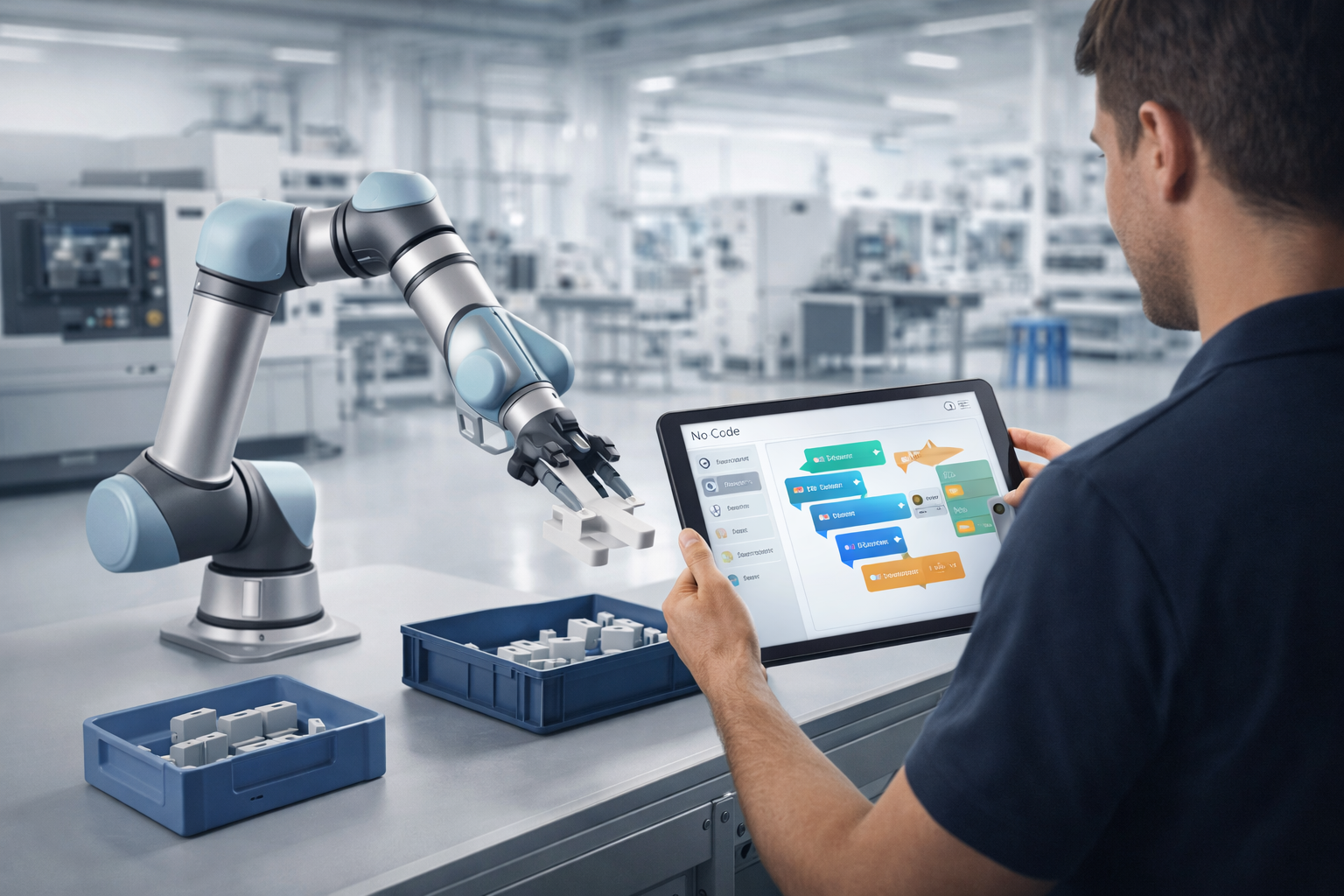
No-code programming removes the need to write lines of code to control a robot. Instead, users interact with the cobot through intuitive tools such as:
- Touchscreen interfaces with drag-and-drop task menus
- Hand-guiding, where the user physically moves the robot arm to teach it a motion
- Visual block programming, where actions are represented as clickable icons
- Pre-built task templates for common operations like picking, placing, or packaging
This approach means that a production line worker with basic training can set up, adjust, and reprogram a cobot without calling in a robotics specialist. The learning curve is short, and changes can be made quickly when production needs shift.
Industries and Applications Where No-Code Cobots Are Being Used
No-code cobots are already active across a wide range of industries. Their ability to be reprogrammed quickly makes them especially useful in environments where tasks change frequently.
| Industry | Common Cobot Applications |
|---|---|
| Manufacturing | Assembly, machine tending, welding assistance |
| Logistics and Warehousing | Pick-and-place, sorting, packaging |
| Food and Beverage | Filling, labelling, quality checks |
| Electronics | Component placement, inspection, testing |
| Healthcare | Lab sample handling, dispensing, packaging |
Because the same cobot can be reprogrammed for different tasks, businesses get more value from a single unit rather than investing in multiple specialized machines.
Real Business Benefits of No-Code Cobot Deployment
The practical advantages of deploying cobots with no-code interfaces go beyond just ease of use. Businesses that adopt this approach often report measurable improvements across several areas:
- Faster deployment: Setup time drops from weeks to days or even hours
- Lower operational costs: No need to hire or outsource robotics programmers
- Improved worker safety: Cobots handle repetitive or physically demanding tasks, reducing injury risk
- Higher productivity: Cobots work consistently without fatigue, improving output quality
- Scalability: Businesses can add more cobots as they grow without major technical overhead
For small and medium enterprises in India and globally, these benefits make cobots a realistic automation option rather than a luxury reserved for large corporations.
Smart Technology Powering the Next Generation of Cobots
Modern cobots are not just mechanical arms following pre-set paths. Many now include smart sensors, vision systems, and intelligent software that allow them to adapt to their environment in real time.
These technologies help cobots detect objects of varying shapes and sizes, identify errors during production, and adjust their movements for greater accuracy. Some advanced systems can even suggest optimised task sequences based on past performance data.
Looking ahead, cobot programming is expected to become even more accessible. Researchers and manufacturers are working on systems that respond to voice commands and visual demonstrations, where a worker simply shows the cobot what to do and the robot learns from observation. This would reduce setup time further and make automation available to businesses with minimal technical infrastructure.
The combination of no-code interfaces with smarter hardware is pushing cobot adoption forward, particularly in sectors like Industry 4.0, where flexible and connected manufacturing is the goal.
As cobot technology continues to mature, businesses that invest in no-code automation today are positioning themselves to adapt quickly to future changes in production demands, workforce availability, and market conditions. The barrier to entry has never been lower, and the potential returns have never been higher.