
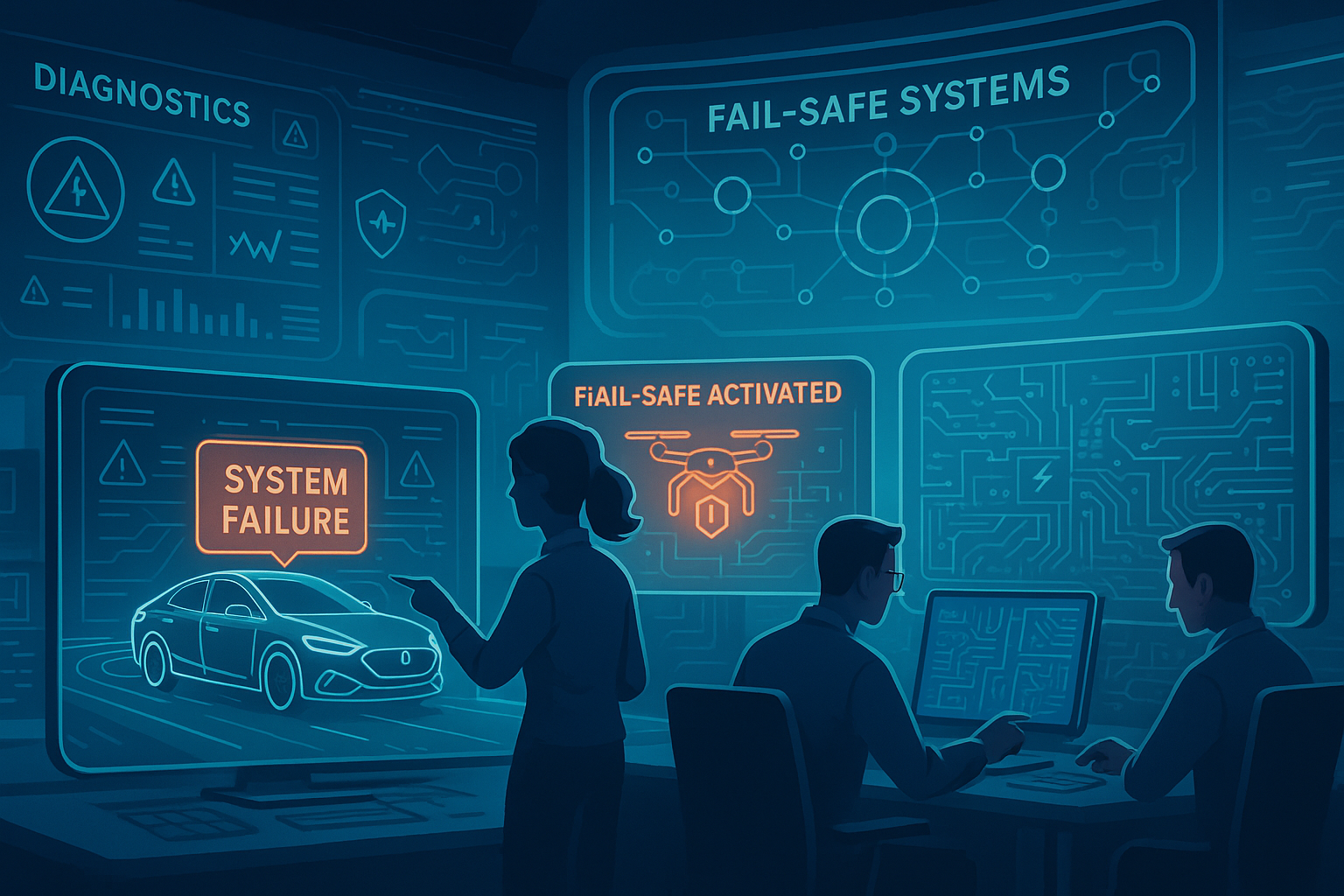
As machines grow smarter and more independent, one question becomes critical: what happens when they fail? From self-driving cars to surgical robots, autonomous systems are now part of everyday life. Engineers have responded with a powerful design philosophy — building systems that fail safely, not catastrophically. This approach, known as fail-safe engineering, is shaping the future of autonomous technology.
What Is a Fail-Safe System?
A fail-safe system is designed to handle failure without causing harm. When something goes wrong — a sensor breaks, power cuts out, or a signal is lost — the system automatically switches to a safe mode or shuts down in a controlled, predictable way.
The core idea is simple but powerful: systems will fail at some point, but how they fail makes all the difference.
- A self-driving car that detects a sensor error may pull over and stop rather than continue driving.
- An autonomous drone may land safely when its battery drops below a critical level or when it loses its control signal.
Fail-safe design does not aim to prevent every failure. Instead, it ensures that when failure happens, the outcome remains safe for people and the environment.
Why Fail-Safe Design Matters in Autonomous Systems
Autonomous systems operate without constant human supervision. That independence is their greatest strength — and their biggest risk. Without a human in the loop, a malfunctioning system could cause accidents, injuries, or serious damage before anyone can intervene.
This is why fail-safe principles are applied across a wide range of autonomous technologies:
- Self-driving vehicles — navigating roads with pedestrians, cyclists, and other vehicles
- Industrial robots — working alongside humans in factories and warehouses
- Autonomous drones — operating in shared airspace or over populated areas
- Medical machines — assisting in surgeries or delivering critical care
In each of these cases, a failure without a safety net could have serious consequences. Fail-safe design acts as that safety net.
Key Features That Make a System Truly Fail-Safe
Building a fail-safe system involves multiple layers of protection working together. Here are the most important elements:
- Redundancy (Backup Components): Extra sensors, processors, or mechanical parts that activate when the primary components fail. Self-driving cars, for example, often carry backup braking systems that engage if the main system stops responding.
- Self-Monitoring: The system continuously checks its own health, watching for early warning signs of trouble before a full failure occurs.
- Safe Shutdown: When a critical fault is detected, the system shuts down in a controlled manner rather than crashing unpredictably or losing control entirely.
- Human Override: In high-stakes situations, a human operator can step in and take control, overriding the autonomous system when needed.
- Alerts and Data Logging: The system notifies operators about issues and records detailed data so engineers can diagnose problems and improve future designs.
| Fail-Safe Feature | Purpose | Example |
|---|---|---|
| Redundancy | Backup systems take over on failure | Backup brakes in autonomous cars |
| Self-Monitoring | Early detection of faults | Sensor health checks in drones |
| Safe Shutdown | Controlled stop on critical failure | Robot arm halting on error |
| Human Override | Manual control in emergencies | Driver taking over from autopilot |
| Alerts and Logging | Issue reporting and data capture | Error logs in surgical robots |
Real-World Examples of Fail-Safe Technology in Action
Fail-safe engineering is not theoretical — it is already embedded in systems people use and depend on today.
- Tesla Autopilot: When sensors malfunction or the system detects an unsafe condition, Tesla’s autopilot can guide the vehicle to the side of the road or bring it to a complete stop, reducing the risk of a collision.
- Surgical Robots: Robotic surgery systems are programmed to halt all movement immediately if they detect any irregularity during a procedure, protecting patients from unintended harm.
- Warehouse Robots: Autonomous robots used in logistics and warehousing stop moving the moment they detect a person or obstacle in their path, preventing workplace injuries.
These are not just safety features added as an afterthought. They are core parts of the engineering design, built in from the ground up.
The Future of Fail-Safe Engineering
As robotics and autonomous systems become more advanced, fail-safe engineering will advance with them. Several developments are already on the horizon:
- Predictive fault detection: Systems that identify potential problems before they cause a failure, using real-time data analysis to stay ahead of breakdowns.
- Self-healing systems: Machines that can diagnose and fix minor issues on their own without needing human intervention.
- Better human-machine collaboration: Smoother handoffs between autonomous operation and human control, making transitions safer and more intuitive.
Safety in autonomous engineering is moving from being a last resort to being a foundational design principle — built into every layer of how these systems think, act, and respond.
As autonomous technology becomes more widespread, fail-safe design will be one of the most important factors determining whether people trust and adopt these systems in their daily lives.