Scientists are pushing the boundaries of quantum technology in a direction few expected — inside living cells. Researchers have found a way to use proteins within cells as biological qubits, turning ordinary cells into tiny quantum detectors. This emerging field, often called bio-quantum technology, could change how we understand biology, medicine, and the natural world.
What Is a Qubit and Why Does It Matter Inside a Cell?
To understand biological qubits, it helps to first understand what a qubit is. In a regular computer, a bit stores information as either a 0 or a 1. A qubit works differently — it can exist as 0, 1, or both at the same time, a property known as superposition.
- A classical bit is like a light switch — either on or off.
- A qubit is like a dimmer switch that can hold multiple states at once.
- This property gives quantum systems far greater sensing and processing power than traditional systems.
Now imagine placing that quantum power inside a living cell. That is exactly what biological qubits aim to do — and researchers believe it is possible using specially engineered proteins.
How Biological Qubits Work Inside Living Cells
The process behind in-cell quantum sensing is both elegant and complex. Here is how scientists approach it:
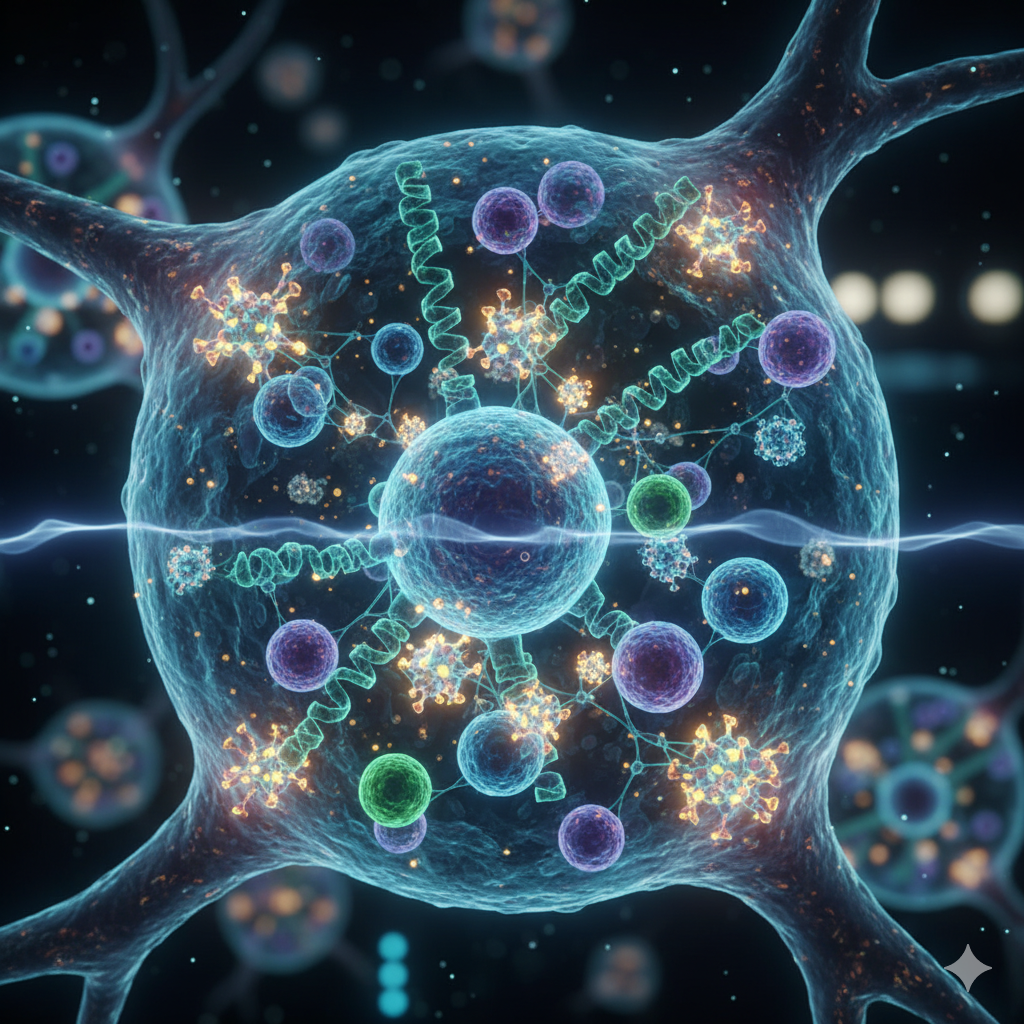
- Researchers engineer glowing proteins inside cells that respond to their environment at a quantum level.
- These proteins behave like quantum bits, reacting to tiny changes in temperature, magnetic fields, or chemical signals around them.
- Scientists then measure the light emitted by these proteins to monitor what is happening inside the cell in real time.
In simple terms, the cell itself becomes a living quantum detector. Instead of placing a sensor outside the cell, the quantum sensing happens from within — giving scientists an unprecedented view of biological activity at the molecular level.
Why This Discovery Could Transform Medicine and Science
The potential applications of biological qubits and in-cell quantum sensing span multiple fields. Some of the most promising areas include:
- Healthcare and Early Diagnosis: Detecting subtle changes inside cells could allow doctors to identify diseases much earlier than current methods allow.
- Brain and Neuroscience Research: Understanding how neurons communicate at a quantum level could open new doors in treating neurological conditions.
- Real-Time Drug Testing: Scientists could observe exactly how a drug interacts with cells as it happens, speeding up pharmaceutical research.
- Fundamental Science: Researchers could investigate whether nature already uses quantum mechanics — for example, in how birds navigate using Earth’s magnetic field or how plants convert sunlight into energy through photosynthesis.
| Application Area | Potential Benefit |
|---|---|
| Healthcare | Earlier disease detection through cell-level quantum sensing |
| Neuroscience | Better understanding of neuron communication |
| Drug Development | Real-time observation of drug effects on cells |
| Fundamental Biology | Discovering quantum effects in natural biological processes |
The Key Challenges Scientists Must Overcome
Despite the excitement, biological qubits face serious technical hurdles before they can move from laboratory research to real-world medical tools.
- Qubit instability: Qubits are fragile. They lose their quantum state quickly — a problem called decoherence — making it difficult to maintain reliable sensing inside a warm, noisy biological environment.
- Cell safety: Introducing engineered proteins or quantum systems into living cells without causing damage or disrupting normal cell function is a significant challenge.
- Scaling up: Moving from controlled lab experiments to practical medical devices will require years of additional research, testing, and regulatory approval.
Scientists acknowledge that these are not small obstacles. However, progress in quantum biology and protein engineering is accelerating, giving researchers reason for cautious optimism.
What the Future of Bio-Quantum Technology Could Look Like
If researchers successfully address these challenges, the future of bio-quantum technology could be remarkable. Possible developments include:
- Doctors using quantum sensors embedded in cells to detect cancer, infections, or metabolic disorders at their earliest stages.
- New bio-quantum devices that combine biology and quantum physics in ways that current technology cannot achieve.
- Entirely new scientific disciplines built around quantum healthcare and quantum biotechnology.
The idea of cells acting as quantum computers or sensors was once purely theoretical. Today, it is an active area of scientific research with real experimental progress behind it.
Biological qubits and in-cell quantum sensing represent one of the most exciting intersections of physics and biology in recent years. While the technology is still in early stages, its potential to reshape medicine, neuroscience, and our understanding of life itself is hard to overstate. The coming decade of research in this field will be worth watching closely.