
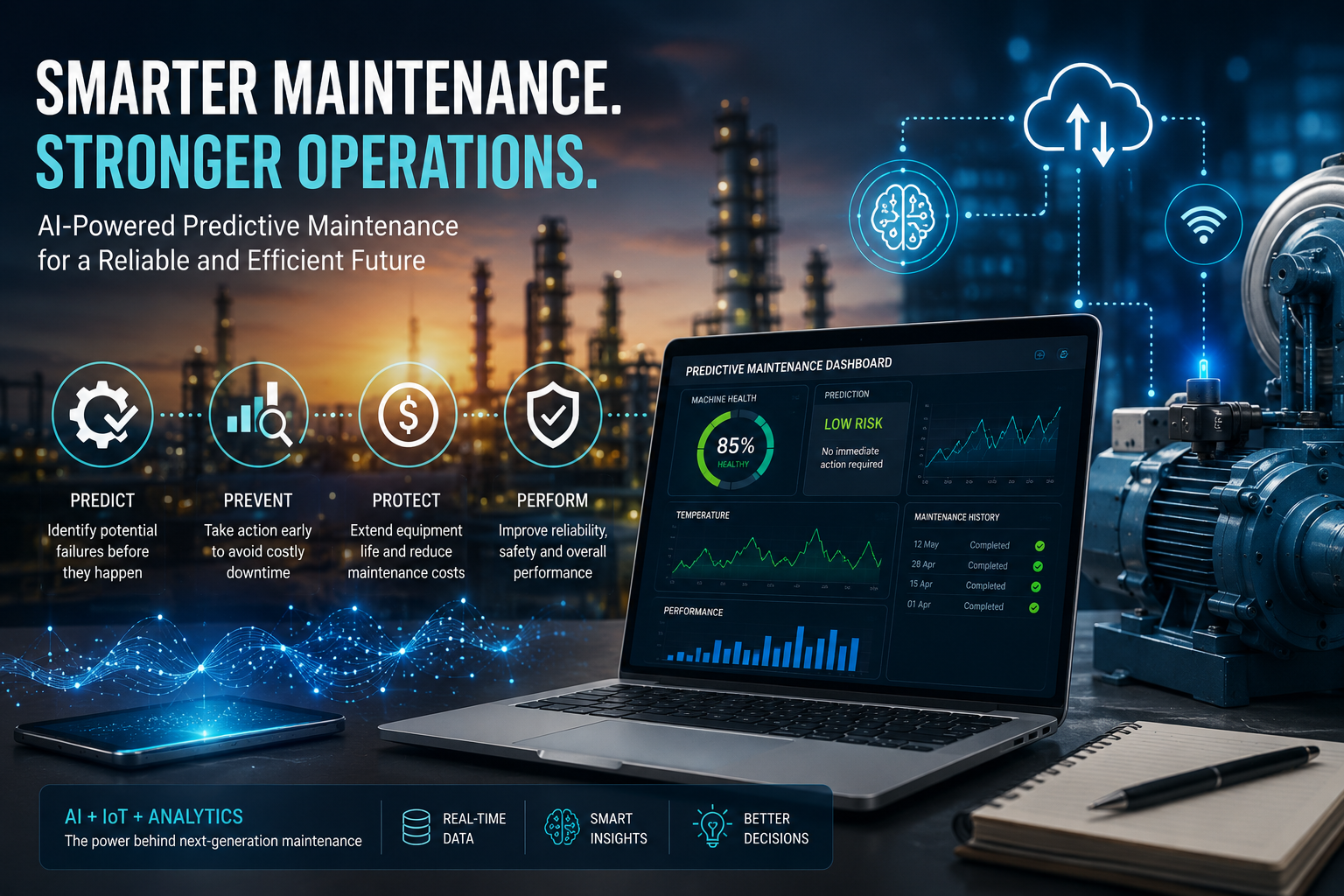
Industrial equipment failures cost businesses millions every year in lost production, emergency repairs, and workplace hazards. AI-powered predictive maintenance is changing how companies handle this challenge — shifting from reactive fixes to smart, data-driven decisions that prevent breakdowns before they happen.
What Is Predictive Maintenance and Why Does It Matter?
Predictive maintenance is a strategy that uses real-time data and technology to forecast when a machine might develop a problem. Unlike traditional approaches — where companies either wait for a breakdown or follow fixed service schedules — predictive maintenance continuously monitors equipment health and flags warning signs early.
Traditional maintenance methods often lead to two costly extremes:
- Reactive maintenance: Fixing equipment only after it fails, causing unplanned downtime.
- Preventive maintenance: Servicing machines on a fixed schedule, even when they don’t need it, wasting time and money.
Predictive maintenance finds the right balance — acting only when data shows a genuine need.
How Artificial Intelligence Powers Smarter Maintenance
Modern industrial equipment is fitted with sensors that constantly collect data — temperature, vibration, pressure, energy consumption, and operating speed. Artificial Intelligence processes this data at scale and identifies unusual patterns that human teams might miss.
When the AI detects an anomaly, it sends an alert to maintenance technicians so they can inspect the equipment before a failure occurs. Over time, the system becomes more accurate as it learns from historical maintenance records and machine behavior patterns.
Key technologies driving this capability include:
- Machine Learning: Helps AI models improve predictions based on past data.
- Industrial IoT (IIoT): Connects machines and sensors to share real-time information.
- Digital Twins: Creates virtual replicas of equipment to simulate and predict performance.
- Edge Computing: Processes data closer to the machine for faster response times.
- Cloud Platforms: Stores and analyzes large volumes of equipment data centrally.
Key Benefits for Businesses and Industries
Companies across sectors are adopting AI-powered predictive maintenance because the advantages are clear and measurable.
| Benefit | Impact |
|---|---|
| Reduced Downtime | Maintenance is scheduled during planned stops, not emergencies. |
| Lower Maintenance Costs | Repairs happen only when data shows actual wear or damage. |
| Better Equipment Performance | Machines run under optimal conditions for longer lifespans. |
| Improved Workplace Safety | Early detection reduces the risk of accidents caused by faulty equipment. |
| Higher Productivity | Fewer disruptions mean more consistent output and better product quality. |
Industries already benefiting from this technology include manufacturing, energy, transportation, mining, oil and gas, logistics, and healthcare — anywhere equipment reliability is critical to operations.
Predictive Maintenance and the Rise of Smart Factories
AI-powered predictive maintenance is a core part of the Industry 4.0 movement. In smart factories, machines, sensors, software platforms, and cloud systems work together to share information in real time. Predictive maintenance fits naturally into this connected environment, giving businesses continuous visibility into equipment health and enabling data-driven decisions at every level.
As smart manufacturing grows globally, predictive maintenance is expected to become a standard operational practice rather than a competitive advantage reserved for large enterprises.
Challenges to Consider Before Implementation
While the benefits are significant, businesses should plan carefully before adopting predictive maintenance systems. Common challenges include:
- Upfront investment: Installing sensors, upgrading equipment, and purchasing software platforms requires capital.
- Skilled workforce: Companies need professionals who can manage AI systems and interpret the data they generate.
- Data quality: Predictions are only as good as the data collected — poor sensor data leads to inaccurate alerts.
- Integration complexity: Connecting new systems with existing equipment and workflows can take time and expertise.
Despite these hurdles, most organizations report that long-term savings and efficiency gains far outweigh the initial costs of implementation.
What the Future Holds for AI-Driven Maintenance
The next phase of predictive maintenance is even more ambitious. Advances in Machine Learning, Digital Twins, and Edge Computing are making systems faster and more accurate. In the near future, AI platforms may automatically schedule repairs, order replacement parts, and optimize entire maintenance plans without requiring human input.
This level of automation will help businesses reduce operational costs further while keeping equipment running at peak performance with minimal manual oversight.
As industries continue their digital transformation journey, AI-powered predictive maintenance will be central to how organizations protect their assets, manage costs, and stay competitive in demanding markets.
In short, predictive maintenance is not just a technology upgrade — it is a smarter way to run industrial operations, protect workers, and build resilient businesses for the long term.