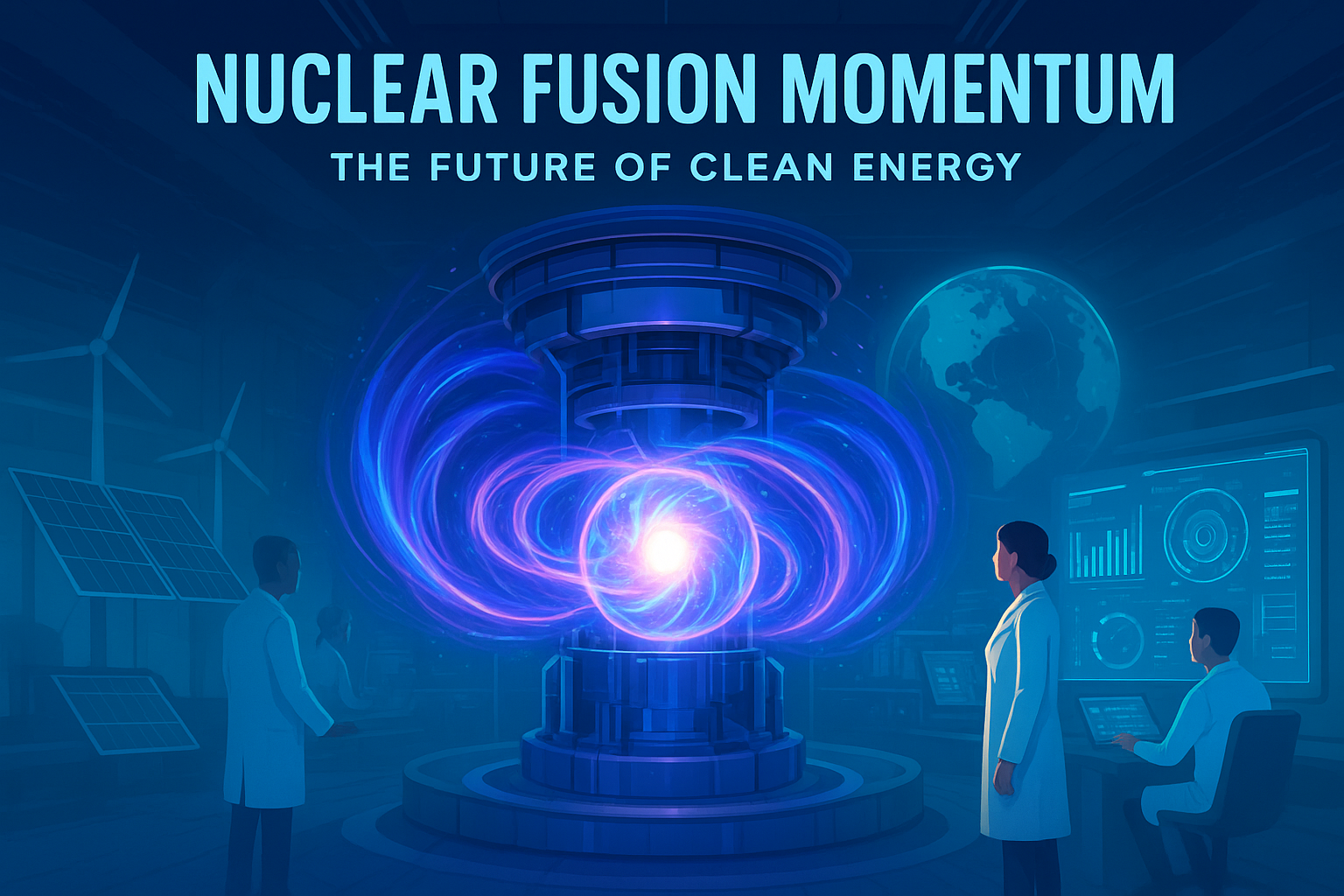
Nuclear fusion has long been called the holy grail of clean energy — powerful, safe, and virtually limitless. For decades, it stayed just out of reach. But in 2025, the picture looks very different. With billions in private investment, tech giants signing future energy deals, and laboratories achieving short but meaningful breakthroughs, nuclear fusion is moving from science fiction to serious science.
What Is Nuclear Fusion and How Does It Work?
Nuclear fusion is the same process that powers the sun and stars. It happens when two light atoms — typically forms of hydrogen — are forced together under extreme heat and pressure to form a heavier atom. This joining releases a massive amount of energy.
It is important to understand how fusion differs from fission, which is what today’s nuclear power plants use. Fission splits heavy atoms apart. Fusion joins light atoms together. The key difference is in the waste and risk:
- Fission produces radioactive waste that remains dangerous for thousands of years.
- Fusion produces little to no long-lasting radioactive waste.
- Fission carries the risk of a nuclear meltdown.
- Fusion has no such meltdown risk — if the reaction is disrupted, it simply stops.
| Feature | Nuclear Fission | Nuclear Fusion |
|---|---|---|
| Fuel Source | Uranium, Plutonium | Hydrogen, Lithium |
| Radioactive Waste | High, long-lasting | Minimal |
| Meltdown Risk | Yes | No |
| Greenhouse Emissions | None during operation | None |
| Commercial Status | Operational worldwide | In development |
Why Nuclear Fusion Is Making Headlines in 2025
The fusion industry has seen a dramatic shift in recent years. What was once a government-only research area is now attracting serious private capital and corporate interest. Here is what is driving the excitement:
- Massive investment: Fusion companies have collectively received over $8.9 billion from private investors and an additional $800 million in government funding.
- Rapid industry growth: The number of active fusion companies has grown from 23 in 2021 to 53 companies today.
- Big tech commitments: Microsoft and Google have both signed agreements to purchase fusion-generated energy in the future, signalling strong corporate confidence.
- Scientific milestones: Laboratories around the world have achieved moments where fusion reactions produced more energy than was used to trigger them — a critical benchmark.
- Government action: The United States and several other nations have launched dedicated programmes to speed up fusion development.
The Real Benefits of Fusion Energy
Fusion energy holds the potential to address some of the most pressing global challenges. Here is why scientists and policymakers are so focused on making it work:
- Zero greenhouse gas emissions: Fusion produces no carbon dioxide or other harmful gases, making it a powerful tool against climate change.
- Virtually unlimited fuel: The primary fuels — hydrogen isotopes and lithium — can be sourced from water and the earth’s crust, making supply concerns minimal.
- Exceptional energy density: A few grams of fusion fuel could theoretically power a city for days.
- Inherently safe design: Unlike conventional nuclear plants, a fusion reactor cannot experience a runaway chain reaction or meltdown.
- Minimal waste: The byproducts of fusion are far less hazardous and shorter-lived than those from fission reactors.
The Challenges That Still Stand in the Way
Despite the progress, fusion energy is not yet ready to power homes or industries. Several significant technical and economic hurdles remain:
- Sustaining the fusion reaction for long enough periods to generate usable electricity continuously.
- Building reactors that can connect reliably to existing power grids.
- Developing advanced materials capable of withstanding the extreme heat and radiation inside a fusion reactor.
- Bringing down the very high costs associated with reactor construction and operation.
These are not small problems. They require years of engineering work, international collaboration, and continued funding. But the pace of progress in 2025 suggests the field is moving faster than at any point in its history.
When Could Fusion Power Actually Reach Homes?
Most experts believe the first commercial fusion power plants could be operational sometime in the 2030s or 2040s, provided current momentum continues. No precise date has been confirmed, and timelines in fusion research have historically shifted. However, the combination of private investment, government support, and scientific breakthroughs makes the current period the most promising yet.
If fusion does reach commercial scale, it could fundamentally change how the world generates and consumes energy — reducing dependence on fossil fuels, lowering energy costs over time, and providing a stable power source for growing global demand.
Nuclear fusion is no longer a distant dream reserved for science textbooks. With over $8.9 billion in private investment, commitments from companies like Microsoft and Google, and real scientific progress being recorded in laboratories worldwide, the path to clean, limitless fusion energy is becoming clearer. The challenges ahead are real and significant, but so is the determination to solve them. The next decade will be critical — and the outcome could reshape the global energy landscape for generations to come.