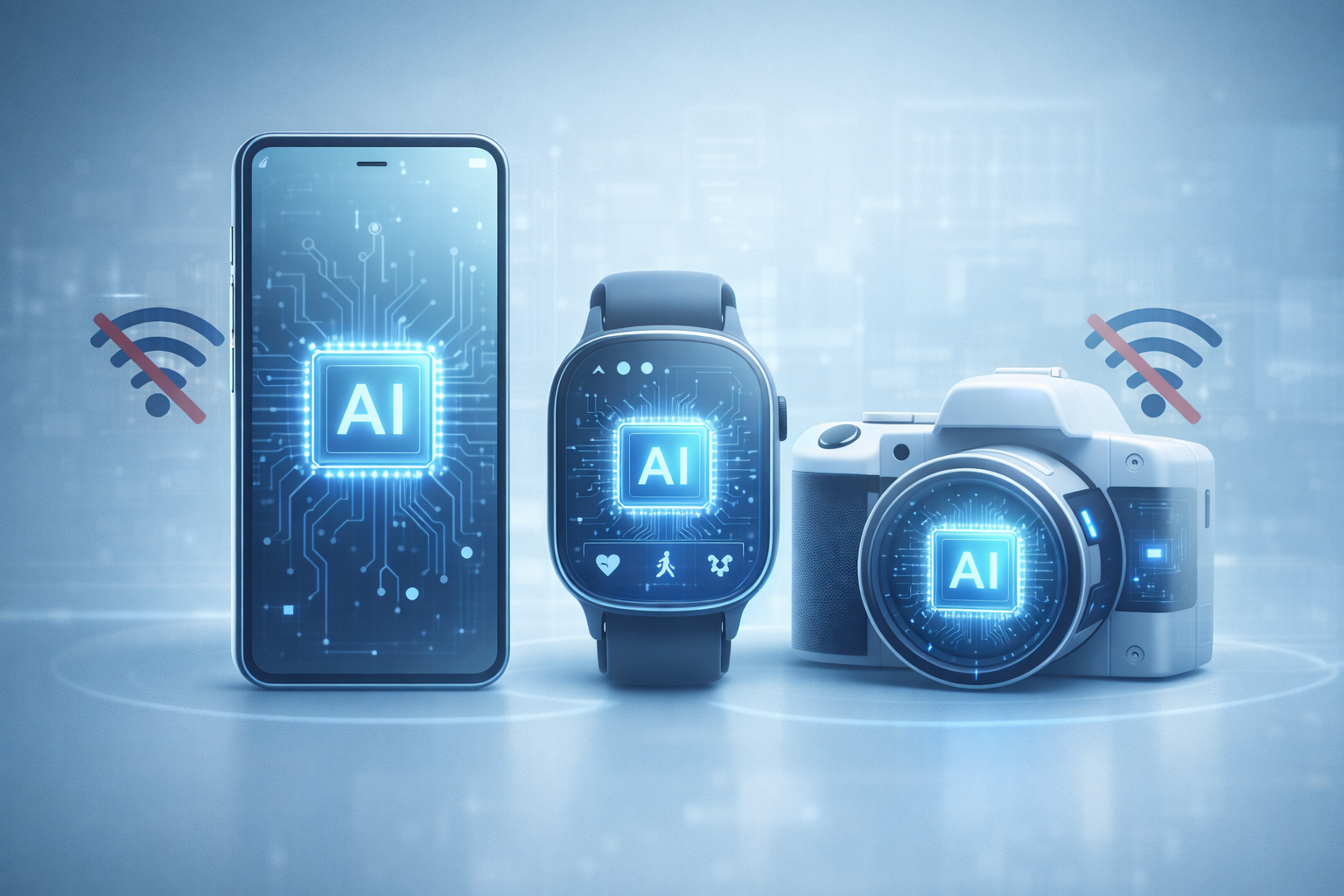
Most smart gadgets today rely heavily on internet connectivity to function properly. But what happens when your Wi-Fi drops or you are in a remote area with no signal? Offline AI gadgets solve this problem by processing data directly on the device, without needing to connect to any server or cloud. These devices are gaining traction fast, and for good reason.
What Are Offline AI Gadgets?
Offline AI gadgets are smart devices that carry built-in artificial intelligence capable of running entirely on the device itself. Unlike traditional smart gadgets that send your data to remote servers for processing, these devices handle everything locally.
This means they can:
- Recognize your voice or face without an internet connection
- Track health metrics like heart rate, steps, and sleep patterns offline
- Detect motion or activity through smart cameras without cloud support
- Respond to basic commands even when mobile data is unavailable
The technology behind this is called on-device AI processing or edge AI. It uses specialized chips built into the gadget to run AI models locally, making the device smart and independent at the same time.
Why Offline AI Gadgets Are Gaining Popularity
There are several practical reasons why more users and manufacturers are moving toward offline AI capabilities.
Reliability in any condition: Whether you are traveling through a tunnel, living in a rural area, or facing a network outage, offline AI gadgets keep working. You do not have to wait for a connection to use core features.
Faster response times: Since data does not travel to a remote server and back, the device responds almost instantly. This is especially noticeable with face unlock on smartphones, real-time health tracking on wearables, and motion detection on smart cameras.
Stronger privacy protection: Your voice recordings, facial data, and health information never leave the device. This significantly reduces the risk of data breaches, unauthorized access, or third-party misuse.
Lower long-term costs: Many cloud-based gadgets require paid subscriptions to access full features. Offline AI gadgets reduce this dependency, saving users money over time.
Common Types of Offline AI Gadgets
Offline AI technology is already present in many devices people use daily. Here is a look at some common categories:
- Smartphones: Face unlock, on-device voice assistants, and camera features like portrait mode use local AI processing.
- Wearables: Fitness bands and smartwatches track steps, heart rate, blood oxygen levels, and sleep cycles without needing internet access.
- Smart security cameras: Some home cameras detect motion and recognize familiar faces locally, without uploading footage to the cloud.
- Voice assistants: Certain voice assistant features, like setting alarms or playing local music, now work offline on supported devices.
- Health monitors: Portable ECG monitors and glucose trackers process readings on the device itself for immediate results.
Offline AI vs Online AI Gadgets: Key Differences
| Feature | Offline AI Gadgets | Online AI Gadgets |
|---|---|---|
| Internet Required | No | Yes |
| Response Speed | Faster (local processing) | Depends on network speed |
| Data Privacy | Higher (data stays on device) | Lower (data sent to servers) |
| Feature Depth | Limited to on-device capability | Access to advanced cloud features |
| Subscription Cost | Usually none | Often required for full access |
Limitations to Keep in Mind
Offline AI gadgets are not without their drawbacks. On-device processors are generally less powerful than large cloud servers, which means some complex AI tasks may not perform as well locally.
Additionally, these gadgets may need periodic software updates to improve accuracy and add new features. Without internet access during updates, users may miss important improvements.
However, hardware is advancing rapidly. Chipmakers are developing more powerful and energy-efficient processors specifically designed for edge AI. Devices from companies like Apple, Qualcomm, and Google already include dedicated AI chips that handle on-device tasks with impressive efficiency.
What the Future Holds for Offline AI Gadgets
The shift toward on-device intelligence is accelerating. As AI chips become smaller, faster, and more affordable, offline AI capabilities will expand into more product categories.
Future offline AI gadgets may be able to handle real-time language translation, advanced health diagnostics, and even complex image analysis, all without a single byte of data leaving the device. This will make smart technology more accessible to people in areas with limited connectivity and more trustworthy for users who value privacy.
In conclusion, offline AI gadgets represent a meaningful step forward in making technology both reliable and private. They work when the internet does not, respond faster, and keep your personal data safe. As demand for privacy-first and connectivity-independent devices grows, offline AI will become a standard expectation rather than a premium feature.