
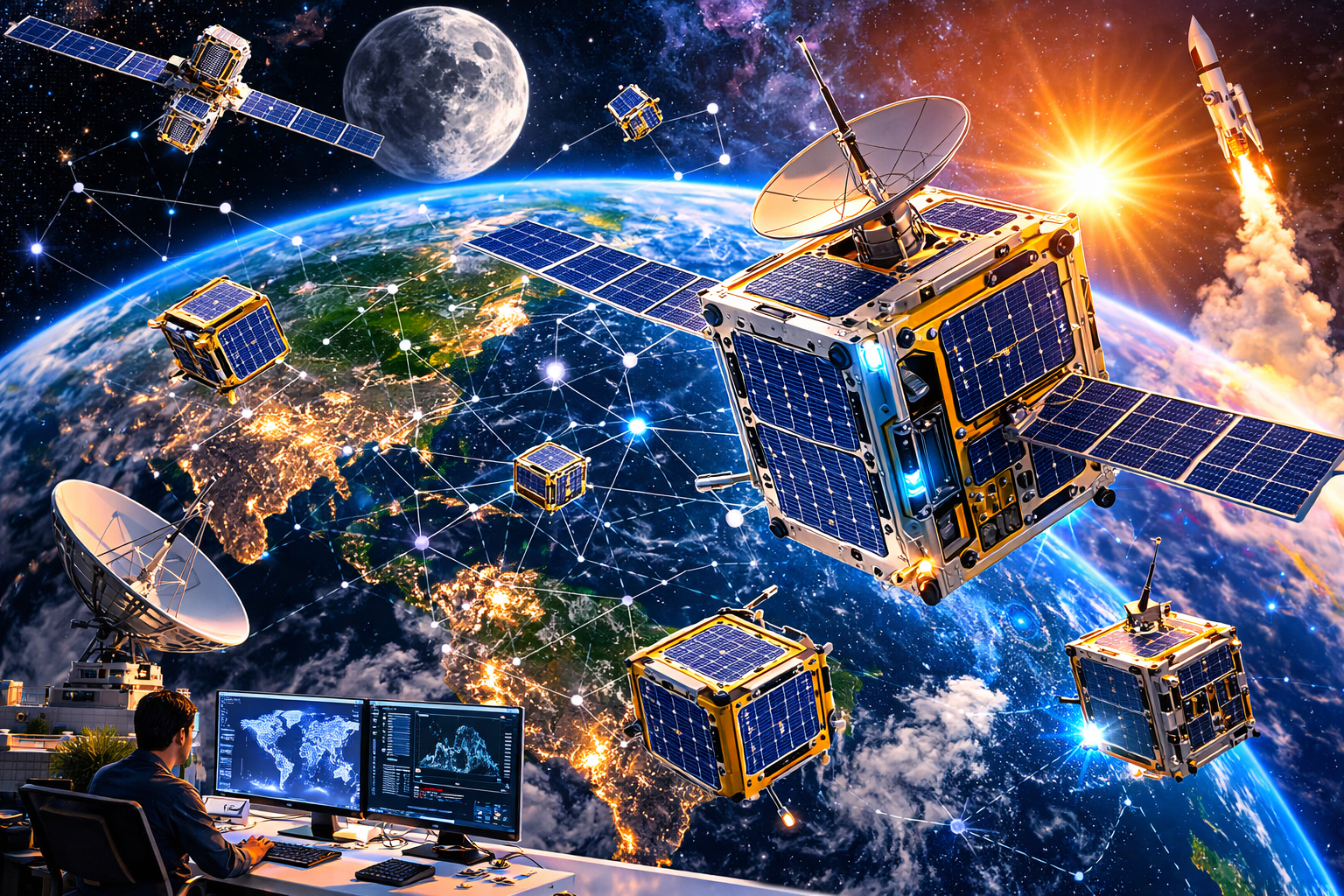
Space exploration was once the exclusive domain of well-funded government agencies with massive budgets and decades of expertise. That reality is shifting fast. Mini satellites and CubeSats are making it possible for universities, startups, small nations, and research institutions to launch their own missions into orbit — at a fraction of the traditional cost and time.
What Are Mini Satellites and CubeSats?
Mini satellites are compact spacecraft that weigh significantly less than conventional satellites. While traditional satellites can tip the scales at several tons, mini satellites typically weigh between 10 kg and 500 kg.
CubeSats are a specific category of mini satellite built around a standardised cube-shaped frame. Each basic unit measures 10 × 10 × 10 centimetres and weighs roughly 1 kilogram. Engineers can stack multiple units together to create larger configurations suited to more complex missions.
This standardised design is a key advantage. It allows teams to build, test, and launch satellites far more quickly than traditional methods allow. The uniformity also makes it easier to source components and share engineering knowledge across organisations.
| Feature | Traditional Satellites | CubeSats / Mini Satellites |
|---|---|---|
| Weight | Several tons | 1 kg to 500 kg |
| Cost | Hundreds of millions of dollars | Much lower budget |
| Development Time | Many years | Months to a few years |
| Who Can Build | Large space agencies | Universities, startups, researchers |
Why CubeSats Are Gaining Ground in Modern Space Missions
The appeal of CubeSats comes down to three core factors: cost, speed, and accessibility.
- Lower cost: Traditional satellites demand budgets running into hundreds of millions of dollars. CubeSats can be developed for a small fraction of that, opening the door to organisations that previously had no path into space.
- Faster development: Large satellite projects can take a decade or more from concept to launch. CubeSat missions can move from design to orbit in a much shorter window, allowing teams to test ideas and iterate quickly.
- Educational value: Many universities now build CubeSats as part of engineering and research programmes. Students gain hands-on experience in satellite design, testing, and mission planning — skills that directly feed into the broader space industry.
These advantages have attracted not just academic institutions but also private companies and government agencies looking for cost-effective ways to gather data and test new technologies in orbit.
Real-World Applications of CubeSat Technology
CubeSats are already performing meaningful work across several sectors. Their applications continue to grow as the technology matures.
- Earth observation: Small satellites capture high-resolution images of the planet, helping scientists track deforestation, monitor ocean pollution, and study the effects of climate change in near real time.
- Global communication: Companies are deploying large groups of small satellites — known as constellations — to provide internet connectivity to remote and underserved regions around the world.
- Scientific research: CubeSats are used to study space weather, radiation levels, and atmospheric conditions. Their lower cost means more experiments can run simultaneously, speeding up discovery.
- Technology testing: Before committing new sensors, navigation systems, or communication hardware to expensive large missions, engineers use CubeSats to validate performance in the actual space environment.
Challenges That Engineers Are Working to Overcome
CubeSats are not without limitations. Their compact size creates real engineering constraints.
- Limited space means less room for power systems, onboard computers, and communication equipment.
- Smaller power generation capacity can restrict the range and complexity of instruments a CubeSat can carry.
- Operational lifespan tends to be shorter compared to large, purpose-built satellites.
However, rapid advances in miniaturised electronics, energy-efficient components, and smarter onboard software are steadily narrowing these gaps. What was a significant limitation five years ago is often a solved problem today.
What the Future Holds for Small Satellites
The trajectory for CubeSats and mini satellites points sharply upward. Rather than relying on a single large satellite, space agencies and private companies are increasingly launching constellations — networks of dozens or even hundreds of small satellites working in coordination.
These constellations offer better global coverage for communication, navigation, and Earth monitoring than any single satellite could provide. They are also more resilient — if one unit fails, the network continues to function.
Looking further ahead, CubeSats are being considered for deep space exploration. Scientists are actively studying how small satellites could support missions to the Moon, Mars, and other destinations in the solar system. NASA has already tested CubeSats in deep space as part of larger missions, demonstrating that small does not mean limited in ambition.
As satellite components become more powerful and efficient, CubeSats will take on increasingly complex roles — from planetary science to space situational awareness and beyond.
Mini satellites and CubeSats have moved from being a niche academic exercise to a central pillar of modern space engineering. Their ability to lower barriers, speed up innovation, and deliver real scientific and commercial value makes them one of the most significant developments in the space sector today. Whether the goal is monitoring Earth, connecting remote communities, or exploring distant planets, small satellites are proving that size is no longer a measure of impact.
Frequently Asked Questions
A CubeSat is a small, standardised satellite built in cube-shaped units measuring 10 × 10 × 10 centimetres and weighing about 1 kilogram per unit. Unlike traditional satellites that can weigh several tons and cost hundreds of millions of dollars, CubeSats are compact, affordable, and can be developed in a much shorter time frame.
CubeSats are used for Earth observation, monitoring environmental changes like deforestation and ocean pollution, providing internet connectivity to remote areas through satellite constellations, conducting scientific research on space weather and radiation, and testing new space technologies before they are used in larger missions.
CubeSats have limited space for power systems, communication equipment, and onboard computers due to their small size. They also tend to have a shorter operational lifespan compared to large satellites. However, advances in miniaturised electronics and energy-efficient components are helping engineers address these challenges.