Businesses looking to automate their operations face a key decision: should they subscribe to Robots-as-a-Service (RaaS) or invest in traditional automation systems? Both paths can improve productivity and reduce manual work, but they differ significantly in cost, flexibility, risk, and long-term value. Choosing the right model depends on your business size, budget, and operational goals.
What Is Robots-as-a-Service (RaaS)?
RaaS is a subscription-based model where businesses pay a monthly or usage-based fee to access robotic systems. The service provider handles installation, maintenance, software updates, and technical support — so the business does not need to own or manage the robots directly.
This model has gained strong traction across industries such as:
- Warehousing and logistics — for sorting, picking, and packing
- Healthcare — for delivery and sanitation tasks
- Retail — for inventory management and customer assistance
- Fast-growing startups — that need automation without heavy capital spending
Because the provider manages all technical aspects, businesses can focus on their core operations without worrying about robot downtime or repairs.
What Is Traditional Automation Investment?
Traditional automation means a business purchases robotic and automation equipment outright. The company owns the machines and is responsible for their maintenance, repairs, and upgrades — either through an in-house technical team or an external service provider.
This approach is most common in:
- Manufacturing plants with consistent, high-volume production
- Heavy industries where automation needs remain stable for decades
- Large enterprises with dedicated engineering and maintenance teams
While the upfront cost is significant, ownership can become more economical over time when machines run continuously for many years.
Cost, Flexibility, and Deployment: A Direct Comparison
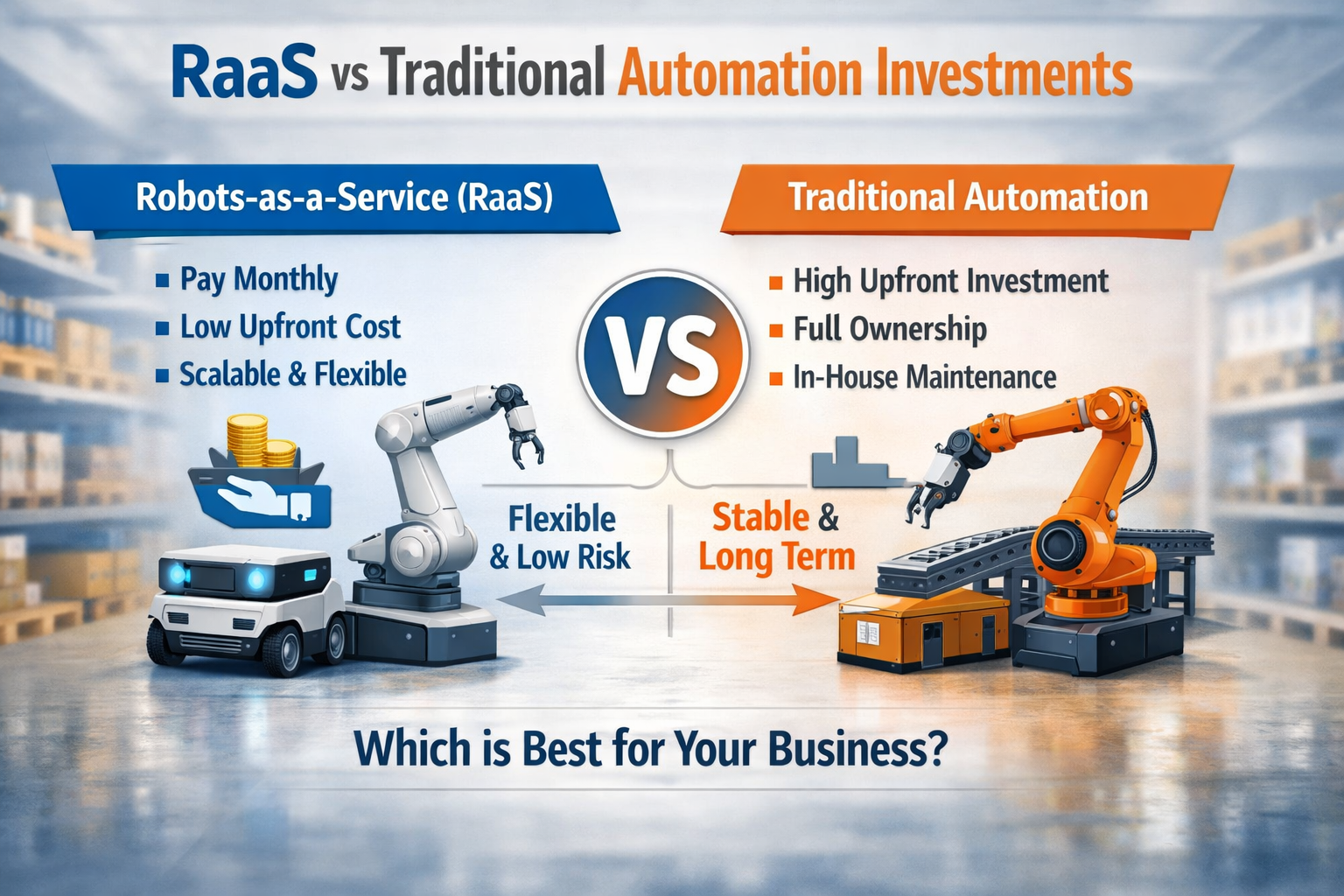
Understanding the practical differences between these two models helps businesses make smarter financial and operational decisions. Here is a side-by-side comparison:
| Factor | RaaS | Traditional Automation |
|---|---|---|
| Upfront Cost | Low — subscription-based | High — full purchase required |
| Ongoing Cost | Regular subscription fees | Maintenance and upgrade costs |
| Flexibility | High — scale up or down easily | Low — changes require investment |
| Deployment Speed | Fast — pre-configured systems | Slow — planning and training needed |
| Maintenance | Handled by provider | Handled by business |
| Risk Level | Lower — no ownership lock-in | Higher — large capital at risk |
| Long-term ROI | Moderate | Strong for stable operations |
Risk, ROI, and Maintenance Responsibilities
One of the biggest advantages of RaaS is reduced financial risk. Since businesses are not locked into ownership, they can test automation strategies before committing to large capital expenditure. If business needs change, scaling back is straightforward.
Traditional automation carries a higher financial risk because of the large initial investment. However, for businesses with predictable, long-term production needs, the return on investment can be substantial. Once the equipment cost is recovered, ongoing operational costs tend to be lower than subscription fees.
On the maintenance front, RaaS removes the technical burden entirely. The provider ensures robots stay updated and operational. Traditional automation requires skilled technicians on staff or on contract, which adds to operational complexity and cost.
Which Automation Model Should Your Business Choose?
The right choice depends on several factors specific to your business:
- Choose RaaS if you need quick deployment, want to avoid large upfront spending, operate in a seasonal or variable-demand environment, or are new to automation and want to test before scaling.
- Choose traditional automation if your production volumes are stable and high, you have the technical resources to manage equipment, and you plan to use the same systems for many years.
- Consider a hybrid approach if your business has both stable core operations and flexible or temporary automation needs. Many companies now use traditional automation for their primary production lines while using RaaS for supplementary or seasonal tasks.
This combined strategy allows businesses to control costs, reduce risk, and stay adaptable as technology and market conditions change.
The Road Ahead for Business Automation
The automation industry is growing rapidly, and both RaaS and traditional models are evolving. RaaS providers are offering more advanced robots with better software integration, making the subscription model attractive even for larger enterprises. At the same time, traditional automation vendors are improving ease of use and reducing maintenance complexity.
Businesses that evaluate their specific needs — rather than following a one-size-fits-all approach — will be better positioned to get the most value from their automation investments. Whether you subscribe or buy, the goal remains the same: work smarter, reduce costs, and grow efficiently.
As automation becomes more accessible, companies of all sizes have an opportunity to improve operations. The key is matching the right model to your business reality.