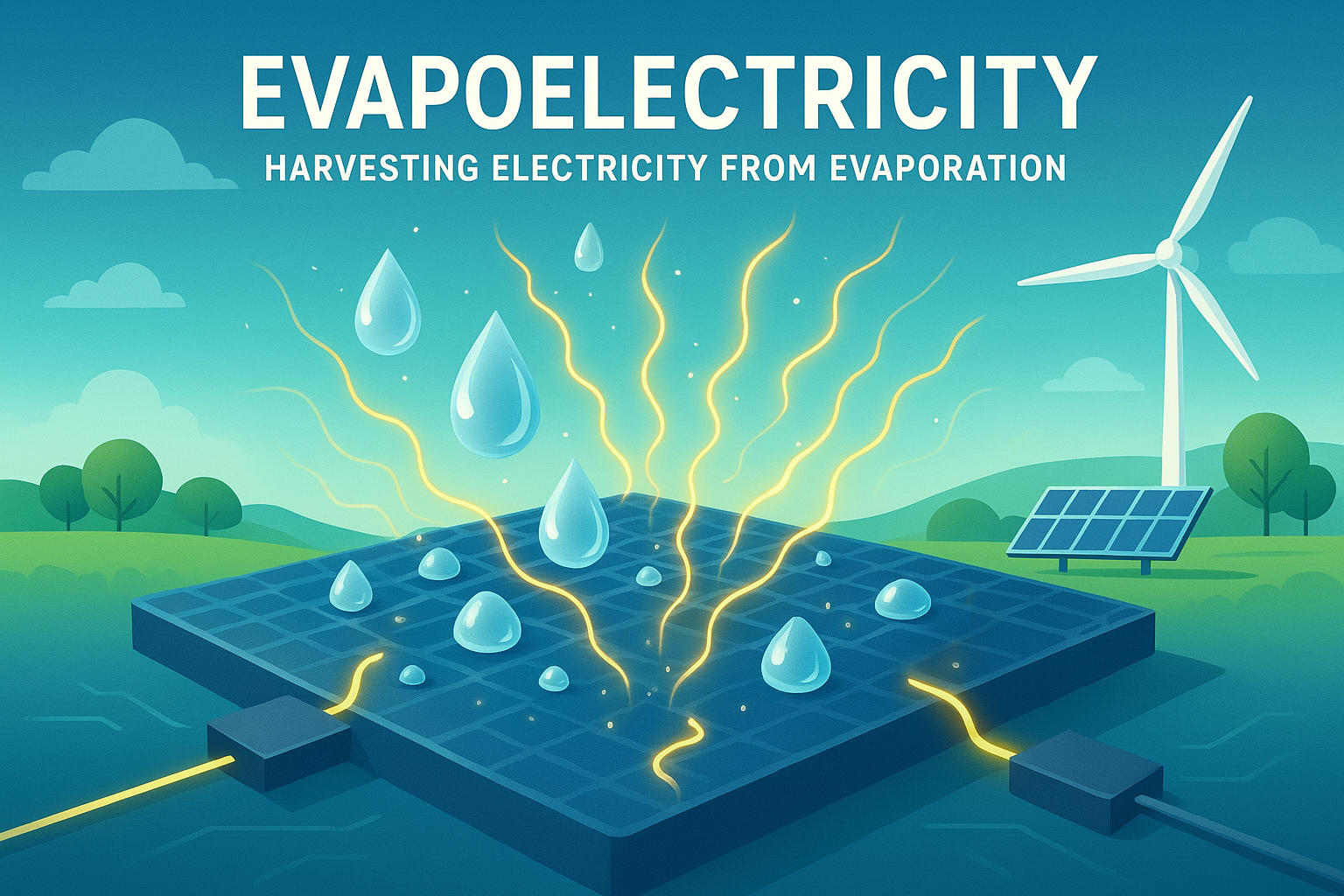
The global push for clean energy has led scientists to explore sources far beyond solar panels and wind turbines. One of the most promising and least talked-about frontiers is evapolectricity — the process of generating usable electricity directly from water evaporation. While still in its research phase, this technology taps into one of nature’s most constant processes and could open a new chapter in renewable energy.
What Is Evapolectricity?
Evapolectricity refers to the generation of electrical energy by harnessing the natural process of water evaporation. When water transitions from liquid to vapor on a surface, it creates heat transfer and moisture movement. Scientists use specially designed nanomaterials and nature-inspired films to capture this moisture-driven motion and convert it into electricity.
What makes this particularly significant is the scale of the resource. Evaporation accounts for more than 50% of the solar energy absorbed by Earth. That makes it one of the largest untapped energy flows on the planet — available day and night, across oceans, lakes, rivers, and even human skin.
How Does Evapolectricity Actually Work?
The process involves a series of carefully engineered steps that convert moisture movement into electrical output:
- Special Materials: Researchers develop porous structures, nanostructures, or bioengineered films designed to interact with water molecules at a microscopic level.
- Moisture Absorption and Movement: As water evaporates, it creates a concentration gradient inside the material, causing molecules to shift from high-moisture to low-moisture zones.
- Charge Separation: This molecular movement drives the separation of ions — positively and negatively charged particles — which generates an electrical potential difference.
- Energy Harvesting: Electrodes placed within the material capture this potential difference and store the resulting energy in small devices or batteries.
In essence, water evaporation alone drives the entire energy generation process — no sunlight, no fuel, and no moving mechanical parts required.
Real-World Applications of Evapolectricity
Though still largely experimental, evapolectricity has a wide range of potential uses across industries:
- Wearable Electronics: Moisture from the human body could power health-monitoring wearables and fitness trackers continuously.
- Environmental Sensors: Self-powered sensors could operate in forests, farmlands, and smart cities without needing battery replacements.
- Off-Grid Energy Solutions: Remote areas where solar or wind energy is not viable could benefit from moisture-based power generation.
- Medical Devices: Low-power implants and portable health tools could run on evaporation-based energy.
- IoT Devices: Distributed Internet of Things gadgets could operate independently using ambient moisture from their surroundings.
Benefits and Challenges of Evapolectricity
Like any emerging technology, evapolectricity comes with both clear advantages and real limitations. Here is a quick comparison:
| Benefits | Challenges |
|---|---|
| Clean and sustainable — uses Earth’s natural water cycle | Low power output with current technology |
| Works round the clock, even without sunlight | Requires advanced nanomaterials that are costly to produce |
| Scalable from small wearables to large installations | Large-scale harvesting methods are still under development |
| Zero harmful emissions or chemical byproducts | Devices must withstand long-term outdoor exposure |
What Does the Future Hold for Evapolectricity?
Researchers across the fields of nanotechnology, bioengineering, and materials science are actively working to improve the efficiency and scalability of evapolectric systems. If these efforts succeed, the technology could realistically power:
- Smart agriculture monitoring systems
- Remote environmental tracking stations
- Next-generation wearable health devices
- Urban infrastructure in smart cities
Some scientists have even proposed building evapolectric power stations near lakes, rivers, and reservoirs, where large volumes of water naturally evaporate every day. These installations could harvest significant amounts of energy without disrupting the surrounding ecosystem.
As nations race to meet net-zero carbon targets, evapolectricity could serve as a complementary power source alongside solar, wind, and hydropower — filling gaps where traditional renewables fall short.
Evapolectricity is still in its early stages, but its potential is hard to ignore. By drawing energy from something as simple and abundant as water turning into vapor, it represents a genuinely new direction in clean energy research. With continued investment and scientific progress, it may one day become a quiet but vital part of the world’s renewable energy mix.
Frequently Asked Questions
Evapolectricity is the process of generating electrical energy from water evaporation. It uses specially designed nanomaterials and bioengineered films to capture moisture-driven molecular movement and convert it into usable electricity.
Unlike solar energy, evapolectricity does not require direct sunlight. It works continuously — day and night — by tapping into the natural water evaporation cycle, which accounts for over 50% of the solar energy absorbed by Earth.
The key challenges include low power output from current devices, the high cost of advanced nanomaterials needed for efficiency, difficulties in scaling up the technology, and ensuring devices can withstand long-term environmental exposure.