Artificial intelligence is no longer confined to powerful cloud servers. A growing shift is happening where AI runs directly on everyday devices — from smartphones and security cameras to factory machines and fitness trackers. This is the core idea behind Edge AI, and it is quietly reshaping industries across the world.
What Is Edge AI and How Does It Work?
Edge AI refers to the deployment of artificial intelligence models directly on devices at the “edge” of a network — meaning the device itself, rather than a remote cloud server, handles all data processing.
Traditional AI systems send data to cloud servers, wait for the server to process it, and then receive a response. Edge AI skips this round trip entirely. The AI model lives on the device and makes decisions locally, in real time.
Here is how the process typically works:
- Developers train AI models on powerful computers or cloud servers.
- These pre-trained models are then transferred and installed onto edge devices.
- Once installed, the device can perform tasks like image recognition, voice processing, or anomaly detection without any internet connection.
- All data stays on the device unless the user chooses to share it.
This approach saves network bandwidth, reduces response time, and keeps sensitive data away from external servers.
Key Advantages of Edge AI
Edge AI offers several practical benefits that make it attractive for both consumers and businesses:
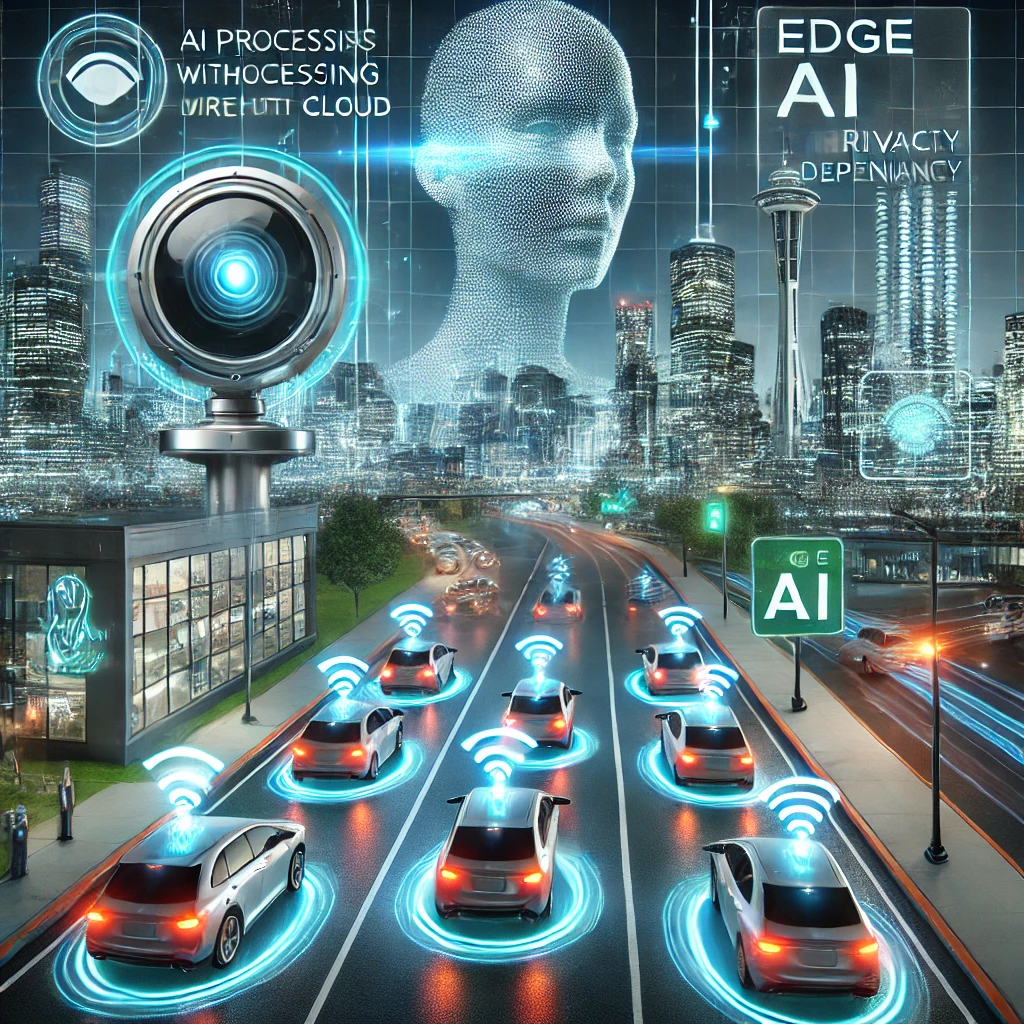
- Real-Time Decision Making: Because data is processed on the device itself, responses are near-instant. This is critical in applications like self-driving cars, where a split-second delay could mean the difference between safety and an accident.
- Better Privacy: Personal data never leaves the device, which significantly reduces the risk of data breaches or unauthorized access. Users retain greater control over their own information.
- Lower Latency: Without the need to send data back and forth to a cloud server, Edge AI dramatically cuts down on processing delays. This makes it ideal for time-sensitive applications.
- Reduced Network Usage: Since data is processed locally, far less information needs to travel over the internet. This lowers bandwidth costs and improves overall system efficiency.
Where Edge AI Is Being Used Today
Edge AI is already active across a wide range of industries. Here is a look at some of the most impactful use cases:
| Industry | Application | Benefit |
|---|---|---|
| Autonomous Vehicles | Processing camera and sensor data on the vehicle | Faster navigation and accident avoidance |
| Smart Cities | Traffic control, public safety monitoring, energy management | More efficient and secure urban systems |
| Healthcare Devices | Wearables tracking health metrics in real time | Instant health alerts for users and doctors |
| Industrial IoT | Predictive maintenance and automated operations | Higher productivity and reduced machine downtime |
In autonomous vehicles, Edge AI allows the car to “see” its surroundings and react immediately — no cloud connection needed. In smart cities, traffic lights and surveillance systems can make real-time adjustments based on live conditions. Fitness trackers use Edge AI to monitor heart rate, sleep, and activity without constantly uploading data to a server. In factories, Edge AI detects equipment faults before they cause costly breakdowns.
Challenges Facing Edge AI
Despite its advantages, Edge AI is not without hurdles. The biggest challenge is hardware limitation. Most edge devices — phones, sensors, wearables — have limited processing power and battery life. Running complex AI models on such devices requires highly optimized, lightweight algorithms that can deliver accurate results without draining resources.
Other notable challenges include:
- Model compression: AI models trained on large servers must be compressed significantly to fit on small devices without losing too much accuracy.
- Security at the device level: While Edge AI improves data privacy, the devices themselves can become targets for physical tampering or local cyberattacks.
- Maintenance and updates: Updating AI models across thousands of distributed edge devices is more complex than updating a single cloud server.
- Standardization: There is currently no universal standard for how Edge AI should be implemented across different hardware and software platforms.
The Future of Edge AI
The outlook for Edge AI is strong. As chip manufacturers develop more powerful yet energy-efficient processors specifically designed for on-device AI — such as neural processing units (NPUs) — the hardware limitations that currently hold Edge AI back are gradually being overcome.
The rise of 5G networks also complements Edge AI by enabling faster communication between edge devices when cloud interaction is still needed. Together, these technologies are expected to make Edge AI a standard feature in consumer electronics, industrial equipment, healthcare tools, and smart infrastructure.
Experts widely agree that as AI becomes more embedded in daily life, the ability to run it locally — quickly, privately, and reliably — will become a core requirement rather than an optional feature.
Edge AI is not a distant concept. It is already running on the devices people use every day, and its role will only grow larger in the years ahead.