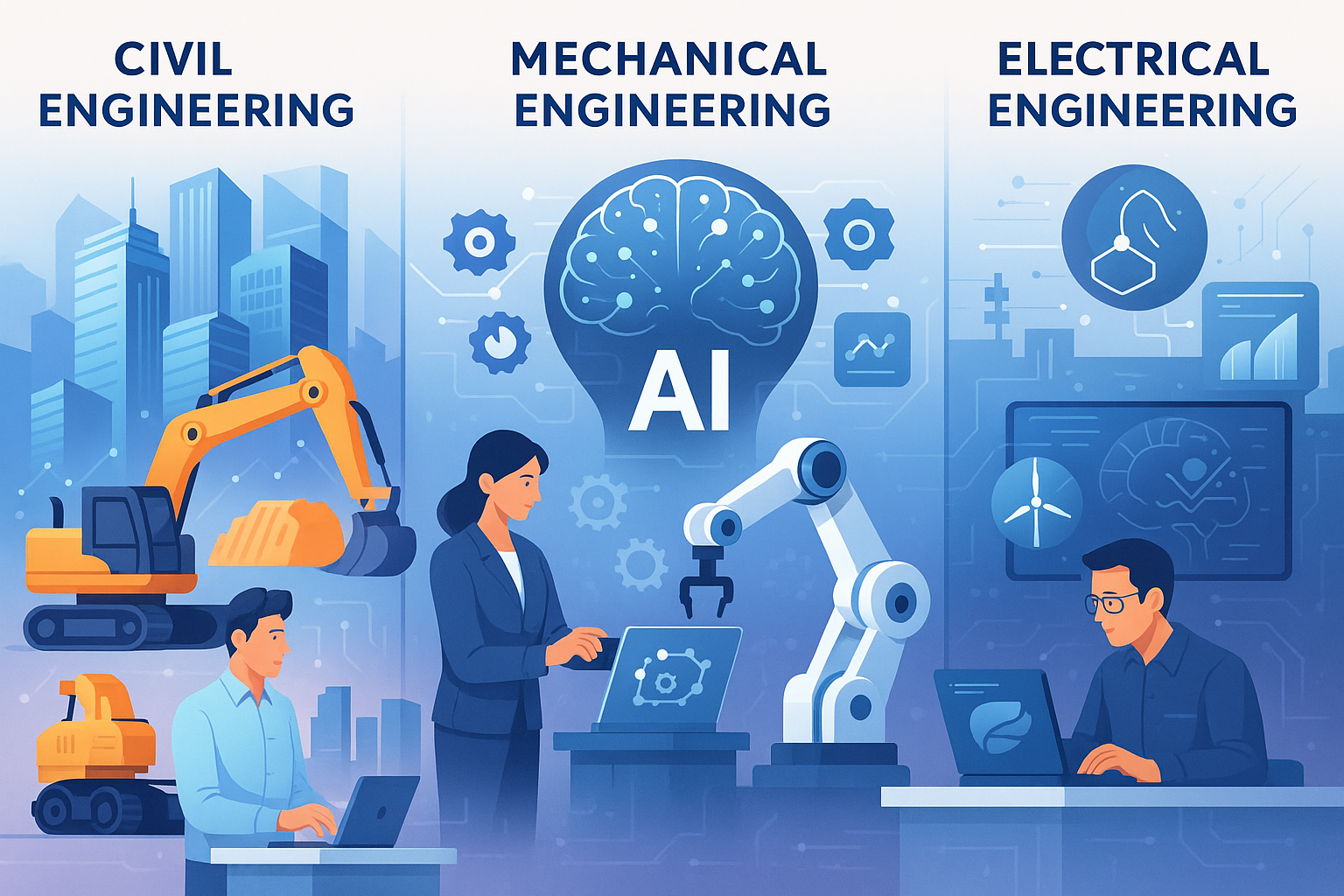
Artificial Intelligence has moved well beyond the buzzword stage. Engineers across disciplines now rely on it as a practical, everyday tool that helps them design better structures, build smarter machines, and manage complex power systems. Here is a clear look at how civil, mechanical, and electrical engineers are putting AI to real use — and why it matters for the future of infrastructure, manufacturing, and energy.
AI in Civil Engineering: Smarter Planning and Safer Sites
Civil engineering involves massive projects — highways, bridges, buildings — where even small errors can have serious consequences. AI is helping engineers reduce those risks at every stage.
Better project planning is one of the biggest wins. AI tools process large volumes of data, including traffic patterns, weather forecasts, and material availability, to help engineers build more accurate timelines. This means fewer surprises during construction and better resource management from day one.
Infrastructure health monitoring is another area where AI adds real value. Sensors installed on bridges, roads, and buildings collect real-time data around the clock. AI systems analyse this data to predict when a structure might start to deteriorate or fail. Engineers can then schedule repairs before a small problem becomes a safety hazard.
On-site safety has also improved significantly. Construction sites now use drones and AI-powered cameras to monitor workers and equipment. These systems can detect unsafe conditions, identify errors in real time, and even track project progress automatically — reducing the need for manual inspections.
AI in Mechanical Engineering: From Design to the Factory Floor
Mechanical engineering covers everything from product design to large-scale manufacturing. AI is making each of these steps faster, more accurate, and less wasteful.
Smarter design processes are one of the clearest benefits. Instead of testing one design at a time, AI can evaluate dozens of design options simultaneously and recommend the best-performing ones. This saves engineers significant time and often leads to stronger, more efficient components.
Manufacturing efficiency has improved as factories adopt AI-driven systems. These systems adjust machine speeds automatically, monitor product quality in real time, and reduce errors on the production line. The result is faster output with less material waste.
Predictive maintenance is perhaps the most impactful application. AI continuously monitors machine performance and flags any unusual patterns. Engineers receive early warnings before a machine breaks down, allowing them to fix issues during planned downtime rather than dealing with costly emergency shutdowns.
AI in Electrical Engineering: Powering Smarter Grids and Robots
Electrical engineering sits at the heart of modern infrastructure — from the power grid to advanced robotics. AI is helping electrical engineers manage increasingly complex systems with greater precision.
Energy management is a key application. Smart grids use AI to balance electricity supply and demand in real time. This helps prevent blackouts, reduces energy waste, and makes it easier to integrate renewable energy sources like solar and wind into the grid.
Fault detection in electrical systems is faster and more accurate with AI. When something goes wrong in a complex circuit or power network, AI can identify the fault quickly and even suggest the best fix. This speeds up maintenance and reduces downtime for both industrial and residential users.
Automation and robotics depend heavily on AI. From self-driving vehicles to factory robots, electrical engineers use AI to improve the intelligence, precision, and responsiveness of automated systems. These machines can now perform tasks that once required constant human supervision.
A Quick Comparison: AI Applications Across Engineering Fields
| Engineering Field | Key AI Applications | Main Benefit |
|---|---|---|
| Civil Engineering | Project planning, infrastructure monitoring, site safety | Fewer delays, safer structures |
| Mechanical Engineering | Design optimisation, manufacturing, predictive maintenance | Less waste, reduced downtime |
| Electrical Engineering | Smart grids, fault detection, robotics | Reliable power, smarter automation |
What This Means for Engineers and the Industry
The adoption of AI across engineering disciplines is not replacing engineers — it is making their work more effective. Here are some practical takeaways:
- Engineers who learn to work with AI tools will have a clear advantage in the job market.
- Projects that use AI for planning and monitoring tend to finish on time and within budget more often.
- Predictive maintenance powered by AI can save companies significant money by avoiding unexpected equipment failures.
- Smart grids supported by AI are essential for managing the growing demand for clean energy.
- AI-driven robotics is opening new possibilities in manufacturing, healthcare, and infrastructure.
As AI tools become more accessible and affordable, their use across all branches of engineering will only grow. Engineers who understand both the technical and practical sides of AI will be best placed to lead the next generation of projects.
Frequently Asked Questions
AI helps civil engineers with project planning by analysing traffic, weather, and material data. It also monitors infrastructure health using sensors and improves on-site safety through drones and AI-powered cameras.
In mechanical engineering, AI is used to optimise product designs, improve manufacturing efficiency, and predict machine failures before they happen — reducing downtime and production costs.
AI helps electrical engineers manage smart grids to balance power supply and demand, detect faults in electrical systems quickly, and improve the intelligence and precision of robots and automated machines.