Managing money has never been more complex — or more interesting. Two powerful systems compete for your trust today: traditional banking and blockchain technology. Both help people store, send, and receive money, but they work in fundamentally different ways. Understanding these differences can help you make smarter financial decisions.
What Is Blockchain and How Does It Work?
Blockchain is a digital record-keeping system that stores data — including financial transactions — across thousands of computers at the same time. Most people associate it with cryptocurrencies like Bitcoin and Ethereum, but its applications go far beyond digital coins. It can manage contracts, supply chains, and identity verification too.
The defining feature of blockchain is decentralization. No single bank, company, or government controls the data. Every transaction is recorded in a block, linked to the previous one, forming a chain that is nearly impossible to alter. This structure makes blockchain highly transparent and resistant to fraud.
What Is Traditional Banking?
Traditional banking is the system most of us grew up with. Banks and financial institutions manage personal accounts, process loans, facilitate payments, and offer investment products. Governments and central banks regulate these institutions to maintain financial stability and protect consumers.
While traditional banking has served societies for centuries, it faces growing pressure from digital alternatives. High fees, slow international transfers, and limited access in rural or developing regions are some of its well-known drawbacks.
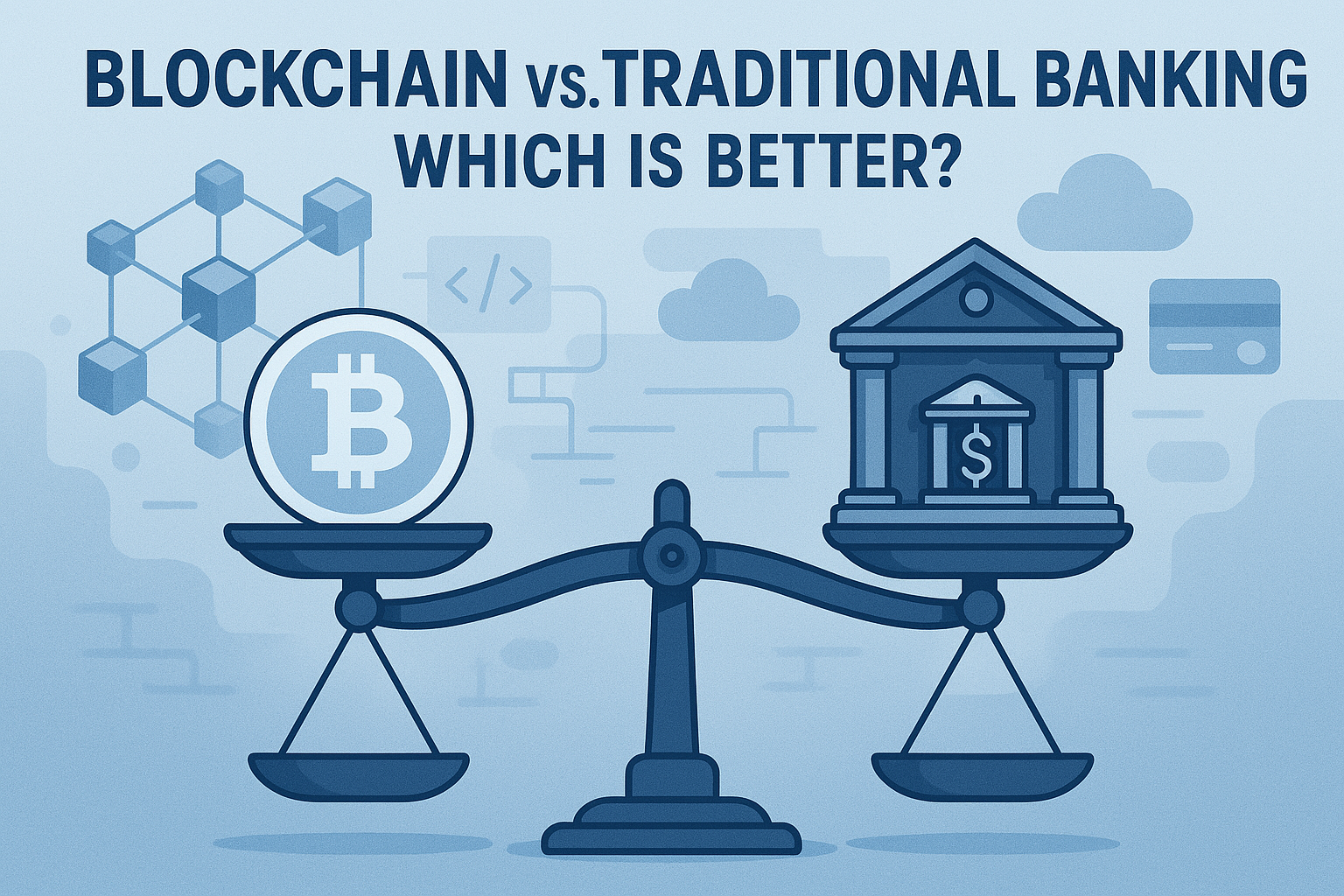
Head-to-Head Comparison: Blockchain vs Traditional Banking
Here is a direct comparison across the most important factors:
| Factor | Blockchain | Traditional Banking |
|---|---|---|
| Transaction Speed | Minutes or near-instant, even cross-border | 1 to 5 business days for international transfers |
| Transaction Costs | Lower fees, no middlemen | Higher fees for wire transfers and currency exchange |
| Security | Decentralized, cryptographically secured | Centralized, vulnerable to large-scale cyberattacks |
| Transparency | Public ledger, fully visible | Internal processes are not publicly visible |
| Access | Needs internet only | Needs physical branches or ATMs |
| Regulation | Largely unregulated in most countries | Heavily regulated by governments |
| Control | Decentralized, no single authority | Centralized, controlled by banks and governments |
Financial Inclusion: Who Benefits More?
One of blockchain’s strongest advantages is its ability to reach people that traditional banks simply cannot serve. According to global financial data, hundreds of millions of adults worldwide remain unbanked — they have no access to basic financial services.
- Blockchain only requires an internet connection. This makes it accessible in remote villages, developing nations, and areas with no bank branches or ATMs nearby.
- Traditional banking depends on physical infrastructure — branches, ATMs, and regulatory frameworks — that many underserved regions lack entirely.
For people in countries like India, where rural banking access has improved but gaps still exist, blockchain-based financial tools offer a practical alternative for sending and receiving money quickly and cheaply.
Trust, Regulation, and Long-Term Stability
Trust is the foundation of any financial system. Here is how both systems compare on this front:
- Blockchain earns trust through its open, tamper-resistant design. However, most countries — including India — are still developing clear regulatory frameworks for cryptocurrencies and blockchain-based finance. This uncertainty makes long-term planning difficult for users and businesses.
- Traditional banking is backed by government regulation and deposit insurance schemes. In India, the Deposit Insurance and Credit Guarantee Corporation (DICGC) insures bank deposits up to ₹5 lakh per depositor. This kind of protection does not exist in blockchain systems.
For everyday users who prioritize stability and legal protection, traditional banking still holds a clear advantage. For those who value speed, low cost, and privacy, blockchain offers compelling benefits.
As both systems continue to develop, financial experts expect a gradual convergence. Several banks globally are already exploring blockchain-based payment rails, and central banks — including the Reserve Bank of India (RBI) — are working on Central Bank Digital Currencies (CBDCs) that combine blockchain technology with government oversight.
In the end, the right choice depends on your personal financial needs, location, and comfort with technology. Neither system is perfect, but together they are shaping the future of money.