Artificial intelligence is no longer a solo act. Across industries, AI systems are being designed to work together — sharing tasks, exchanging data, and making decisions as a coordinated unit. At the heart of this shift are AI collaboration protocols, the communication standards that allow multiple AI agents to function as a team. This development is reshaping how businesses approach automation, productivity, and intelligent decision-making.
What Are AI Agents and Why Do They Matter?
AI agents are independent software programs capable of thinking, deciding, and acting without constant human input. Each agent is built to handle a specific function — answering queries, analyzing data, managing schedules, or controlling automated systems.
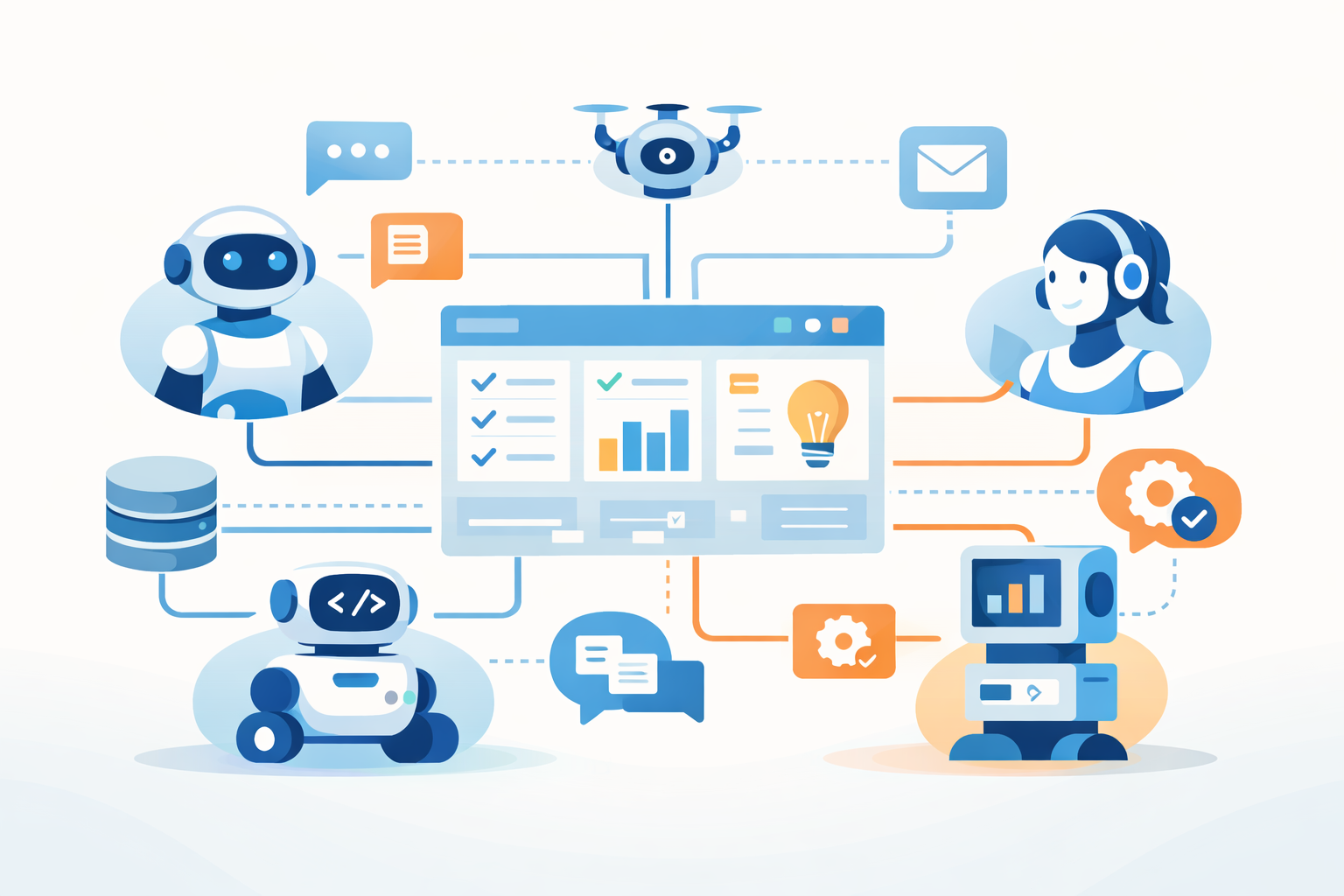
On their own, individual AI agents are useful. But when multiple agents work together, they can tackle far more complex challenges. A single agent might struggle with a multi-step business workflow, but a team of specialized agents can divide the work and complete it faster and more accurately.
- Planning agents break down tasks and set priorities.
- Execution agents carry out specific actions based on instructions.
- Monitoring agents track results and flag issues in real time.
This division of responsibility is what makes multi-agent AI systems so powerful.
Understanding AI Collaboration Protocols
AI collaboration protocols are standardized methods that allow different AI agents to communicate, share information, and coordinate actions. Think of them as a common language that agents use to stay aligned — even when they come from different developers or run on different platforms.
Without these protocols, AI agents would operate in silos, unable to pass instructions or share data reliably. With them, agents can work in sync, making the overall system more efficient and less prone to errors.
Key functions of AI collaboration protocols include:
- Defining how agents send and receive messages
- Setting rules for data sharing and access permissions
- Establishing error-handling procedures when one agent fails
- Ensuring transparency and accountability in automated decisions
Why Businesses Are Adopting Multi-Agent AI Systems
The growing demand for smarter automation is driving businesses toward collaborative AI. Simple, single-purpose AI tools can no longer keep up with complex operational needs. Multi-agent systems offer a practical solution.
One major advantage is scalability. Companies can add or remove individual agents without rebuilding the entire system. This flexibility makes it easier to adapt AI infrastructure as business needs change.
Another benefit is cost efficiency. Specialized agents handle tasks more accurately than a general-purpose system, reducing the need for human intervention and minimizing costly errors.
| Feature | Single AI Agent | Multi-Agent AI System |
|---|---|---|
| Task Complexity | Limited to simple tasks | Handles complex, multi-step workflows |
| Scalability | Difficult to scale | Easily scalable by adding agents |
| Error Handling | Single point of failure | Other agents can compensate |
| Speed | Sequential processing | Parallel task execution |
Real-World Applications Across Industries
AI agent collaboration is already delivering results in several sectors:
- Customer Support: One agent handles conversations, another analyzes customer sentiment, and a third decides when to escalate to a human representative.
- Software Development: Separate agents write code, run tests, and manage deployment — reducing development time and human error.
- Business Operations: AI agents manage report generation, approval workflows, and data processing simultaneously.
- Healthcare: Agents can coordinate patient scheduling, flag abnormal test results, and assist with administrative tasks in parallel.
These use cases show that collaborative AI is not a distant concept — it is already changing how organizations operate.
Challenges That Come With AI Agent Collaboration
Despite its clear advantages, multi-agent AI also brings challenges that organizations must address carefully.
Data security is a top concern. When agents share information across systems, sensitive data must be protected at every step. A weak link in the communication chain can expose critical business or personal information.
Error propagation is another risk. If one agent makes a mistake, it can pass incorrect data to the next agent, causing a chain reaction of errors throughout the workflow.
Transparency and accountability also become harder to maintain as systems grow more complex. Businesses need to know which agent made which decision and why — especially in regulated industries.
Well-designed AI protocols address these risks by building in clear rules, access controls, and audit trails from the start.
What the Future Holds for Collaborative AI
As AI technology matures, multi-agent systems will become more autonomous and capable. Experts expect future AI agents to function like digital teams — managing entire departments, coordinating projects, and adapting to new challenges without human direction.
Organizations that invest in AI collaboration frameworks now are likely to hold a significant advantage in operational efficiency and innovation over the next few years. The companies building these systems today are laying the groundwork for a fundamentally different way of working.
In conclusion, AI protocols for agent collaboration represent a meaningful shift in how intelligent systems are built and deployed. Rather than isolated tools, AI is becoming an interconnected network of specialized agents working toward shared goals. For businesses ready to embrace this approach, the potential gains in speed, accuracy, and scalability are substantial.