Businesses today are sitting on mountains of data, but the real challenge is knowing what to do with it. Predictive analytics powered by artificial intelligence is helping companies move from reactive decisions to proactive strategies — and the results are significant across every major industry.
What Is Predictive Analytics and Why Does It Matter?
Predictive analytics uses historical data to forecast what is likely to happen in the future. It is not guesswork — it is pattern recognition at scale.
Some straightforward examples include:
- An online retailer predicting which products customers are likely to buy next month
- A hospital identifying patients who may need urgent care before their condition worsens
- A bank flagging a transaction as potentially fraudulent before it is processed
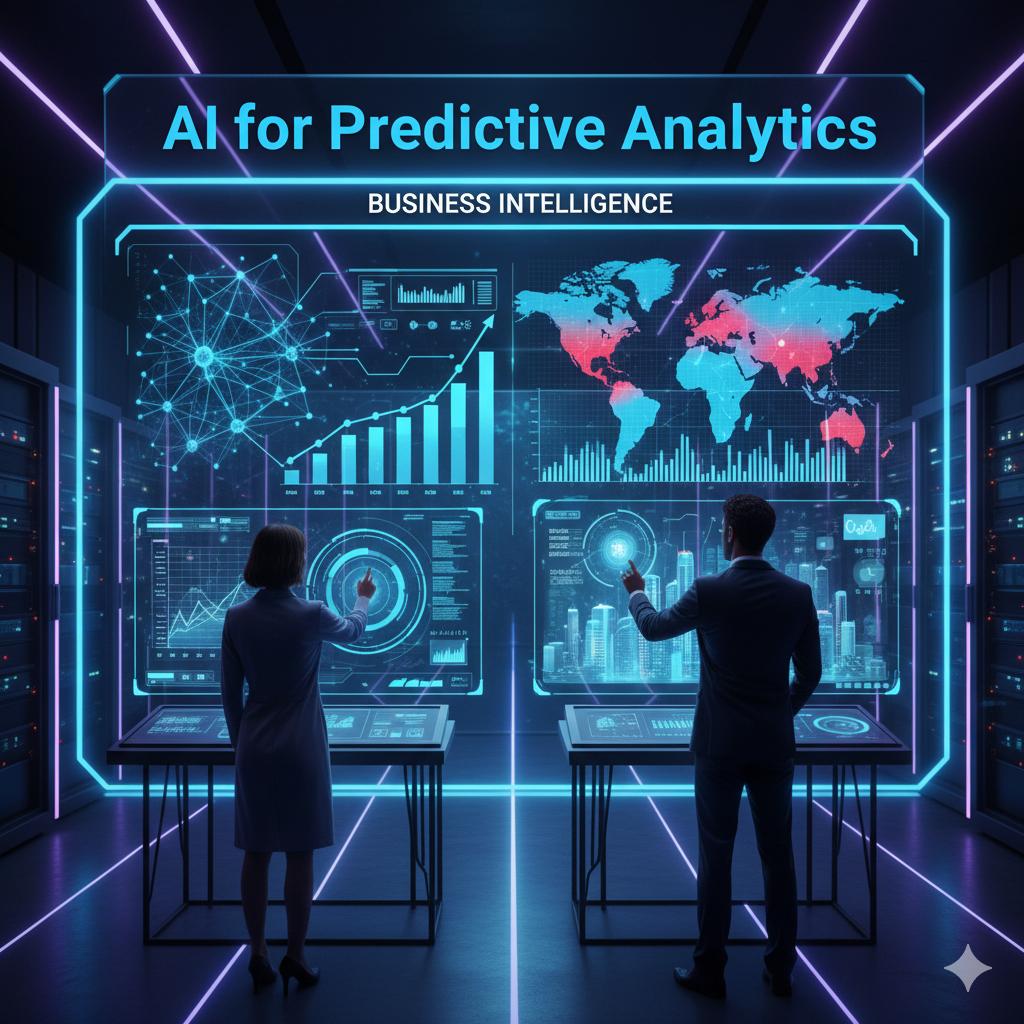
When artificial intelligence is added to this process, the speed and accuracy of these forecasts improve dramatically. AI can scan through vast datasets, detect trends humans might miss, and generate predictions without requiring manual analysis at every step.
How AI Makes Business Intelligence Smarter
Business Intelligence (BI) has traditionally focused on understanding what already happened — dashboards showing last quarter’s sales, weekly reports on customer churn, and monthly revenue summaries.
That backward-looking approach has its limits. Knowing that sales dropped last week does not automatically tell you why it happened or what to do about it.
AI changes this by making BI forward-looking. When integrated with BI tools, AI can:
- Forecast future trends — such as which product category will see the highest demand next quarter
- Uncover hidden patterns in customer behaviour, supply chains, or market movements
- Suggest specific actions to improve performance based on the data
Instead of simply reporting that sales dropped, an AI-powered BI system can explain the likely cause and recommend the next best step — giving decision-makers a clear path forward rather than just a problem to react to.
Real-World Applications Across Industries
AI-driven predictive analytics is already being used across a wide range of sectors. Here is how different industries are putting it to work:
| Industry | How AI Predictive Analytics Is Used |
|---|---|
| Retail | Product recommendations, demand forecasting, inventory management |
| Finance | Fraud detection, credit risk assessment, market trend forecasting |
| Healthcare | Disease outbreak prediction, patient risk scoring, treatment planning |
| Manufacturing | Predictive maintenance, equipment failure prevention, supply chain optimisation |
| Marketing | Customer behaviour analysis, campaign optimisation, churn prediction |
Each of these use cases shares a common thread — using past data to make smarter decisions about the future, with AI doing the heavy analytical lifting.
Key Benefits of AI-Powered Predictive Analytics for Businesses
Companies that adopt AI-driven predictive analytics gain several practical advantages over those relying on traditional data methods:
- More accurate forecasts — AI learns from large datasets and continuously improves its predictions over time
- Faster decision-making — real-time analysis means businesses can act quickly when conditions change
- Cost reduction — identifying problems early, such as a machine likely to fail or a customer about to leave, helps prevent costly outcomes
- Smarter long-term planning — spotting trends early gives businesses the time to prepare rather than scramble
- Competitive advantage — companies using predictive insights can position themselves ahead of market shifts
What Comes Next: Prescriptive Analytics
The next step beyond predictive analytics is prescriptive analytics — where AI does not just forecast what will happen but also recommends specific actions to take in response.
For example, a prescriptive system might tell a business: “Sales are likely to drop next week — consider increasing your advertising budget by 10% to offset the decline.”
This moves AI from being an analytical tool to an active decision-support system. Businesses no longer just receive data insights — they receive a recommended course of action, backed by data.
As AI models become more sophisticated and datasets grow richer, prescriptive analytics is expected to become a standard feature in enterprise business intelligence platforms. Companies that begin building their data infrastructure and AI capabilities now will be better positioned to benefit from these advances.
In summary, AI is reshaping how businesses understand and use data. From retail to healthcare to finance, predictive analytics powered by AI is helping organisations make faster, smarter, and more confident decisions — not just about what happened, but about what is coming next.