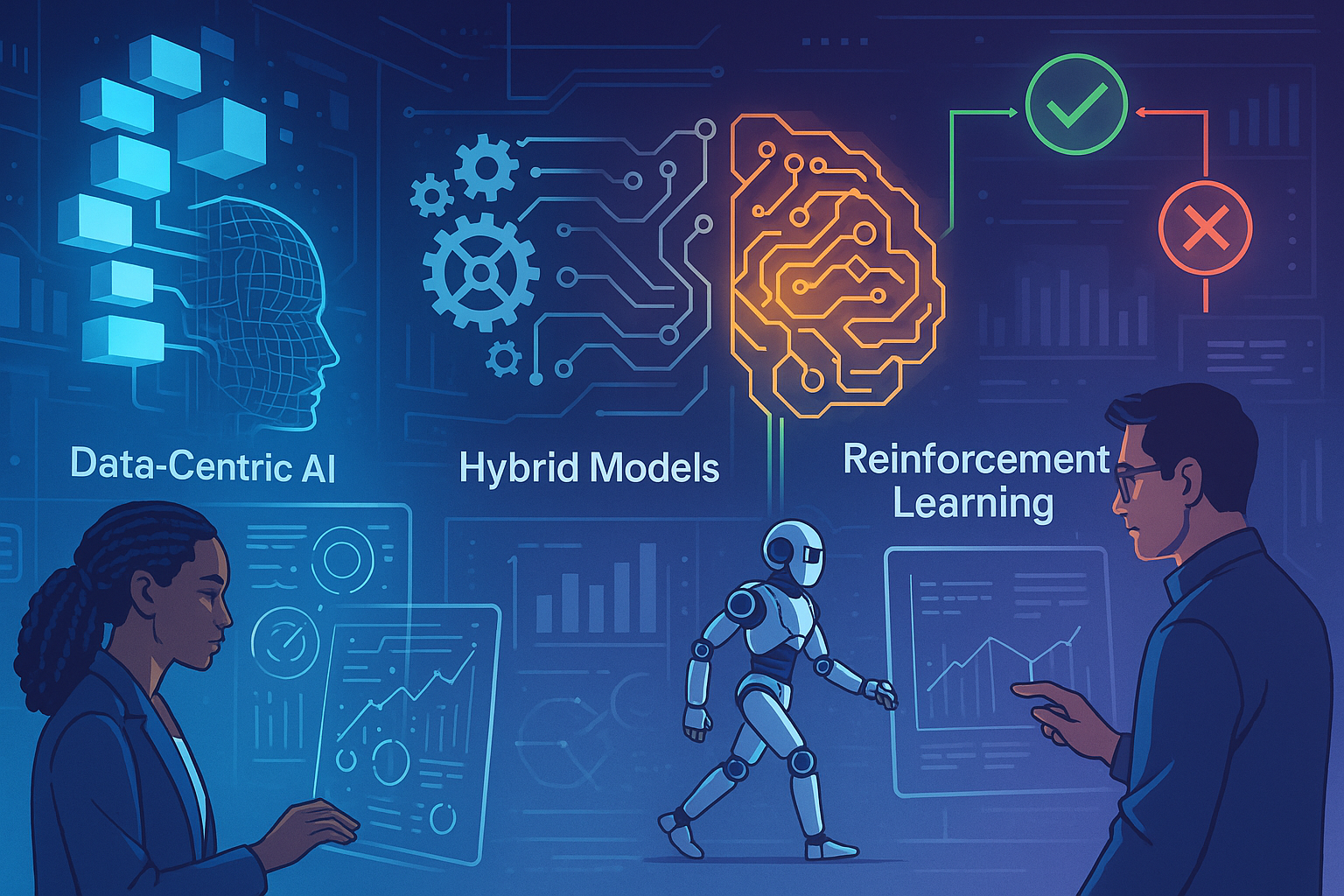
The AI industry is shifting its focus. Instead of simply building bigger and more complex models, researchers and developers are now paying closer attention to data quality, smarter learning techniques, and flexible system designs. Three trends are leading this shift in 2025: Data-Centric AI, Hybrid AI Models, and Reinforcement Learning. Here is a clear breakdown of what each means and why it matters.
What Is Data-Centric AI and Why Is It Important?
Data-Centric AI is an approach that focuses on improving the quality of training data rather than constantly upgrading the AI model itself. The core idea is simple: when your data is accurate, clean, and well-structured, even a basic AI model can deliver strong results.
For years, the AI community focused heavily on model architecture — making neural networks deeper, wider, and more complex. Data-Centric AI flips that thinking. It argues that the data feeding into a model is just as important, if not more so, than the model itself.
Key benefits of a data-centric approach include:
- Higher accuracy because the model learns from reliable information
- Reduced bias and fewer errors in AI decisions
- Lower costs compared to building and training complex new models
- Faster development cycles since improving data is often quicker than redesigning models
A practical example: if you are training an AI to identify flowers, fixing blurry or incorrectly labelled images in your dataset will improve results far more efficiently than rebuilding the model from scratch.
What Are Hybrid AI Models and Where Are They Used?
Hybrid AI Models combine two distinct types of intelligence into a single system:
- Rules-based logic — structured instructions similar to traditional programming
- Machine learning — the ability to learn patterns from data
This combination makes AI systems both adaptable and explainable. The rules-based component ensures decisions follow a predictable, transparent logic. The machine learning component allows the system to handle new situations and improve over time.
Hybrid models are especially valuable in high-stakes industries where decisions must be both smart and justifiable:
- Healthcare: An AI diagnostic tool can follow clinical guidelines (rules) while also analysing patient records and medical images (machine learning)
- Finance: Fraud detection systems can apply fixed compliance rules alongside pattern recognition from transaction data
- Law: Legal research tools can combine statutory rules with learned case law patterns
The strength of hybrid models lies in their balance — they are flexible enough to handle complexity but structured enough to be trusted in critical environments.
What Is Reinforcement Learning and How Does It Work?
Reinforcement Learning is a training method where an AI learns by doing. The system tries different actions, receives feedback in the form of rewards or penalties, and gradually improves its behaviour over time. Think of it like training a pet — good actions are rewarded, mistakes are corrected, and the learner gets better through repeated practice.
This approach is particularly powerful for tasks that involve sequences of decisions or physical interaction with an environment. Real-world applications include:
- Board games and strategy games such as Chess and Go — AlphaGo by DeepMind is a well-known example
- Self-driving cars that learn to navigate roads safely
- Robots that learn to walk, pick up objects, or perform assembly tasks
- Traffic management systems that optimise signal timing
- Smart energy grids that balance supply and demand efficiently
A simple example: a robot learning to walk tries different leg movements, earns points for staying balanced, and over thousands of attempts develops a stable walking pattern — without being explicitly programmed on how to walk.
How Data-Centric AI, Hybrid Models, and Reinforcement Learning Work Together
These three approaches are not competing ideas — they complement each other. When combined, they create AI systems that are smarter, safer, and more dependable.
| Concept | Role in Building Smart AI |
|---|---|
| Data-Centric AI | Ensures the AI learns from high-quality, accurate data |
| Hybrid AI Models | Combines rule-based logic and machine learning for reliable, explainable decisions |
| Reinforcement Learning | Trains AI through real-world practice, rewards, and continuous improvement |
For example, a self-driving car system could use clean, well-labelled sensor data (data-centric approach), follow traffic laws through rules-based logic while adapting to road conditions through machine learning (hybrid model), and continuously improve its driving behaviour through trial and feedback (reinforcement learning).
Key Takeaways for Anyone Building or Using AI in 2025
Whether you are a developer, a business leader, or simply someone curious about where AI is heading, these three trends offer practical lessons:
- Start with clean, accurate, and well-labelled data before investing in complex model upgrades
- Consider hybrid designs when your use case requires both flexibility and transparency
- Use reinforcement learning for tasks that involve sequences of actions, physical environments, or continuous decision-making
- Combining all three approaches often produces the most reliable and trustworthy AI systems
The shift toward data quality, explainability, and learning-by-doing reflects a maturing AI industry — one that is moving beyond raw computing power toward building systems that are genuinely useful and responsible in real-world settings.
As 2025 progresses, these three pillars — Data-Centric AI, Hybrid AI Models, and Reinforcement Learning — are set to define how the next generation of intelligent systems is built, trained, and deployed across industries worldwide.