
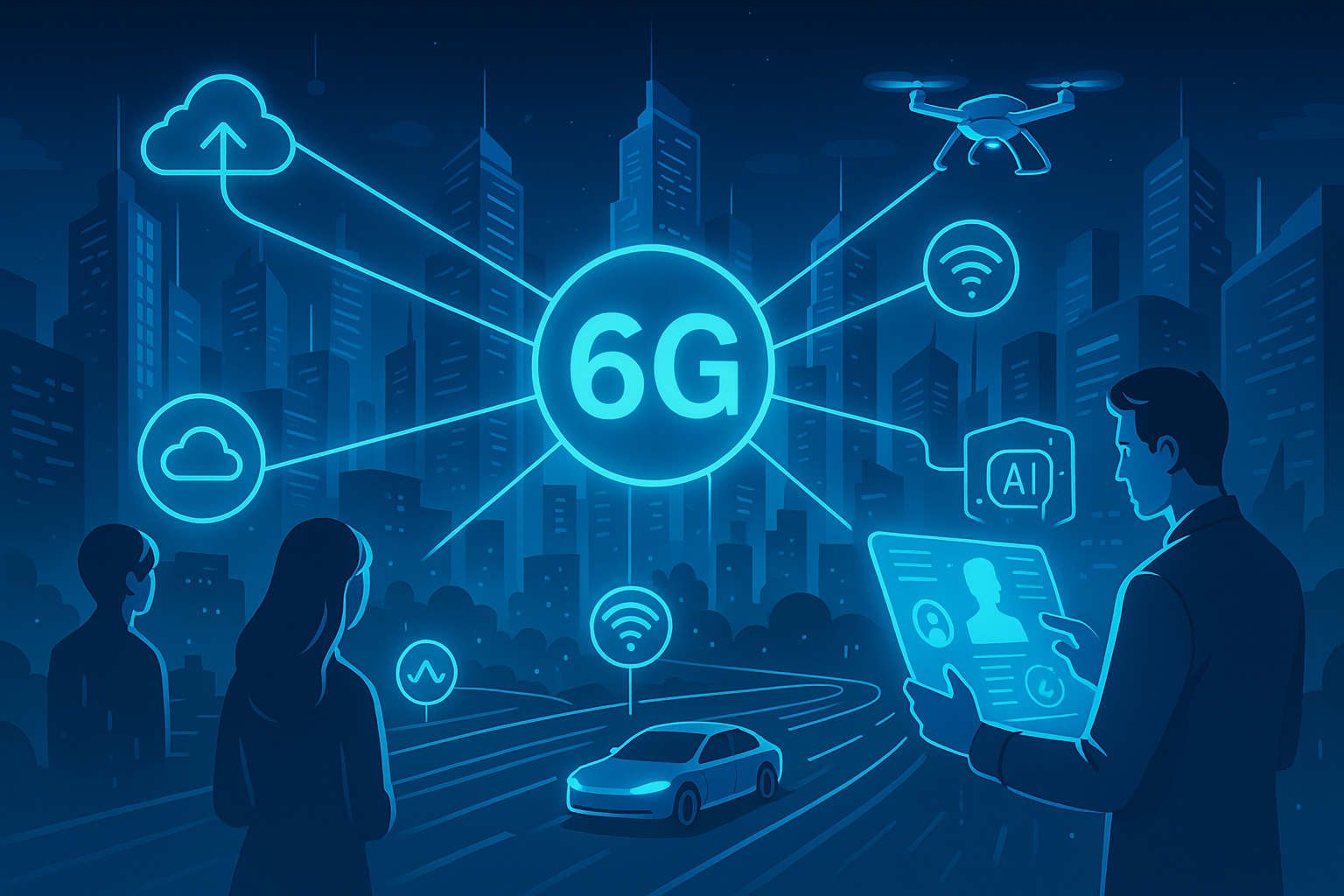
The world is still getting used to 5G, but the next big leap in wireless technology is already being planned. Called 6G, the sixth generation of mobile networks promises speeds that were unimaginable just a few years ago. Companies like Samsung, Nokia, Huawei, and Apple are already testing it, and experts expect it to arrive around 2030. Here is everything you need to know about 6G connectivity and why it matters.
What Exactly Is 6G?
6G stands for the sixth generation of mobile networks. It is the direct successor to 5G and is designed to be far more powerful, intelligent, and responsive. Unlike previous network upgrades that focused mainly on speed, 6G brings a new level of intelligence to wireless communication by deeply integrating Artificial Intelligence into the network itself.
This means the network will not just carry data — it will learn, adapt, and fix problems on its own. The result is a wireless system that is faster, smarter, and more reliable than anything available today.
How Fast Will 6G Be Compared to 5G?
Speed is one of the most talked-about features of 6G, and the numbers are staggering. 6G is expected to be up to 100 times faster than 5G. To put that in perspective:
- You could download a full HD movie in under one second
- Latency, or network delay, will drop to less than 0.1 milliseconds — nearly zero
- Networks will support over one million connected devices per square kilometre
- High-frequency radio waves will carry far more data than current 5G bands
Here is a simple comparison between 5G and 6G:
| Feature | 5G | 6G |
|---|---|---|
| Speed | Up to 10 Gbps | Up to 1 Terabit/sec (1,000 Gbps) |
| Latency | ~1 millisecond | Less than 0.1 milliseconds |
| Network Intelligence | Some AI features | Fully AI-powered |
| Device Density | ~100,000 devices/km² | Over 1 million devices/km² |
What Will 6G Make Possible?
The real impact of 6G goes far beyond faster downloads. Its near-zero latency and AI-driven intelligence will open doors to applications that are either impossible or unreliable on today’s networks.
- Remote surgery: Doctors will be able to perform operations on patients in different cities or countries using robotic tools guided in real-time over 6G networks.
- Self-driving cars: Vehicles will communicate with each other and with road infrastructure instantly, making autonomous driving far safer and more reliable.
- Smart factories: Industrial machines will operate, learn, and improve continuously using live data, reducing downtime and increasing efficiency.
- Immersive AR and VR: Augmented and virtual reality experiences will feel truly real, with no lag, no blurry visuals, and no slow response times — making the metaverse a practical reality.
- Smart cities: Traffic signals, parking systems, pollution monitors, and public services will all be connected and managed intelligently in real-time.
- Holographic education: Students will learn through 3D holograms, making remote education far more engaging and interactive.
Why Is 6G Important for India and the World?
For a country like India, which is still expanding its 5G infrastructure, 6G represents a massive long-term opportunity. The technology could help bridge the digital divide by connecting rural areas with high-speed, intelligent networks. It could also boost industries like healthcare, agriculture, manufacturing, and education.
Globally, 6G is seen as a strategic technology. Nations and corporations are racing to lead its development because whoever sets the 6G standard will have significant influence over the future of global communications. Countries like South Korea, Japan, China, and the United States have already launched national 6G research programmes.
Key benefits that make 6G important include:
- Enabling real-time automation across industries
- Supporting billions of IoT devices simultaneously
- Making smart homes and cities more efficient and safer
- Reducing energy consumption through intelligent network management
- Powering next-generation healthcare and education services
When Will 6G Actually Arrive?
As of 2025, 6G is still in the research and early testing phase. Major technology companies including Samsung, Nokia, Huawei, and Apple are actively working on 6G prototypes and standards. Industry experts and organisations like the International Telecommunication Union (ITU) expect commercial 6G networks to begin rolling out around 2030.
The timeline will depend on how quickly global standards are agreed upon, how fast the required hardware is developed, and how governments allocate the necessary radio frequency spectrum. Much like 5G took several years to move from lab to consumer hands, 6G will follow a similar path — but the groundwork is being laid right now.
In conclusion, 6G is not simply a faster version of 5G. It represents a fundamental shift in how networks operate, combining extreme speed, near-zero latency, and built-in artificial intelligence to create a truly intelligent wireless world. From remote surgeries to self-driving cars and smart cities, 6G has the potential to reshape nearly every aspect of daily life. While 2030 may seem far away, the decisions and investments being made today will determine how quickly this technology reaches people around the world.
Frequently Asked Questions
6G is the sixth generation of mobile networks and the successor to 5G. It is expected to be up to 100 times faster than 5G, with latency below 0.1 milliseconds and a fully AI-powered network that can learn and adapt on its own.
Experts and organisations like the ITU expect commercial 6G networks to launch around 2030. Companies like Samsung, Nokia, Huawei, and Apple are currently in the research and testing phase as of 2025.
6G will enable applications like real-time remote surgery, safer self-driving cars, immersive AR and VR experiences, smart city infrastructure, holographic education, and fully automated smart factories.