Ethereum’s Account Abstraction is one of the most significant shifts in how blockchain wallets and transactions work. It moves away from rigid, private-key-only accounts toward programmable, smart contract-based wallets that developers can customize for real-world needs. If you build decentralized apps, this is something you cannot afford to ignore.
Understanding Ethereum Account Types
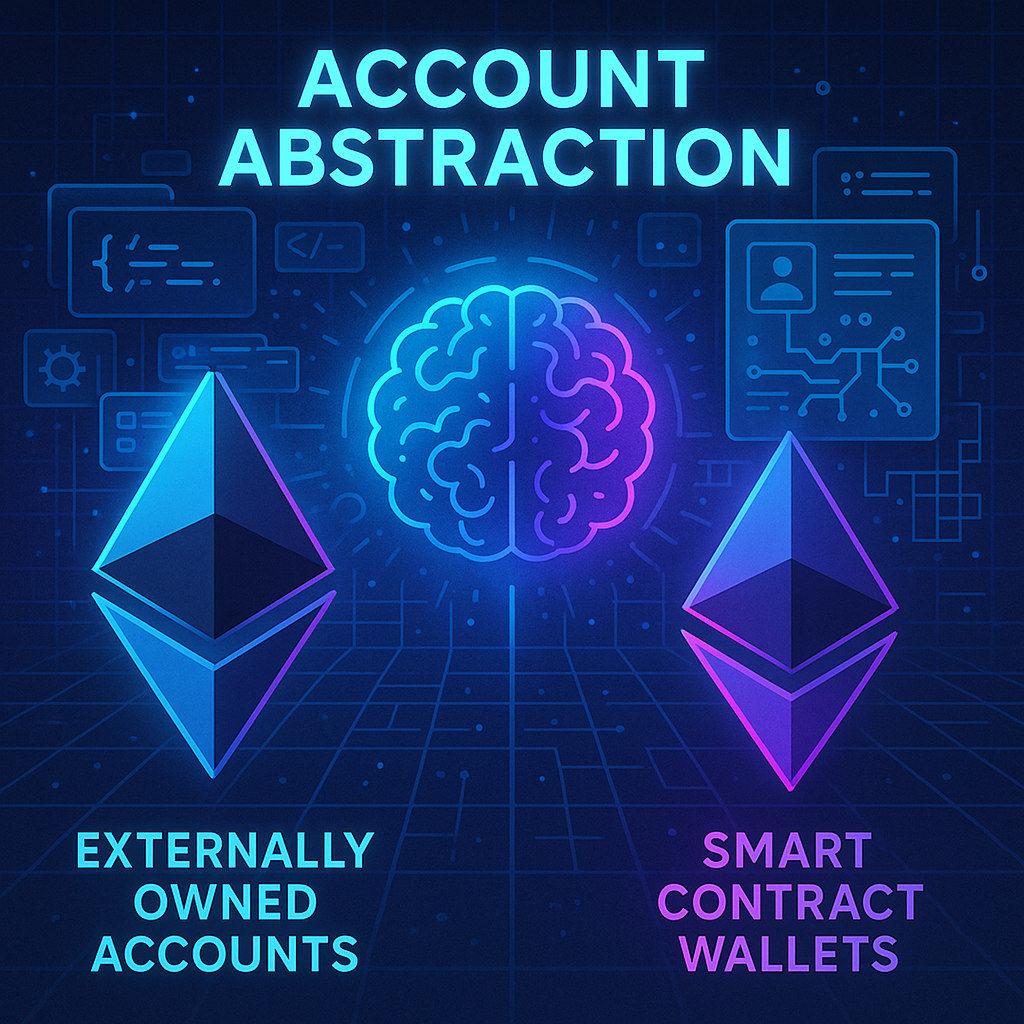
To understand Account Abstraction, you first need to know how Ethereum accounts work today. Ethereum currently has two types of accounts:
- Externally Owned Accounts (EOAs): These are standard user wallets controlled by a private key, such as MetaMask. Only EOAs can initiate transactions on the network.
- Smart Contract Accounts: These are pieces of code deployed on the blockchain. They can store funds and execute logic, but they cannot send transactions on their own — they need an EOA to trigger them first.
This separation creates friction. Users must always hold ETH for gas, manage seed phrases carefully, and manually approve every action. For mainstream adoption, this is a serious barrier.
What Is Account Abstraction and How Does It Change Things?
Account Abstraction (AA) removes the hard boundary between EOAs and smart contract accounts. With AA, users can operate smart contract-based wallets that are fully programmable and customizable — without needing a traditional private-key wallet to initiate every transaction.
A wallet built with Account Abstraction can:
- Automatically approve certain transactions without manual sign-off
- Split payments between multiple parties
- Allow a third party, called a paymaster, to cover gas fees on behalf of the user
- Help users recover access to their wallet if they lose their device
- Support biometric login, PINs, or time-based locks
This makes wallets behave more like modern apps rather than cryptographic tools that only technically skilled users can manage comfortably.
How ERC-4337 Powers Account Abstraction
Account Abstraction on Ethereum is being rolled out through a standard called ERC-4337. The key advantage of ERC-4337 is that it does not require any changes to Ethereum’s core protocol, which means it is already live on the Ethereum mainnet today.
Here is how the system works step by step:
- Instead of sending a regular Ethereum transaction, the user signs a UserOperation — a structured data object that describes what they want to do.
- A special network participant called a Bundler collects these UserOperations and submits them to the blockchain as a single transaction.
- A core smart contract called the EntryPoint receives the bundle, validates each UserOperation, and executes the logic defined in the user’s smart contract wallet.
This architecture keeps the Ethereum base layer unchanged while adding a powerful new layer of flexibility on top.
Key Benefits for Developers Building on Ethereum
Account Abstraction opens up practical possibilities that were previously difficult or impossible to build. Here is what developers gain:
- Custom Wallet Logic: You can build wallets with your own security rules — biometric authentication, spending limits, parental controls, or multi-signature requirements.
- Flexible Gas Payments: Users no longer need to hold ETH just to pay gas. They can pay fees using ERC-20 tokens, or your app can sponsor gas entirely through a paymaster contract.
- Batch Transactions: Multiple actions — such as token approval and swap — can be bundled into a single transaction, removing the need for repeated wallet popups.
- Social Recovery: Developers can build recovery flows that let users regain wallet access through trusted contacts or backup methods, without relying on a seed phrase.
| Feature | Traditional EOA Wallet | AA Smart Contract Wallet |
|---|---|---|
| Gas Payment | Must use ETH | Any token or sponsored |
| Transaction Batching | Not supported | Supported natively |
| Account Recovery | Seed phrase only | Social or custom recovery |
| Custom Security Rules | Not possible | Fully programmable |
Real-World Use Cases and Developer Considerations
The practical applications of Account Abstraction are already taking shape across different sectors. If you are building a blockchain gaming app, smart wallets can handle in-game actions silently in the background, so players never need to approve every move manually. If you are working on a DeFi platform, batching approvals and swaps into one step creates a much cleaner user experience.
For consumer-facing apps, the ability to sponsor gas fees means new users can interact with your app without buying ETH first — a major step toward mainstream usability.
That said, developers should keep a few important points in mind:
- Tooling is still maturing: Not all wallets and libraries fully support ERC-4337 yet. Check compatibility before building.
- Bundler reliability matters: You need to work with trusted Bundler providers or run your own infrastructure.
- Security is critical: Since these wallets run on smart contract code, any bug or vulnerability in your wallet logic can put user funds at risk. Thorough auditing is essential.
Despite these considerations, adoption is growing steadily, and the developer tooling ecosystem around Account Abstraction is improving at a fast pace.
Account Abstraction represents a meaningful step forward for Ethereum’s usability. By giving developers the tools to build smarter, more flexible wallets, it lowers the barrier for new users and makes decentralized apps far more practical for everyday use. If you are building on Ethereum, exploring ERC-4337 now puts you ahead of the curve as the ecosystem continues to mature.
Frequently Asked Questions
Microsoft Cloud is a collection of cloud-based services from Microsoft that includes three main platforms: Microsoft Azure for cloud infrastructure and AI, Microsoft 365 for productivity and collaboration tools, and Dynamics 365 for CRM and ERP business applications.
Yes, Microsoft Cloud is designed for businesses of all sizes. Small businesses can start with Microsoft 365 for email and collaboration tools, and scale up to Azure or Dynamics 365 as their needs grow. The pay-as-you-go pricing model also helps keep costs manageable.
Microsoft Cloud offers enterprise-grade security features including data encryption, multi-factor authentication, and compliance with major global regulatory standards. These features help protect sensitive business data from unauthorized access and cyber threats.