Mid-sized businesses are at a crossroads when it comes to technology. Fully migrating to the cloud can be expensive, while sticking with old on-premise setups can limit growth. Hybrid cloud offers a practical middle ground — combining private infrastructure with public cloud services to give businesses the best of both worlds.
What Is Hybrid Cloud and How Does It Work?
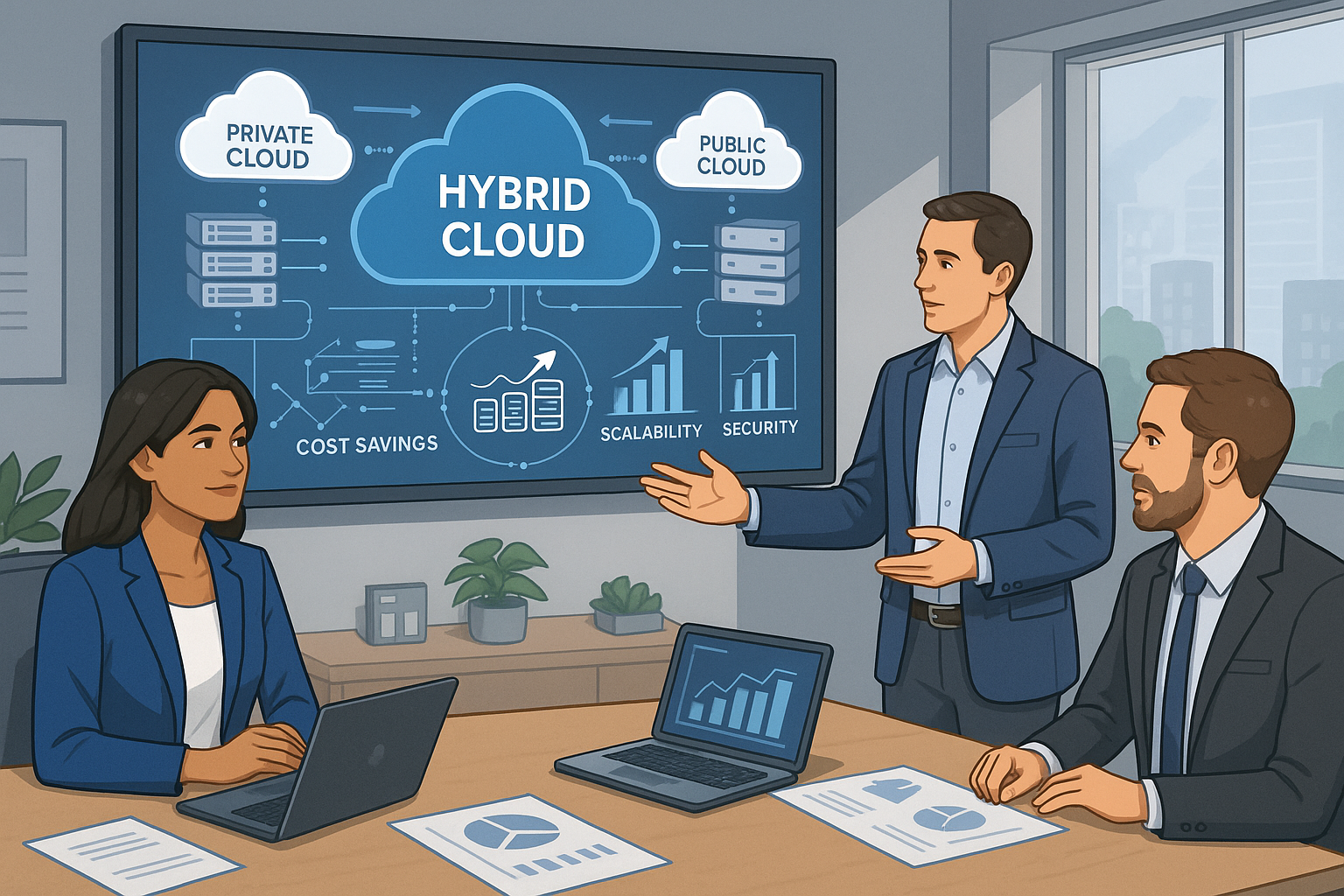
Hybrid cloud is an IT setup that blends two types of computing environments:
- Private infrastructure — your company’s own servers or an on-site data center that you control directly.
- Public cloud services — platforms provided by third-party companies such as Amazon Web Services (AWS), Google Cloud, or Microsoft Azure.
By connecting these two environments, businesses can run certain workloads on-site and shift others to the cloud — depending on cost, performance needs, and data sensitivity. The two systems communicate through secure networks, allowing data and applications to move between them as needed.
Why Mid-Sized Businesses Are Choosing Hybrid Cloud
Mid-sized companies often operate with tighter budgets than large enterprises but face similar technology demands. Hybrid cloud addresses several key challenges at once:
- Flexible resource use: You do not need to move everything to the cloud at once. Keep critical apps on-site and tap into cloud capacity during peak demand periods.
- Lower hardware costs: Instead of buying new servers every few years, businesses can scale up cloud resources on demand and pay only for what they use.
- Faster performance: Core systems that stay on-site run with lower latency, while less time-sensitive tasks are offloaded to the cloud.
- Better data control: Sensitive business data stays within your private systems, while public cloud tools handle collaboration, reporting, and other functions.
This combination helps growing businesses manage costs without sacrificing performance or security.
Real-World Examples of Hybrid Cloud in Action
Hybrid cloud is not just a concept — businesses across industries are already using it effectively:
- Retail brands store customer and sales data on private servers but use the cloud to handle website traffic spikes and run marketing analytics.
- Healthcare clinics keep patient records secured in-house while using cloud platforms to manage appointment scheduling and staff coordination.
- Finance teams protect sensitive spreadsheets and budget data on private systems while relying on cloud-based apps for collaboration and report generation.
This approach lets businesses stay in control of their most critical data while still benefiting from the speed and scale of public cloud platforms.
Is Hybrid Cloud Secure Enough for Business Use?
Security is one of the biggest concerns businesses have when considering any cloud strategy. Hybrid cloud, when managed properly, can offer strong protection. Here is how companies typically secure their hybrid environments:
- Encryption: Data is encrypted both when stored and when transferred between private and public systems.
- Access controls: Only authorised users can access specific systems or data, reducing the risk of internal and external breaches.
- Backups and disaster recovery: Redundant data storage across both environments ensures business continuity if one system fails or is attacked.
Major cloud providers like AWS, Google Cloud, and Microsoft Azure also offer built-in compliance tools that help businesses in regulated industries — such as healthcare, finance, and legal services — meet data protection requirements.
| Feature | Private Cloud | Public Cloud | Hybrid Cloud |
|---|---|---|---|
| Cost | High upfront | Pay-as-you-go | Balanced |
| Data Control | Full control | Limited control | Selective control |
| Scalability | Limited | High | High |
| Security | Very high | Provider-managed | Configurable |
What the Future Holds for Hybrid Cloud
Hybrid cloud adoption is growing rapidly, and the technology itself is becoming more capable. Here is what businesses can expect in the near future:
- Smarter automation tools that automatically decide whether an app or dataset should run on-site or in the cloud based on real-time conditions.
- Edge computing integration that processes data closer to the end user, reducing delays and improving response times for customer-facing applications.
- Dedicated hybrid-ready platforms from major providers like AWS Outposts, Google Anthos, and Microsoft Azure Arc, making setup easier for mid-sized businesses.
These developments mean that hybrid cloud will become even more accessible and affordable for companies that are not yet large enterprises but are growing fast.
For mid-sized businesses looking to grow without overspending on IT, hybrid cloud offers a practical, secure, and scalable path forward. It allows companies to protect what matters most while staying agile enough to compete in a fast-moving market.
Frequently Asked Questions
Hybrid cloud combines a company's own private servers or data center with public cloud services from providers like AWS, Google Cloud, or Microsoft Azure. Unlike a fully public or fully private setup, hybrid cloud lets businesses choose where each workload runs based on cost, security, and performance needs.
Yes. Hybrid cloud is particularly well-suited for mid-sized businesses because it avoids the high upfront cost of building full private infrastructure while also reducing dependence on expensive public cloud plans. Businesses pay for cloud resources only when they need them, keeping IT spending manageable.
Hybrid cloud can be very secure when managed correctly. Businesses use encryption, strict access controls, and disaster recovery systems to protect data. Sensitive information stays on private servers, while less critical tasks use the public cloud. Major providers also offer compliance tools for regulated industries like healthcare and finance.