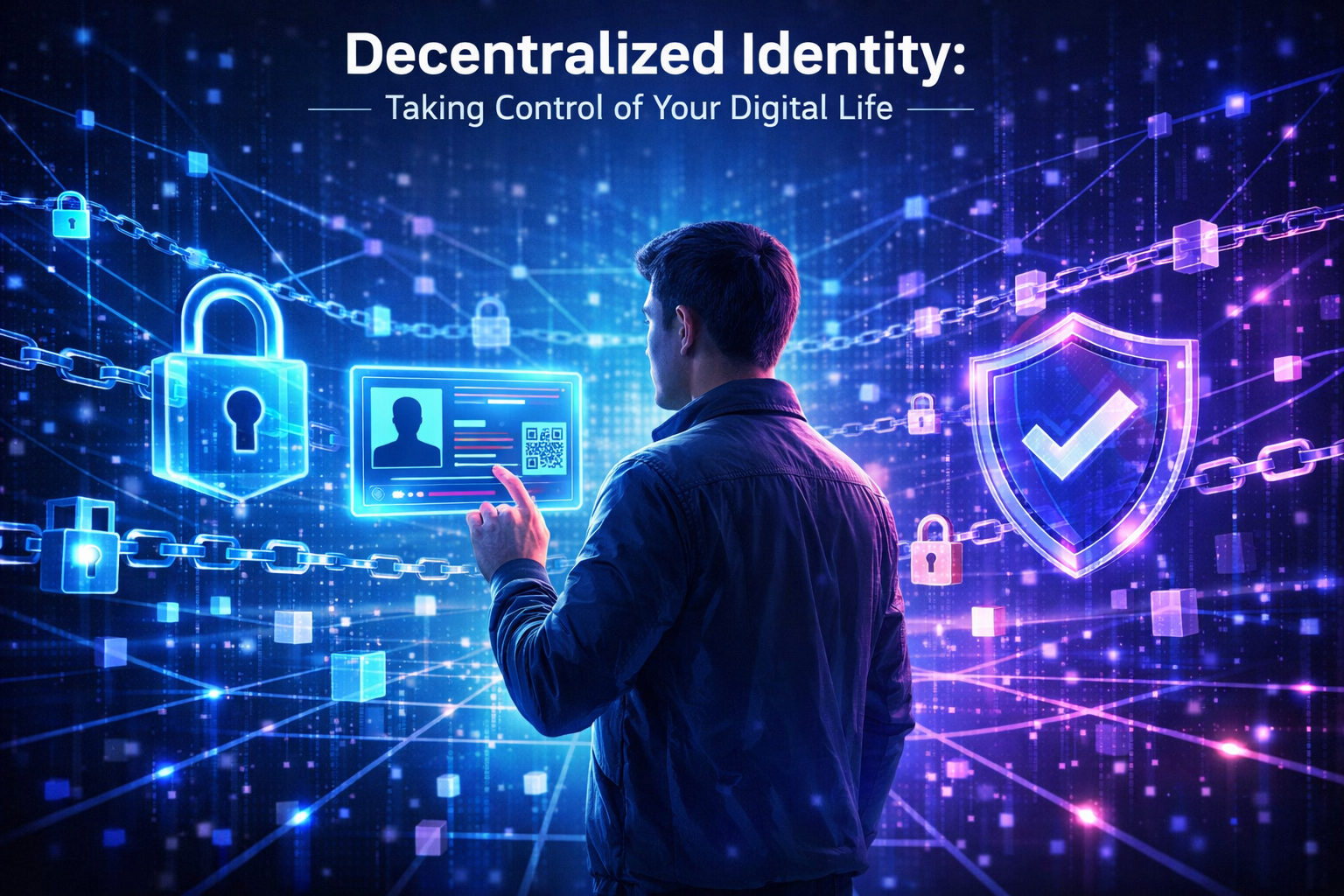
Your digital identity is scattered across dozens of platforms — Google, Facebook, banks, government portals — and none of them are fully under your control. Decentralized Identity, commonly known as DID, is changing that. Built on blockchain technology, DID puts you back in charge of your own data, offering a safer and smarter way to manage who you are online.
What Is Decentralized Identity (DID)?
Decentralized Identity is a new approach to managing your online identity where you own and control your personal data, not a corporation or government server.
Right now, when you sign in using Google or Facebook, your personal information lives on their servers. They decide how it is stored, shared, and used. You have very little say in the matter.
With DID, your identity is stored on a blockchain — a distributed, tamper-resistant digital ledger. No single company holds your data. You carry it in a secure digital wallet, and you decide when and what to share.
How Decentralized Identity Actually Works
The technology behind DID is powerful, but the experience for users is designed to be simple. Here is how it works step by step:
- You receive a unique digital identifier that is recorded on a blockchain.
- Your documents — ID proof, certificates, licenses, health records — are stored in a secure digital wallet on your device.
- When a service asks for verification, you share only the specific information they need, nothing more.
- The receiving party can verify the data instantly without contacting a central authority.
This selective sharing model means your full profile is never exposed unnecessarily, giving you far greater privacy than today’s systems allow.
The Big Problems with Today’s Identity Systems
The current model of digital identity is built on centralized servers, and that creates serious vulnerabilities.
- Data breaches are increasingly common. When a company’s server is hacked, millions of users lose control of their personal information overnight.
- Users are forced to create new accounts repeatedly across different platforms, each storing a copy of your data.
- Companies can misuse or sell your data without meaningful consequences.
- Once your data is leaked, there is no way to take it back.
These are not small inconveniences. They are structural flaws in how the internet handles identity today.
Why Decentralized Identity Is a Stronger Alternative
DID addresses these problems directly. Here is a quick comparison between the traditional identity model and decentralized identity:
| Feature | Traditional Identity | Decentralized Identity (DID) |
|---|---|---|
| Data Control | Held by companies | Held by the user |
| Security | Centralized, hackable | Blockchain-secured, distributed |
| Privacy | Full data shared often | Only required data shared |
| Re-verification | Required on every platform | One identity works everywhere |
| Risk of Data Leak | High | Significantly reduced |
Blockchain technology makes it extremely difficult for hackers to alter or steal identity data. And because there is no central server to attack, the attack surface shrinks dramatically.
Real-World Applications of Decentralized Identity
DID is not just a theoretical concept. It is already finding practical use across several industries:
- Banking and Finance: KYC (Know Your Customer) processes can be completed faster and more securely. Users verify once and reuse their identity across multiple financial institutions.
- Education: Students can carry verified digital certificates in their wallets and share them instantly with employers or universities without needing third-party verification.
- Healthcare: Patient records can be stored securely and accessed only when the patient gives explicit permission, reducing the risk of medical data misuse.
- Travel: Digital identity can speed up airport check-ins and border verification, reducing queues and paperwork.
- Government Services: Citizens can access public services using a single verified digital identity without re-submitting documents repeatedly.
The Road Ahead: DID and the Web3 Future
The internet is gradually shifting toward Web3 — a version of the web where users have more ownership, privacy, and control. Decentralized Identity is a core part of that vision.
In the coming years, the expectation is that passwords may become obsolete. Instead of managing dozens of usernames and passwords across different websites, one secure, blockchain-backed identity could serve as your universal digital passport.
Governments and major companies are already exploring DID frameworks. The World Wide Web Consortium (W3C) has published official DID standards, signaling that this technology is moving from experiment to mainstream infrastructure.
Growing awareness around data privacy, rising cyber threats, and the rapid expansion of blockchain infrastructure are all pushing DID closer to widespread adoption. For Indian users especially, where digital services like Aadhaar have already normalized digital identity, the transition to a more user-controlled model could be both natural and impactful.
Decentralized Identity represents a meaningful shift in how we think about personal data online. As cyber threats grow and privacy concerns mount, DID offers a practical path toward a safer digital life — one where you hold the keys to your own identity.
Frequently Asked Questions
Decentralized Identity (DID) is a system where your digital identity is stored on a blockchain instead of a company's server. This means you own and control your personal data, and you decide what information to share and with whom.
Yes. DID is considered significantly safer than traditional identity systems because blockchain technology makes it very difficult to hack or alter stored data. There is no central server that attackers can target, which reduces the risk of large-scale data breaches.
DID is being explored and used in banking for faster KYC, in education for verified digital certificates, in healthcare for secure patient records, and in travel for smoother airport verification. The W3C has also published official DID standards to support wider adoption.