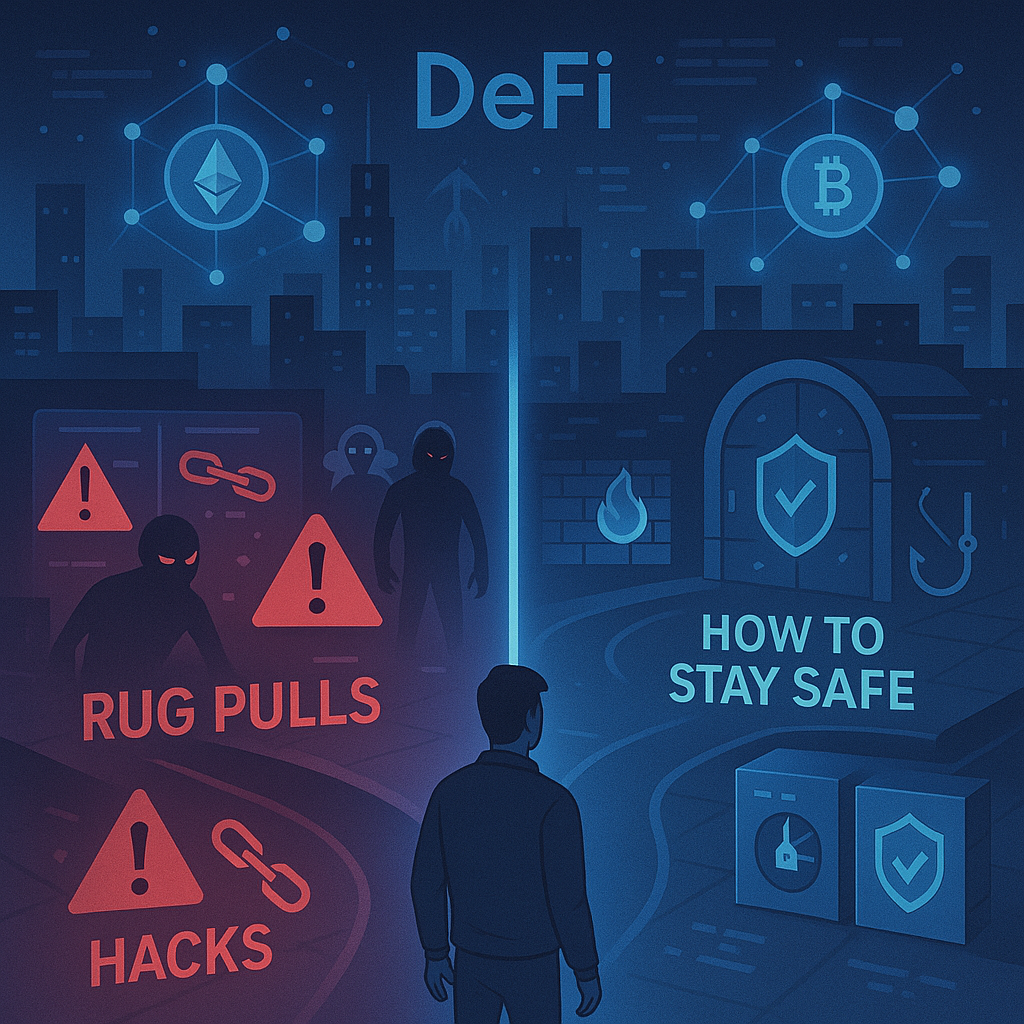
Decentralized Finance, or DeFi, has opened up a new world of financial possibilities — letting people lend, borrow, trade, and earn interest without relying on traditional banks. But with that freedom comes serious risk. From rug pulls to smart contract hacks, DeFi users face threats that can wipe out their investments in seconds. Here is what you need to know to stay safe.
What Is DeFi and Why Does It Carry Risk?
DeFi stands for Decentralized Finance. These platforms run on blockchain technology — most commonly Ethereum — and use smart contracts, which are self-executing pieces of code, to offer financial services without any middlemen.
There are no banks, no customer support lines, and no refund policies. If something goes wrong, users are largely on their own. That is what makes understanding DeFi risks so important before putting any money in.
The Most Common DeFi Risks You Should Know
Rug Pulls: When Developers Vanish With Your Money
A rug pull is one of the most damaging scams in the DeFi space. Developers launch a new token or project, generate hype on social media, attract investors, and then suddenly withdraw all the funds — leaving behind worthless tokens and no accountability.
How to protect yourself from rug pulls:
- Avoid projects with anonymous or unverified development teams.
- Be skeptical of promises about massive, quick returns.
- Only invest in projects with audited smart contracts and a clear long-term roadmap.
Smart Contract Bugs and Hacks
DeFi runs entirely on code. Any flaw in that code can be exploited by hackers to drain funds from a protocol. Once stolen on-chain, those funds are almost impossible to recover.
Tips to reduce your exposure:
- Choose platforms that have completed independent security audits.
- Look for open-source projects with active developer communities.
- Avoid being an early user of brand-new, untested platforms.
Phishing Attacks and Fake Platforms
Not all attacks are technical. Scammers often create fake websites, social media accounts, or messaging groups that look identical to real DeFi platforms. Their goal is to trick users into sharing private keys or wallet credentials — after which they drain the wallet completely.
How to stay safe:
- Never share your wallet’s seed phrase with anyone, ever.
- Always double-check website URLs before connecting your wallet.
- Only use official links from verified and trusted sources.
Flash Loan Exploits
Flash loans are a unique DeFi feature that lets users borrow large amounts of crypto instantly, as long as the loan is repaid within the same transaction. While this is a legitimate tool, attackers have used flash loans to manipulate token prices and drain liquidity pools for profit.
The best defense is to use DeFi platforms that have built-in flash loan protection mechanisms within their smart contracts.
A Quick Comparison: Trusted vs Risky DeFi Platforms
| Feature | Trusted Platforms (e.g. Uniswap, Aave, MakerDAO) | Risky or Unknown Platforms |
|---|---|---|
| Smart Contract Audit | Yes, multiple independent audits | Often none or unverified |
| Team Transparency | Known, public team members | Anonymous or fake identities |
| Community Trust | Large, active user base | Small or artificially inflated |
| Open-Source Code | Publicly available | Closed or copied code |
Practical Steps to Keep Your DeFi Investments Safe
Staying safe in DeFi does not require technical expertise. It mostly comes down to careful habits and informed decisions.
- Research before investing: Read the project whitepaper, check the team’s background, review community feedback, and confirm that the code has been audited by a reputable firm.
- Stick to trusted protocols: Platforms like Uniswap, Aave, and MakerDAO have proven track records and have passed rigorous security reviews.
- Diversify your assets: Never put all your crypto into a single DeFi platform, especially a new or lesser-known one. Spreading investments across multiple trusted platforms reduces the risk of total loss.
- Secure your wallet: Use a hardware wallet for better protection. Enable two-factor authentication (2FA) wherever possible. Avoid clicking unknown links or connecting your wallet to suspicious decentralized apps (dApps).
Why DeFi Security Awareness Matters More Than Ever
The DeFi sector has grown rapidly, attracting billions of dollars in user funds. That growth has also attracted bad actors looking to exploit inexperienced users. Billions of dollars have been lost to DeFi hacks and scams over the past few years, making security awareness one of the most important skills for anyone participating in this space.
Unlike traditional banking, there is no insurance, no regulator to complain to, and no way to reverse a blockchain transaction. The responsibility for safety falls entirely on the user.
In conclusion, DeFi offers genuine financial freedom and opportunity, but it demands a higher level of personal responsibility. By understanding the risks — rug pulls, smart contract vulnerabilities, phishing attacks, and flash loan exploits — and following basic safety practices, users can participate in DeFi with much greater confidence and security.
Frequently Asked Questions
A rug pull is a type of scam where DeFi project developers hype up a new token or platform, attract investor funds, and then suddenly withdraw all the liquidity and disappear — leaving investors with worthless tokens and no way to recover their money.
Look for platforms that have undergone independent smart contract security audits, have a transparent and verifiable team, maintain open-source code, and have a large and active user community. Established platforms like Uniswap, Aave, and MakerDAO are generally considered safer options.
A flash loan exploit occurs when an attacker uses DeFi's instant borrowing feature to borrow large amounts of crypto within a single transaction, manipulate token prices or liquidity pools for profit, and repay the loan — all before the transaction closes. Platforms with built-in flash loan protection mechanisms are better defended against this type of attack.