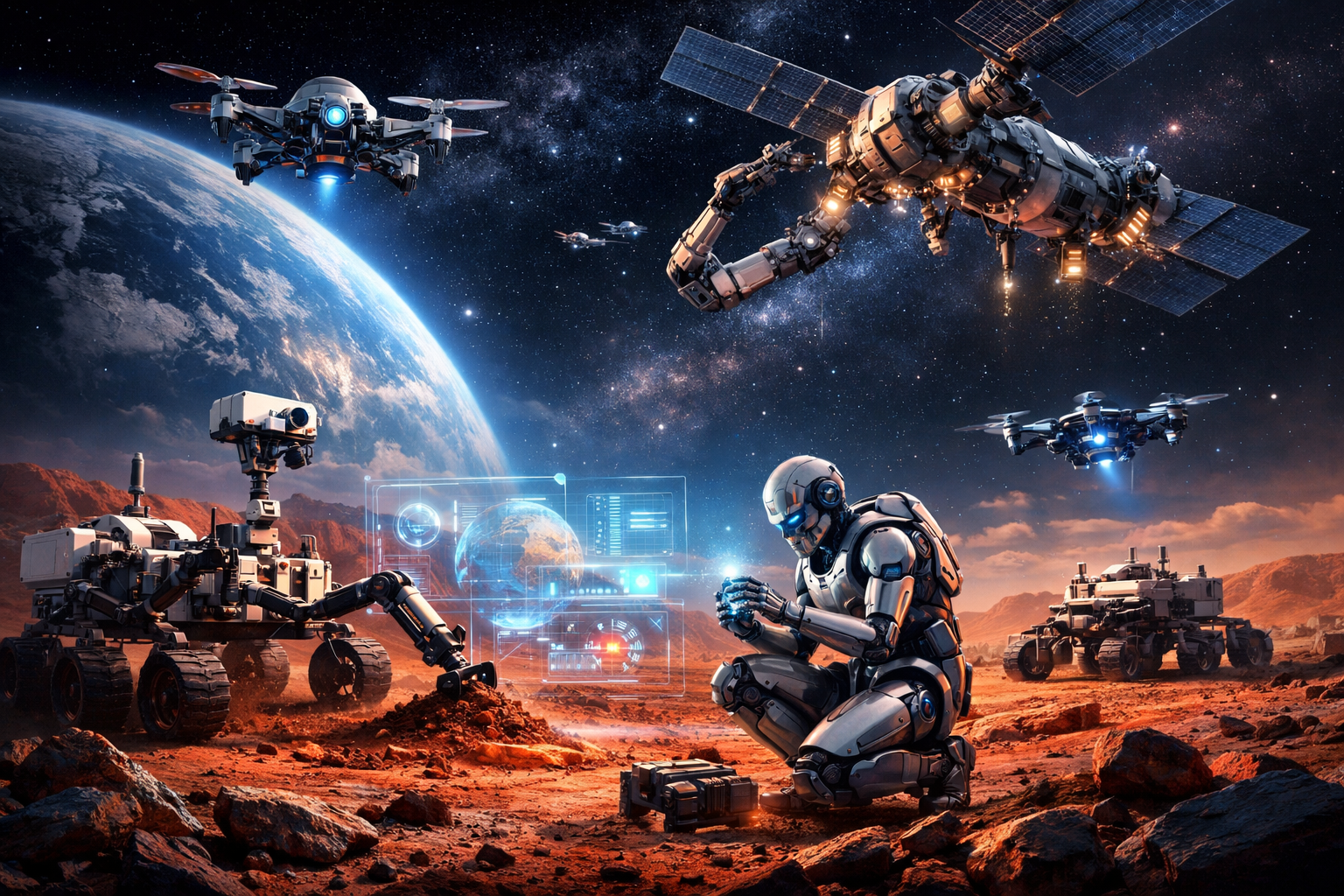
Space exploration has always pushed the limits of human capability. Today, robots and autonomous systems are taking that ambition further — venturing into environments too dangerous, too distant, or too extreme for humans. From roving across Mars to repairing satellites in orbit, space robotics is reshaping how we understand and explore the universe.
What Is Space Robotics?
Space robotics refers to the use of specially designed machines to carry out tasks in outer space. These robots are built to survive conditions that no human could endure for long — zero gravity, intense radiation, extreme temperature swings, and near-total vacuum.
Unlike factory robots or medical devices, space robots must be highly reliable. There is no technician nearby to fix a malfunction. Every component must work correctly, often for years at a time, with minimal maintenance.
These machines help scientists and space agencies study planets, moons, asteroids, and other celestial bodies in ways that would otherwise be impossible or far too costly with human crews.
Understanding Autonomous Systems in Space
One of the biggest challenges in space robotics is communication delay. A signal sent from Earth to Mars can take anywhere from 3 to 22 minutes to arrive, depending on the positions of the two planets. This means a robot on Mars cannot wait for real-time instructions from mission controllers.
This is where autonomous systems become essential. These are machines capable of making their own decisions using onboard sensors, cameras, and artificial intelligence. They can:
- Navigate terrain without step-by-step human guidance
- Detect and avoid obstacles automatically
- Collect and analyse scientific data independently
- Respond to unexpected situations in real time
Autonomy allows space robots to complete complex tasks efficiently, even when communication with Earth is delayed or temporarily lost.
Types of Robots Used in Space Missions
Different missions require different kinds of robots. Here is a look at the main types currently in use or under development:
| Robot Type | Primary Role | Example |
|---|---|---|
| Rovers | Surface exploration and sample collection | NASA’s Perseverance on Mars |
| Robotic Arms | Equipment handling and repairs on space stations | Canadarm2 on the ISS |
| Satellite Servicing Robots | Repairing and refuelling satellites in orbit | Northrop Grumman’s MEV |
| Flying Drones | Aerial exploration of planetary surfaces | NASA’s Ingenuity helicopter on Mars |
| Construction Robots | Building structures on Moon or Mars | Under active development |
Key Technologies Powering Space Robots
Modern space robots rely on a combination of advanced technologies working together. These include:
- Artificial Intelligence: Enables robots to process information, recognise patterns, and make decisions without human input.
- Machine Learning: Allows robots to improve their performance over time by learning from past experiences and data.
- Advanced Sensors and Cameras: Help robots perceive their environment, measure distances, detect hazards, and capture scientific data.
- Radiation-Hardened Electronics: Specially designed components that continue functioning even after prolonged exposure to cosmic radiation.
- Lightweight Materials: Strong yet light materials reduce launch costs while keeping robots durable enough for harsh conditions.
Together, these technologies make space robots more capable, reliable, and adaptable than ever before.
Benefits of Using Robots in Space Exploration
The case for using robots in space is strong. Their advantages over human missions are significant, especially for long-duration or high-risk operations.
- Safety: Robots take on dangerous tasks, reducing the risk to human astronauts.
- Endurance: Unlike humans, robots do not need food, water, sleep, or breathable air. They can work continuously for months or years.
- Cost Efficiency: Robotic missions are generally far less expensive than crewed missions, especially for distant destinations.
- Access: Robots can reach places where humans cannot survive, such as the surface of Venus or the deep craters of the Moon.
- Earth Applications: Technologies developed for space robots often find uses in healthcare, manufacturing, disaster response, and everyday devices.
The Future of Space Robotics
The next decade promises major advances in space robotics. Space agencies including NASA, ESA, ISRO, and private companies like SpaceX and Blue Origin are investing heavily in robotic systems for future missions.
Key areas of development include:
- Robots capable of constructing habitats on the Moon and Mars before human crews arrive
- Fully autonomous deep space probes that can make mission-critical decisions without Earth guidance
- Swarm robotics, where multiple small robots work together to complete large tasks
- In-orbit manufacturing and assembly using robotic systems
As these technologies mature, robots will not just support human space exploration — they will lead it, paving the way for humans to follow safely into deeper space.
Space robotics also carries broader significance for life on Earth. Advances in autonomous systems, sensor technology, and AI developed for space missions continue to drive innovation in industries ranging from surgery and logistics to agriculture and infrastructure. The investment in space robots is, in many ways, an investment in the future of technology itself.
Frequently Asked Questions
Space robotics involves using specially designed machines to perform tasks in outer space. These robots can work in extreme conditions like zero gravity and high radiation where humans cannot easily survive. They make space missions safer, more cost-effective, and allow exploration of distant or hazardous environments.
Autonomous systems in space use artificial intelligence, sensors, and cameras to make decisions without real-time human input. Because communication signals between Earth and distant planets like Mars can take several minutes, robots must be capable of navigating, collecting data, and responding to situations on their own.
Notable examples include NASA's Perseverance rover and Ingenuity helicopter on Mars, the Canadarm2 robotic arm on the International Space Station, and Northrop Grumman's Mission Extension Vehicle (MEV) used for satellite servicing in Earth's orbit.