
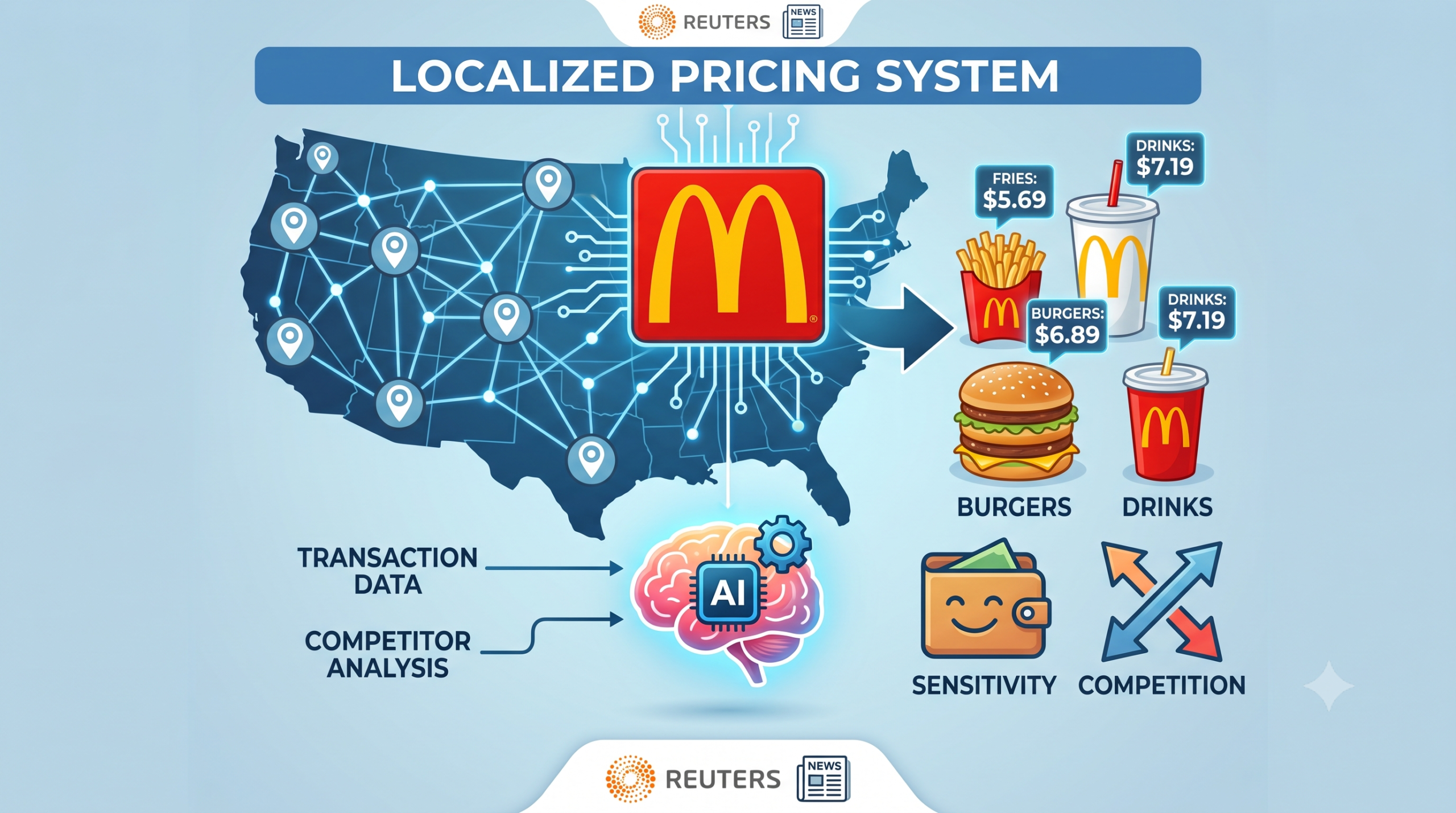
McDonald’s has been using a machine-learning pricing platform to generate recommended menu prices for individual restaurant locations across the United States and in some international markets. A Reuters investigation, which reviewed screenshots of the platform and spoke with nine people who have direct knowledge of the company’s pricing strategy, provides the most detailed account yet of how the fast-food giant applies data-driven technology to pricing decisions across its vast franchise network.
How the Pricing System Works
The system processes data from millions of daily transactions across McDonald’s US restaurants and generates pricing recommendations for each individual location. Unlike generative AI, it relies on machine-learning algorithms that analyse existing transaction and pricing data to produce its outputs. McDonald’s has described the platform as a tool that supports pricing decisions rather than one that automatically sets prices.
Factors the system considers include local competition and estimates of how sensitive customers in a given area are to price changes. The platform also incorporates publicly available menu prices from nearby competing restaurant chains. Crucially, the reporting found no evidence that McDonald’s uses individual customers’ personal data to generate customer-specific prices — a distinction that separates the system from personalised pricing practices currently under regulatory scrutiny in the United States.
To illustrate the degree of variation the system can produce, Reuters found that two company-operated McDonald’s locations approximately two miles apart in Fresno, California, were charging $5.69 and $6.89, respectively, for a Big Mac in September. The report did not establish that the pricing platform directly caused that difference.
History and Development of the Technology
McDonald’s has used some form of AI-assisted pricing technology since at least 2019. Over the years, that capability has developed into a proprietary system that produces location-specific pricing recommendations. Company documents reviewed by Reuters show that recommendations are distributed to franchisees periodically, and McDonald’s has characterised participation as optional.
Franchise Control and Pricing Governance
McDonald’s says franchisees retain full responsibility for determining final menu prices. The company notes that 90% of its US restaurants are independently owned and operated, and that nearly 95% of its global locations are run by franchisees. It also points out that restaurants only a few miles apart can face meaningfully different costs and market conditions, which can legitimately explain price variation.
From January 1, 2026, McDonald’s updated its global franchising standards to place greater emphasis on customer value. Under those standards, franchisees continue to set prices and work directly with third-party pricing advisers, while McDonald’s evaluates the resulting customer value as part of its standard business reviews.
Some franchisees interviewed for the Reuters investigation said they had experienced pressure to follow the pricing recommendations. McDonald’s disputed that characterisation, maintaining that operators remain free to determine their own final prices. The company also monitors differences between recommended and actual prices charged, though it continues to describe the platform as advisory in nature.
Regulatory Landscape Around Algorithmic Pricing
The broader use of algorithmic and data-driven pricing has attracted growing scrutiny from US regulators. The Federal Trade Commission is separately examining personalised pricing — defined as using personal data to set prices based on how much a business believes an individual consumer is willing to spend. In August 2026, the FTC proposed guidance covering such practices, noting that personalised pricing is not automatically unlawful but that companies can face scrutiny if personal data is used in unfair or deceptive ways, including when relevant pricing practices are not disclosed to consumers.
Because McDonald’s system recommends prices at the restaurant level rather than targeting individual customers, it operates differently from the personalised pricing model the FTC has been examining.
Antitrust authorities have also been active in related areas:
- In 2024, the Justice Department and FTC argued in hotel-pricing litigation that businesses cannot avoid antitrust rules simply by routing pricing decisions through software.
- The Justice Department has pursued RealPage over allegations that competing landlords supplied non-public pricing and leasing information to software used to generate rental-price recommendations. Under a proposed settlement announced in 2025, RealPage would face restrictions on using competitors’ non-public, competitively sensitive data when determining prices.
Those cases involve different markets and business models from McDonald’s, and US antitrust authorities have not accused McDonald’s of the conduct alleged in either case.
Antitrust Awareness Built Into the Platform
Screenshots of the McDonald’s pricing platform reviewed by Reuters include an antitrust warning stating that restaurant owners “may be competitors of each other.” McDonald’s said the warning reflects its approach to competition-law compliance and does not indicate anticompetitive conduct. The Reuters investigation also found that McDonald’s has considered potential antitrust issues related to its pricing programme more broadly and has incorporated competition-law warnings directly into the platform provided to franchisees.
The development underscores how major restaurant chains are applying data technology to pricing strategy while navigating a complex and shifting regulatory environment. For McDonald’s, the pricing platform represents one element of a wider effort to align menu prices with local market realities across thousands of individual franchise locations worldwide.
Frequently Asked Questions
No. McDonald's describes the platform as advisory. It generates pricing recommendations for individual restaurant locations, but franchisees retain the final decision on what prices to charge. McDonald's says participation in the recommendations is optional.
According to the Reuters investigation, McDonald's does not use individual customers' personal data to generate customer-specific prices. The system recommends prices at the restaurant level based on factors such as local competition and area-wide price sensitivity, not personal consumer profiles.
McDonald's says that even restaurants a few miles apart can face different operating costs, competitive environments, and local market conditions. The machine-learning system accounts for those local factors when generating its recommendations, which can result in different suggested prices for nearby locations.