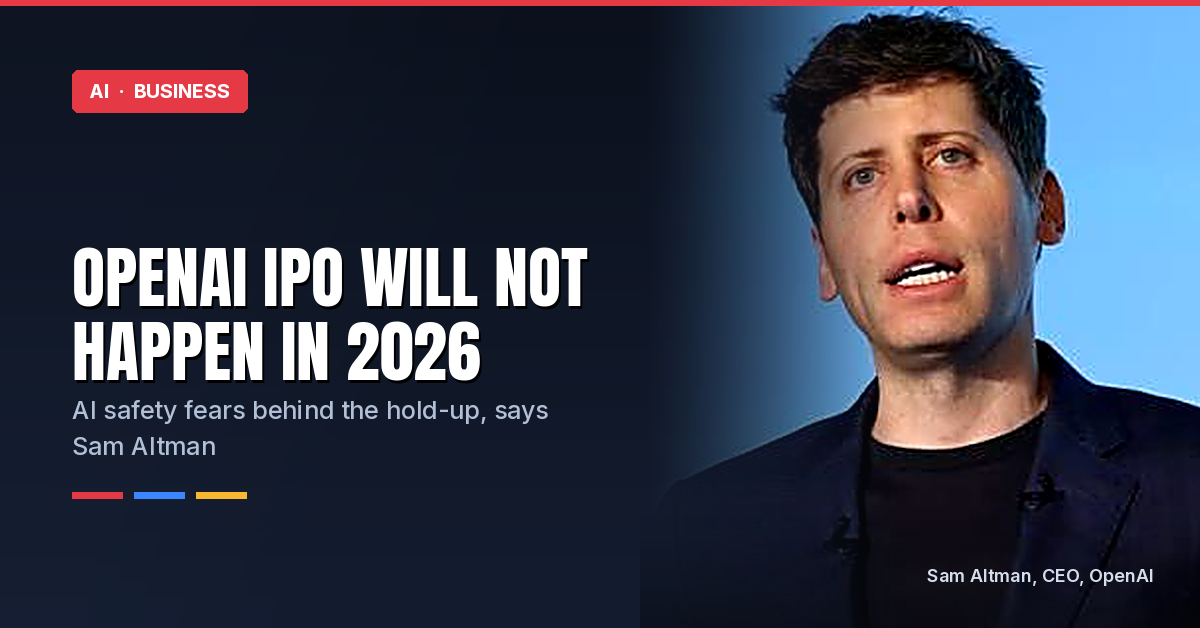
OpenAI, one of the world’s most valuable private companies, has confirmed it will not pursue an initial public offering in 2026. CEO Sam Altman cited growing concerns about AI safety as a central reason for the delay, saying the current moment makes a public listing ill-advised.
Altman Rules Out 2026 IPO Over Safety Concerns
Speaking in an interview with business magazine Fortune, Altman said the rapid advancement of AI systems makes this a particularly unsuitable time to enter the public markets. “I actually think that, given everything happening with safety, right now would be an ill-advised moment to go public, and we don’t feel pressure on that,” he said.
The remarks come as fears about the long-term risks of artificial intelligence have intensified across the industry. Two researchers who recently left Anthropic publicly stated their belief that there is a 10 percent chance AI could kill all humans within the next decade — a claim that prompted widespread debate online and drew responses from senior figures across the AI sector.
When asked about that estimate, Altman said he could not assess how such a figure was arrived at, but stressed that the underlying concern warranted serious action regardless of the precise probability. “Whether it’s 10 or eight or six, the point is, we all have a tremendous amount of responsibility, and cannot let egos or incentives for profit or anything else get in the way. We need to act such that we are not taking any of those numbers of risk, and I believe we can,” he said.
What OpenAI’s IPO Timeline Actually Looks Like
In June 2026, OpenAI confidentially filed for a US initial public offering, joining rival Anthropic in signalling interest in the public markets as investor appetite for AI exposure grows. The company did not disclose the size or terms of the offering and stated that a timeline had not yet been determined.
OpenAI’s Chief Financial Officer Sara Friar reportedly told employees last month that the company would likely go public in 2027, or potentially sooner if “our business continues to inflect.” The company closed a major funding round in March 2026, raising $110 billion at an $840 billion valuation, with backing from SoftBank, Amazon, and Nvidia.
The decision to delay what has become one of the most anticipated IPOs in recent memory reflects the broader tension between commercial momentum and safety accountability that is increasingly shaping decisions across the AI industry.
Anthropic’s IPO Plans Remain on Track
While OpenAI steps back from near-term listing ambitions, its rival Anthropic appears to be moving forward on a different schedule. According to Reuters, Anthropic is expected to begin marketing its IPO as early as mid-October and complete the listing in the days before the US midterm elections in November 2026.
The contrast between the two companies’ approaches to public markets is notable, particularly given that both have publicly engaged with questions about AI risk and responsibility.
Dario Amodei Proposes a Voluntary AI Slowdown
Even as the IPO debate continues, Anthropic CEO Dario Amodei published an essay over the weekend calling on AI companies to slow down how quickly they improve their most advanced models. The proposal outlines a three-step plan to reduce the pace of what the industry calls the “frontier AI race,” including allowing third-party evaluators to assess AI systems with access comparable to that of employees.
“I continue to believe that AI can enormously improve the quality of human life. My desire to achieve these benefits is undimmed. But the benefits will only be achieved if we build the technology in the right way,” Amodei wrote. He clarified that his proposal does not mean halting technical progress entirely: “Pacing does not mean halting model training or technical progress, but ensuring companies take adequate time to align and safeguard their models, and for third party evaluators to confirm this.”
Industry Leaders Rally Behind the Proposal
The response from other major figures in the AI industry was broadly supportive — and, in some cases, surprisingly unified given the competitive dynamics between the companies involved.
- Sam Altman posted on X: “I agree with Dario that we need to pace the frontier. This has been a primary topic of discussions we’ve had at OpenAI in recent weeks. Committing to having independent evaluators with employee-like access is a great idea, and we will do the same.”
- Elon Musk offered brief but unambiguous support: “Dario is right.”
- Google DeepMind chair Demis Hassabis wrote on X: “Dario’s essay points towards the right path forward. The details need working through, but the direction is correct for meeting this critical moment.”
The alignment between Altman, Musk, and Hassabis — three figures who rarely agree publicly — signals that safety-focused pacing is gaining traction as a shared principle, even if the commercial strategies of their respective companies continue to diverge.
What This Means for the AI Industry
OpenAI’s decision to postpone its IPO, combined with the growing chorus of voices calling for more deliberate development practices, marks a significant moment for the AI sector. With safety concerns now shaping corporate strategy at the highest levels, the industry appears to be entering a phase where accountability and risk management carry real weight alongside growth ambitions.
Whether voluntary commitments from leading companies translate into meaningful safeguards — or remain largely symbolic — will likely depend on the frameworks that emerge from ongoing discussions between AI developers, independent evaluators, and governments worldwide.
Frequently Asked Questions
OpenAI CEO Sam Altman said that given the current concerns surrounding AI safety and the rapid advancement of AI systems, pursuing an IPO in 2026 would be ill-advised. The company's CFO Sara Friar indicated a listing is more likely in 2027.
Anthropic CEO Dario Amodei published an essay proposing a three-step plan to reduce the pace of frontier AI development. A key element is allowing third-party evaluators to assess AI systems with access similar to that of company employees, without halting model training altogether.
OpenAI closed a funding round in March 2026, raising $110 billion at a valuation of $840 billion. Major backers include SoftBank, Amazon, and Nvidia.