
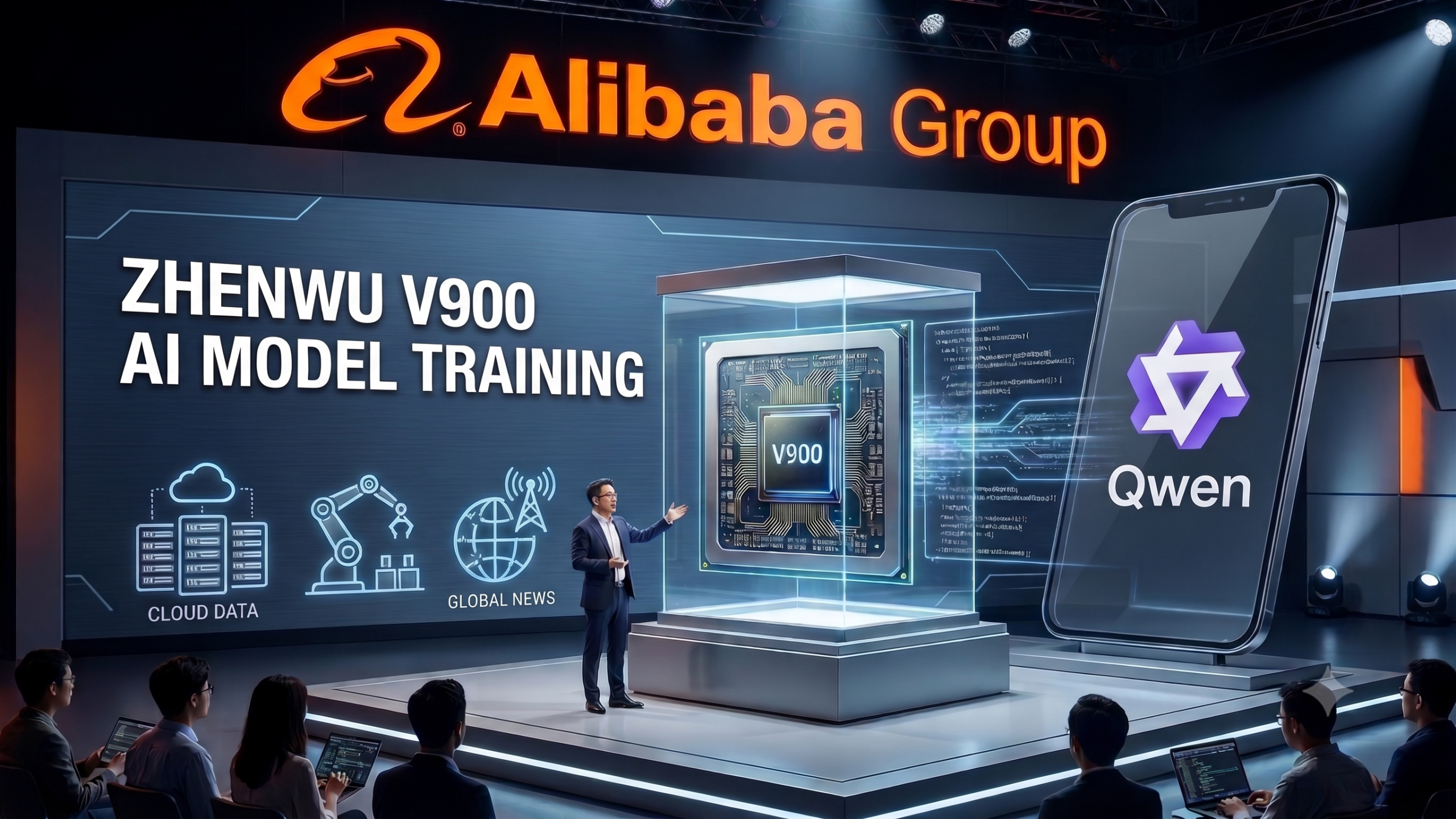
Alibaba Group has unveiled its latest in-house artificial intelligence chip, the Zhenwu V900, and announced plans to use it to train a new large-scale AI model. The announcement marks one of the most significant steps yet by the Chinese technology giant to build its own AI hardware infrastructure and reduce reliance on foreign processors.
What Is the Zhenwu V900?
The Zhenwu V900 is Alibaba’s newest homegrown AI chip, designed for training and running large AI models at scale. Alibaba shared the chip’s existence as part of a broader disclosure of its ambitions in AI infrastructure, positioning the V900 as a key component of its long-term strategy in artificial intelligence.
The chip is developed under Alibaba’s semiconductor arm and is intended for deployment in the company’s own data centers. While Alibaba has not released a full public specification sheet at launch, the V900 is described as a high-performance processor built specifically for AI workloads, including model training at a large scale.
Plans to Train a New AI Model
Alongside the hardware announcement, Alibaba confirmed plans to train a new AI model using the Zhenwu V900 chip. This signals that Alibaba intends to use its own silicon, rather than relying exclusively on third-party processors such as those from Nvidia, to power its next generation of AI development.
Alibaba is already known for its Qwen series of large language models, which the company has released openly and which have attracted significant attention globally. The new model being trained on the Zhenwu V900 is expected to build on that foundation, though Alibaba has not yet disclosed a name or a specific release timeline for the model.
Why This Matters for China’s AI Push
The Zhenwu V900 announcement comes against a backdrop of tightening US export restrictions on advanced semiconductor technology to China. These restrictions have made it increasingly difficult for Chinese companies to access the most advanced chips from companies such as Nvidia and AMD, pushing firms like Alibaba, Huawei, and Baidu to accelerate their own chip development programs.
Alibaba’s move into in-house AI chip production is part of a wider national effort in China to achieve greater self-sufficiency in semiconductor technology. The Chinese government has prioritized chip independence as a strategic goal, and major technology companies have responded by investing heavily in their own silicon research and development.
- Huawei has developed the Ascend series of AI chips for similar training and inference tasks.
- Baidu has its Kunlun chip line for AI acceleration.
- Alibaba’s Zhenwu V900 adds another domestic option to China’s growing AI chip ecosystem.
Alibaba’s Broader AI Strategy
Alibaba has been sharpening its focus on artificial intelligence across multiple fronts. The company has invested heavily in Alibaba Cloud, which serves as its primary platform for delivering AI services to enterprise customers. Its Qwen model family has been positioned as a direct competitor to models from OpenAI, Google, and Meta, particularly in Chinese-language and multilingual tasks.
Developing its own AI chip allows Alibaba to better control performance, cost, and supply chain risk across its AI operations. It also gives the company a platform to optimize hardware and software together, which is a strategy that has proven effective for companies such as Google with its Tensor Processing Units (TPUs) and Apple with its in-house silicon.
Training a new model on the Zhenwu V900 would also serve as a real-world benchmark for the chip’s capabilities, demonstrating to enterprise customers and developers that Alibaba’s own hardware is production-ready at the highest levels of AI workload demand.
What Comes Next
Alibaba has not yet provided a detailed roadmap for the Zhenwu V900’s commercial availability or the timeline for releasing the AI model being trained on it. Industry observers will be watching closely to see how the chip performs against established alternatives in both training speed and energy efficiency — two critical factors for large-scale AI infrastructure.
The announcement is expected to draw attention from governments, researchers, and technology companies monitoring the global AI chip competition, particularly as it demonstrates that Chinese firms continue to make tangible progress in developing advanced AI hardware despite significant external pressure.
As the race to build capable and independent AI infrastructure intensifies, Alibaba’s Zhenwu V900 represents a meaningful step forward in the company’s effort to compete at the frontier of artificial intelligence on its own terms.
Frequently Asked Questions
The Zhenwu V900 is Alibaba Group's latest in-house AI chip, designed for training and running large-scale artificial intelligence models. It is built by Alibaba's semiconductor division and is intended for use in the company's own data centers.
Alibaba is developing its own AI chip partly to reduce dependence on foreign processors amid US export restrictions that limit Chinese companies' access to advanced chips from companies like Nvidia. Building its own silicon also gives Alibaba greater control over performance, cost, and supply chain resilience.
Alibaba has confirmed plans to train a new large-scale AI model using the Zhenwu V900 chip, but has not yet disclosed the model's name or a specific public release timeline. It is expected to build on the company's existing Qwen model series.