Human settlement on Mars has moved from science fiction to serious scientific planning. Engineers, space agencies, and private companies are now working on real systems to build habitats, generate oxygen, grow food, and power entire colonies on the Red Planet. Here is a close look at how space engineering is tackling each of these challenges.
Why Mars Is the Most Viable Target for Human Settlement
Among all the planets in our solar system, Mars comes closest to Earth in terms of livability potential. Its day lasts 24.6 hours, nearly identical to ours. It has polar ice caps containing frozen water, possible underground water reserves, and a solid surface suitable for both humans and machines.
However, Mars also presents serious obstacles that engineers must solve before any human can survive there:
- The atmosphere is extremely thin and made mostly of carbon dioxide
- Surface temperatures can drop below -100°C
- Without a magnetic field, Mars receives high levels of harmful radiation
- Dust storms can last for months and cover the entire planet
Space engineering addresses each of these problems with purpose-built systems and structures.
Designing and Building Habitats on Mars
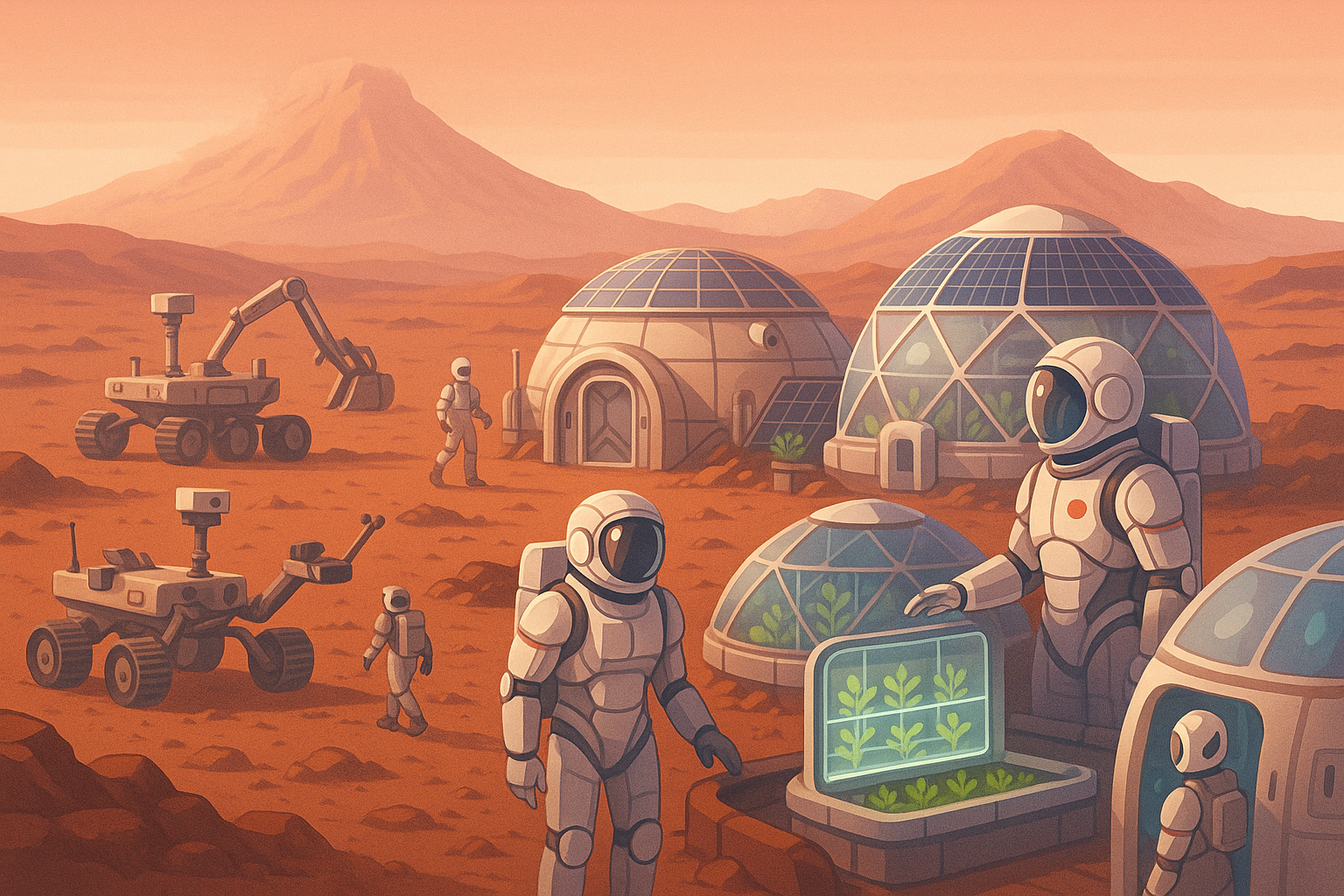
Any Mars habitat must protect its occupants from radiation, extreme cold, and violent dust storms. Engineers are currently exploring three main approaches:
- 3D-Printed Structures: Robots can use Martian soil, known as regolith, to 3D-print building structures directly on the surface. This removes the need to transport heavy construction materials from Earth, cutting mission costs significantly.
- Inflatable Modules: Lightweight, expandable living units can be packed compactly inside a spacecraft and inflated after landing. These modules are already being tested for use on the International Space Station.
- Underground Bunkers: Building habitats below the Martian surface offers natural shielding from radiation and temperature swings. Lava tubes discovered on Mars could serve as ready-made underground shelters.
| Habitat Type | Key Advantage | Main Challenge |
|---|---|---|
| 3D-Printed Structures | Uses local Martian soil | Requires advanced robotics |
| Inflatable Modules | Lightweight and compact for transport | Vulnerable to punctures |
| Underground Bunkers | Natural radiation shielding | Complex excavation needed |
Life Support Systems: Air, Water, and Food on Mars
Surviving on Mars means producing and recycling the three basics of life entirely within a closed system.
Oxygen Generation: NASA’s MOXIE experiment, carried aboard the Perseverance rover, successfully demonstrated that it is possible to convert Martian carbon dioxide into breathable oxygen. Future missions aim to scale this technology to support entire crews.
Water Supply: Engineers plan to extract water from ice deposits beneath the Martian surface. Wastewater recycling systems, similar to those already operating on the ISS, will also be essential to conserve every drop.
Food Production: Mars missions will rely on hydroponic farms inside habitats, where crops are grown without soil using LED lighting and recycled water. Research on Earth is already identifying which crops grow best in low-gravity, controlled environments.
Powering a Mars Colony: Solar and Nuclear Energy
Mars has no power grid, so every watt of energy must be generated on-site. Two main sources are being developed:
- Solar Power: Solar panels can generate electricity across much of the Martian surface. The main drawback is dust accumulation, which reduces efficiency and requires regular cleaning by robots.
- Nuclear Power: NASA and other agencies are developing compact nuclear reactors that can deliver consistent energy regardless of weather or dust storms. Nuclear power is widely seen as the most reliable long-term energy source for a permanent Mars base.
Transportation, Automation, and the Road Ahead
Getting to Mars is itself a massive engineering challenge. SpaceX is developing reusable rockets designed to carry both astronauts and large cargo payloads to Mars. Once on the surface, the mission will depend on:
- Rovers and drones to move materials and conduct exploration
- Advanced landing systems capable of operating in Mars’ thin atmosphere
- Return vehicles to bring crew members safely back to Earth
Communication delays between Mars and Earth can stretch up to 24 minutes each way, which means on-site systems must operate largely on their own. Autonomous systems will manage habitat conditions, monitor oxygen and water levels, guide drones, and respond to emergencies without waiting for instructions from Earth.
Looking at the next two decades, the roadmap for Mars colonization includes the first long-term human outpost, robotic construction crews that prepare habitats before astronauts arrive, and international cooperation on interplanetary missions. Scientists also hope that sustained human presence on Mars will finally answer whether life ever existed there.
Space engineering is not just about reaching Mars — it is about making it possible for humans to stay, work, and eventually thrive on another world. Each solved problem brings that goal one step closer to reality.
Frequently Asked Questions
Engineers are exploring three main types of Mars habitats: 3D-printed structures made from Martian soil, lightweight inflatable modules that expand after landing, and underground bunkers that provide natural protection from radiation and extreme temperatures.
NASA's MOXIE experiment has already demonstrated that carbon dioxide in Mars' atmosphere can be converted into breathable oxygen. Water will be extracted from underground ice deposits and recycled using closed-loop systems similar to those on the International Space Station.
Two primary energy sources are being developed for Mars colonies: solar panels for locations with adequate sunlight, and compact nuclear reactors that can supply steady power regardless of dust storms or weather conditions. Nuclear power is considered the most reliable long-term option.