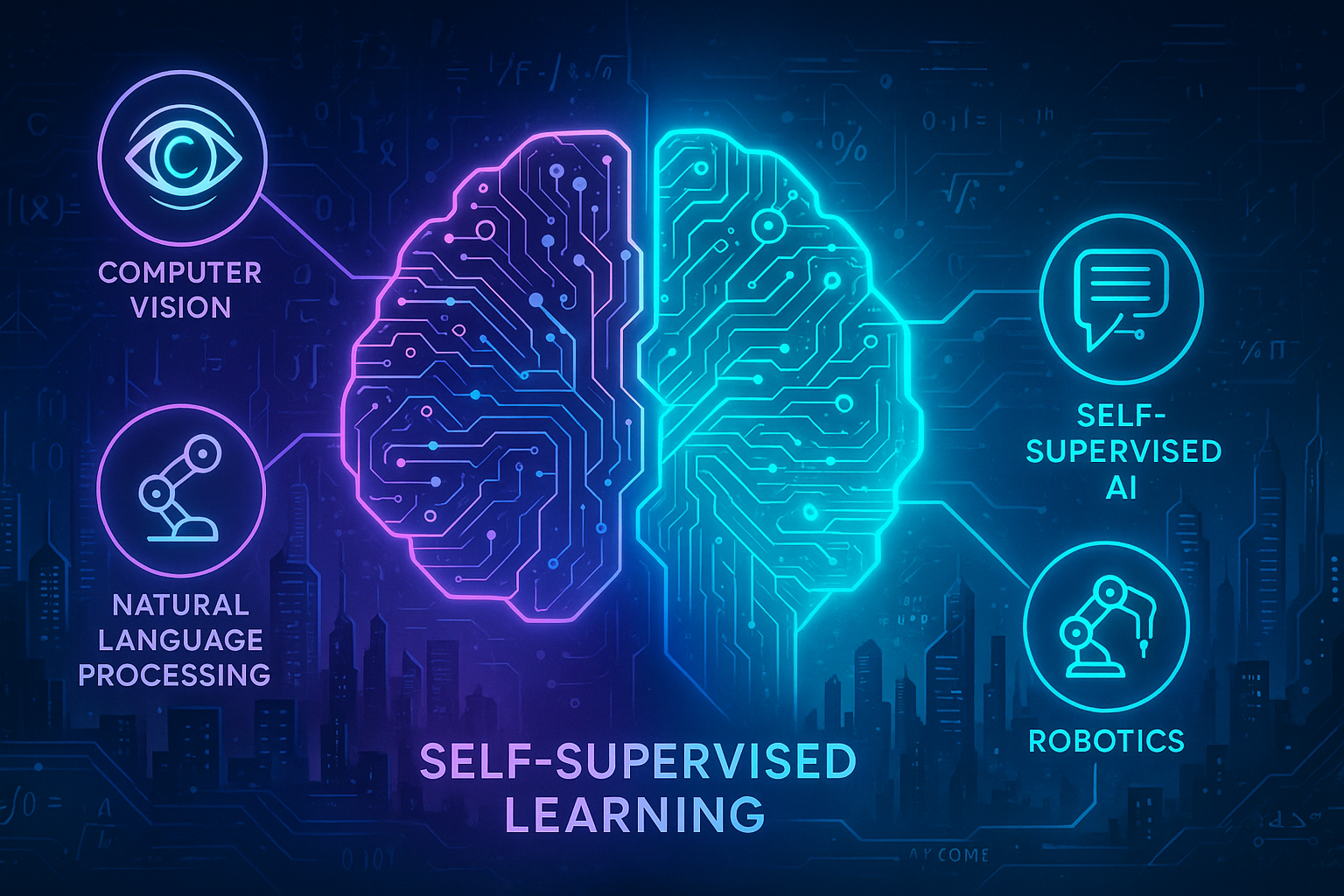
Artificial Intelligence has taken a significant leap forward in recent years, and much of that progress traces back to smarter training methods. One approach that has gained serious attention is Self-Supervised Learning (SSL) — a technique that allows machines to learn from raw, unlabeled data, much the way humans pick up knowledge through experience and observation.
What Is Self-Supervised Learning?
Self-Supervised Learning is a machine learning approach where a model learns patterns and structures from data on its own — without needing human-labeled examples to guide it.
Think of it like a child learning to recognize objects by seeing them in different situations, not by being told what each one is. In SSL, the model is given small, auto-generated challenges called pretext tasks that are built directly from the data itself.
Some common examples of pretext tasks include:
- Predicting the next word in a sentence when only the first half is given
- Filling in missing parts of an image
- Matching audio to the correct segment of a video clip
By solving these mini-challenges repeatedly, the model builds a deep understanding of language, images, or sound — all without any manual tagging.
Why Traditional AI Training Had Limitations
For years, supervised learning was the dominant approach in AI. It works well, but it comes with real-world constraints that slow things down:
- Time-consuming: Human experts must label thousands or millions of data points manually
- Expensive: Large-scale data labeling requires significant investment
- Limited scope: Labeled datasets can never cover every possible scenario
In specialized fields like medicine, audio processing, and video analysis, labeled data is especially hard to collect. A radiologist cannot label every X-ray, and audio engineers cannot tag every accent or noise variation. Self-supervised learning addresses this gap by enabling models to extract useful knowledge from any available data — labeled or not.
How Self-Supervised Learning Works: A Step-by-Step View
The SSL process follows a clear three-step structure:
- Step 1 — Build a Pretext Task: The system creates a problem using the data itself. For example, it removes a word from a sentence and asks the model to predict what belongs there.
- Step 2 — Train the Model: The model works through thousands of these tasks, learning deep patterns — sentence structure, visual features, sound characteristics — along the way.
- Step 3 — Fine-Tune for a Real Task: Once the model has built up general knowledge, it is adapted for a specific application such as language translation, image recognition, or voice command processing.
This approach means the heavy lifting of learning happens without labeled data, and only a small amount of labeled data is needed at the fine-tuning stage.
Real-World Applications of Self-Supervised Learning
SSL is already powering some of the most widely used AI tools and technologies today. Here is a look at where it is making a real difference:
| Domain | SSL Application | Examples |
|---|---|---|
| Language | Learning from billions of sentences without labels | ChatGPT, BERT, GPT-4 |
| Vision | Pattern recognition in images and videos | SimCLR, DINO |
| Healthcare | Analyzing X-rays and medical reports | Medical imaging AI tools |
| Speech and Audio | Understanding speech across accents and noise | Voice assistants, transcription tools |
Tools like ChatGPT, BERT, and GPT-4 are built on SSL principles — trained on massive text datasets without human-labeled supervision. In computer vision, techniques like SimCLR and DINO use SSL to identify visual patterns that power everything from image search to robotics.
Key Benefits and the Road Ahead for SSL
Self-supervised learning brings several practical advantages that make it attractive for both researchers and businesses:
- Reduced dependence on labeled data — models can train on vast amounts of raw content
- Better generalization — models trained with SSL tend to perform well across multiple tasks
- More flexible deployment — one base model can be fine-tuned for many different uses
- Lower costs and faster development — less manual effort means quicker time to production
SSL sits at the core of what researchers call foundation models — large, adaptable models that can be customized for a wide range of tasks. Looking ahead, SSL is expected to play a growing role in robotics, climate modeling, self-driving vehicles, and creative tools. As models become capable of handling text, images, and sound together — known as multimodal learning — SSL will be the engine driving that capability.
The shift toward self-supervised learning reflects a broader move in AI development: building systems that learn more naturally, require fewer human resources, and scale more effectively across industries and use cases.
Frequently Asked Questions
Supervised learning requires large datasets where each data point is manually labeled by humans. Self-supervised learning, on the other hand, generates its own labels from the raw data using pretext tasks, removing the need for human annotation.
Several well-known AI tools are built on self-supervised learning, including ChatGPT, BERT, and GPT-4 for language tasks, and SimCLR and DINO for image and video understanding.
In healthcare, collecting labeled data is difficult because it requires expert input from doctors and specialists. Self-supervised learning allows AI models to analyze X-rays, medical scans, and clinical reports without needing every case to be manually labeled, making AI tools more practical and scalable in medical settings.