Space exploration has always pushed the limits of human ambition. Today, robots are doing much of the heavy lifting — literally and scientifically. From rolling across the Martian surface to orbiting distant moons, robotic systems are making space missions safer, cheaper, and more productive than ever before.
Robots on Other Worlds: Rovers Leading the Way
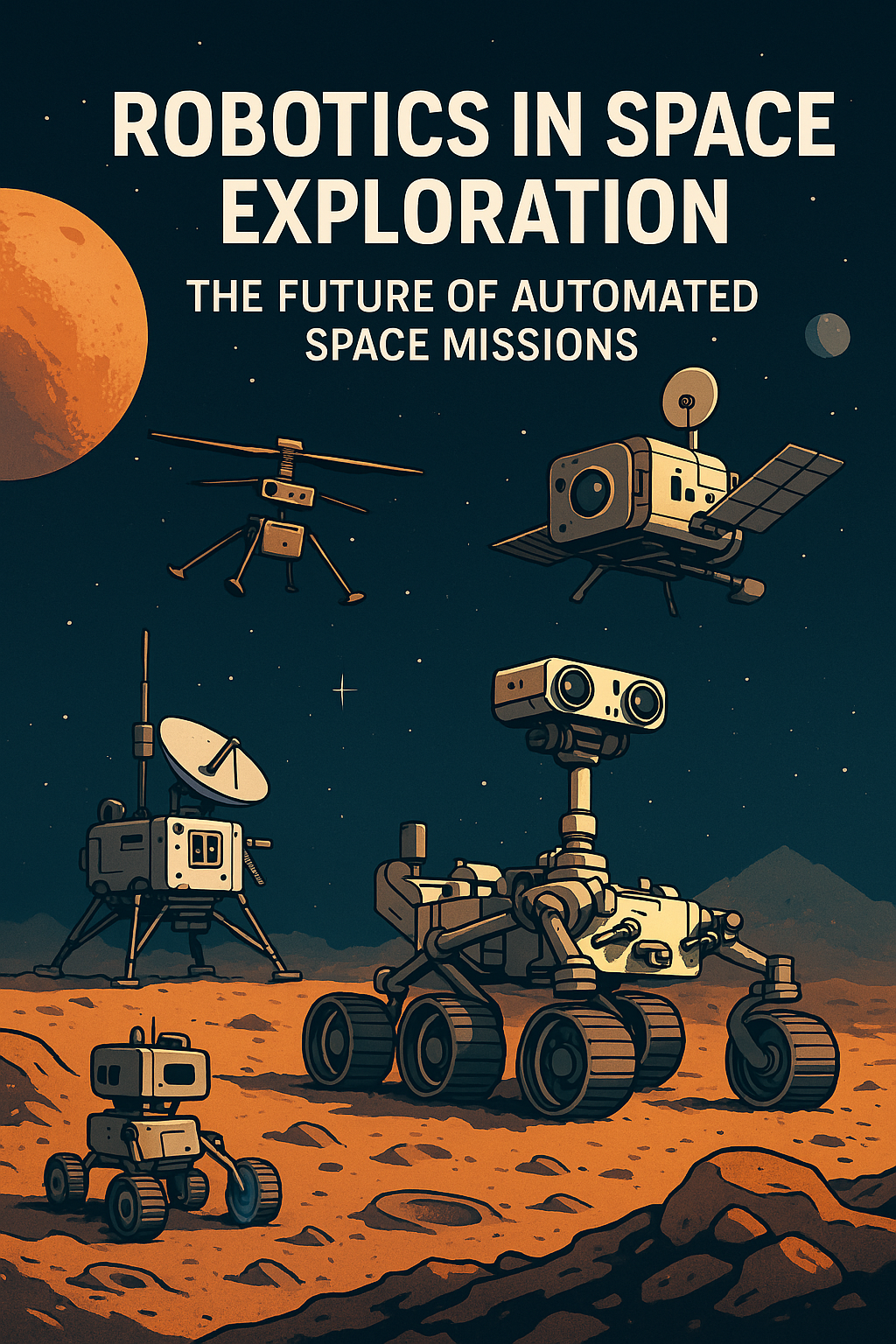
NASA’s Mars rovers, Curiosity and Perseverance, are among the most successful robotic explorers in history. These machines navigate rocky terrain, capture high-resolution images, drill into soil, and transmit scientific data back to Earth — all without a human on board.
Human missions to Mars remain years away due to the extreme risks and costs involved. Robotic missions fill that gap by collecting valuable data that helps scientists plan future crewed expeditions. They are not just placeholders — they are active contributors to our understanding of the solar system.
Autonomous Spacecraft: Operating Far From Human Control
Some of the most impressive robotic achievements in space involve spacecraft that operate almost entirely on their own. Voyager 1 and Voyager 2, launched in the 1970s, continue to transmit data from beyond our solar system — decades after their launch.
As artificial intelligence improves, future spacecraft will be capable of making navigation decisions, identifying scientific targets, and adjusting mission plans without waiting for instructions from Earth. This is critical for deep-space missions where communication delays can stretch to hours or even days.
AI-Powered Rovers and Drones Expanding Exploration
AI-driven robots are taking planetary science to new heights — quite literally. NASA’s Ingenuity helicopter made history by completing multiple powered flights on Mars, proving that aerial exploration is possible on another planet.
These robotic tools allow scientists to study areas that rovers cannot easily reach, such as steep cliffs, deep craters, or icy surfaces. The combination of ground-based rovers and aerial drones creates a much more complete picture of planetary environments.
Key advantages of AI-powered space robots include:
- Surviving Extreme Conditions: Robots do not need oxygen, food, or shelter, making them ideal for harsh environments like Mars or the vacuum of space.
- Enhanced Safety: Robots handle dangerous tasks, reducing risks for human astronauts during spacewalks and repairs.
- Cost-Effective Exploration: Automated missions cost significantly less than crewed spaceflight.
- Adaptive Intelligence: AI-powered robots can respond to unexpected situations in real time.
Space Mining and Robotic Maintenance: Practical Applications
Robotics in space is not limited to exploration. Engineers are developing robotic miners capable of extracting water, metals, and minerals from asteroids and moons. These resources could serve as fuel or construction materials for future deep-space missions, reducing the need to carry everything from Earth.
On the maintenance side, robots are already helping keep satellites and space stations operational. NASA’s Robonaut 2 (R2), deployed on the International Space Station (ISS), was designed to assist astronauts with routine tasks and reduce the frequency of risky spacewalks.
| Robot / Spacecraft | Mission | Key Achievement |
|---|---|---|
| Curiosity Rover | Mars Exploration | Confirmed ancient water on Mars |
| Perseverance Rover | Mars Sample Collection | Collecting samples for future return to Earth |
| Ingenuity Helicopter | Mars Aerial Exploration | First powered flight on another planet |
| Voyager 1 and 2 | Interstellar Space | Transmitting data from beyond the solar system |
| Robonaut 2 (R2) | ISS Maintenance | Assisting astronauts with station tasks |
What Lies Ahead: Icy Moons, Colonies, and Self-Running Missions
Mars is just the beginning. Space agencies are planning robotic missions to the frozen moons of Jupiter and Saturn — particularly Europa and Titan. Scientists believe these moons may harbour liquid oceans beneath their icy surfaces, making them strong candidates in the search for extraterrestrial life.
Robots equipped with advanced sensors and drilling tools could bore through layers of ice and analyse what lies beneath — a task far too dangerous and complex for human explorers at this stage.
Looking further ahead, robots are expected to play a central role in building habitats, gathering local resources, and preparing planetary surfaces before humans arrive. As robotics and AI continue to advance, fully autonomous space missions — ones that plan, execute, and adapt entirely on their own — are becoming a realistic possibility.
Robotics in space is not a luxury or a novelty. It is a practical necessity that is already delivering results and will only grow more important as humanity reaches deeper into the cosmos.
Frequently Asked Questions
Robots do not require oxygen, food, or protection from radiation, making them far better suited for the harsh conditions of space. They are also significantly cheaper to send on missions and can operate in environments that would be fatal to humans, such as the surface of Mars or the vacuum of deep space.
Artificial intelligence allows space robots to make decisions independently, navigate terrain, identify scientific targets, and respond to unexpected situations without waiting for instructions from Earth. This is especially important for deep-space missions where communication delays can be several hours long.
Space mining involves extracting valuable resources such as water, metals, and minerals from asteroids and moons. Robots are being developed to carry out this work because they can withstand extreme temperatures and conditions. These resources could be used as fuel or building materials for future long-duration space missions.