
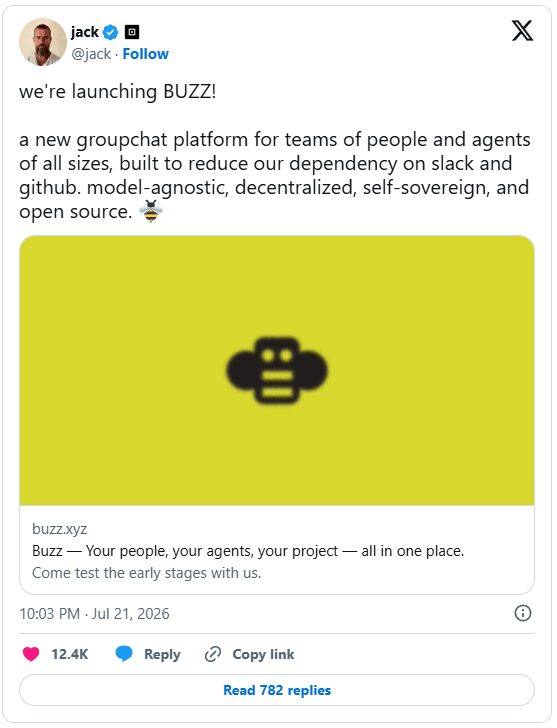
Block, led by Jack Dorsey, has launched Buzz, a new open-source app that merges human teams and AI agents into one collaborative workspace.
Block, the company led by Twitter co-founder Jack Dorsey, has introduced a new workplace collaboration app called Buzz. Designed to bring together human employees and AI agents on a single platform, Buzz enters a market long dominated by tools like Slack and GitHub.
What Is Buzz and Why Was It Built?
Buzz functions as a group chat platform built for both people and AI agents working side by side. Dorsey announced the app in a post on X, positioning it as a way to reduce enterprise reliance on existing communication tools.
The launch arrives as more startups and large companies lean on AI agents to automate everyday tasks. Many teams currently juggle multiple platforms to manage different AI workflows, which can create friction and reduce productivity.
Key Features of the Buzz App
Buzz combines several communication and workflow tools into one workspace. Reported features include:
- Threaded conversations for organized discussions
- Direct messaging between users
- Voice communication capabilities
- Integrated code repositories
- Support for automated, agent-driven workflows
The platform’s branding echoes Dorsey’s history with Twitter, with a bee and hive-themed visual identity on its website.
Built to Be Open, Flexible, and Model-Agnostic
Buzz has been designed as a model-agnostic, decentralised, self-sovereign, and open-source platform. This means it is not tied to any single AI provider, giving developers flexibility in choosing which AI models to integrate.
Because the code is open-source, developers can:
- Customize their own instance of the app
- Build new features tailored to their workflows
- Deploy changes independently using full access to the source code
Current Availability and Development Stage
Block has confirmed that Buzz is still in its early stages of development. The source code has been released under an open-source license and is available on GitHub. A free desktop version of the app currently supports macOS, Windows, and Linux.
Competing With Slack and the AI Agent Ecosystem
Buzz will need to compete not only with Salesforce-owned Slack but also with a growing number of AI agent collaboration platforms that emerged following the rapid rise of OpenClaw, an open-source AI agent framework. Whether enterprises are willing to migrate from established tools remains uncertain.
Block’s Broader Business Context
Beyond Buzz, Block operates a portfolio of consumer and business apps, including Square, Cash App, Afterpay, and Tidal. Notably, in February 2026, Dorsey announced plans to significantly restructure Block’s workforce as the company shifts toward a more AI-driven operating model.
According to Dorsey, Block planned to reduce its headcount from over 10,000 employees to just under 6,000, meaning more than 4,000 employees would either leave the company or enter consultation processes.
What This Means Going Forward
Buzz reflects a broader shift in how companies are rethinking workplace tools in the AI era. As agentic AI systems become more common in daily operations, platforms that can unify human and machine collaboration may become increasingly valuable. Its open-source approach could appeal to developers who want more control over customization, though widespread enterprise adoption will depend on how well it performs against established players like Slack.
Frequently Asked Questions
Buzz is a new workplace collaboration app created by Block, the company led by Twitter co-founder Jack Dorsey. It is designed to bring human employees and AI agents together on one platform.
Yes, Buzz's free desktop app is currently available for macOS, Windows, and Linux, though Block has stated the platform is still in its early stages of development.
Unlike Slack, Buzz is open-source, model-agnostic, and built specifically to integrate AI agents alongside human users, allowing developers to customize and deploy their own versions of the platform.