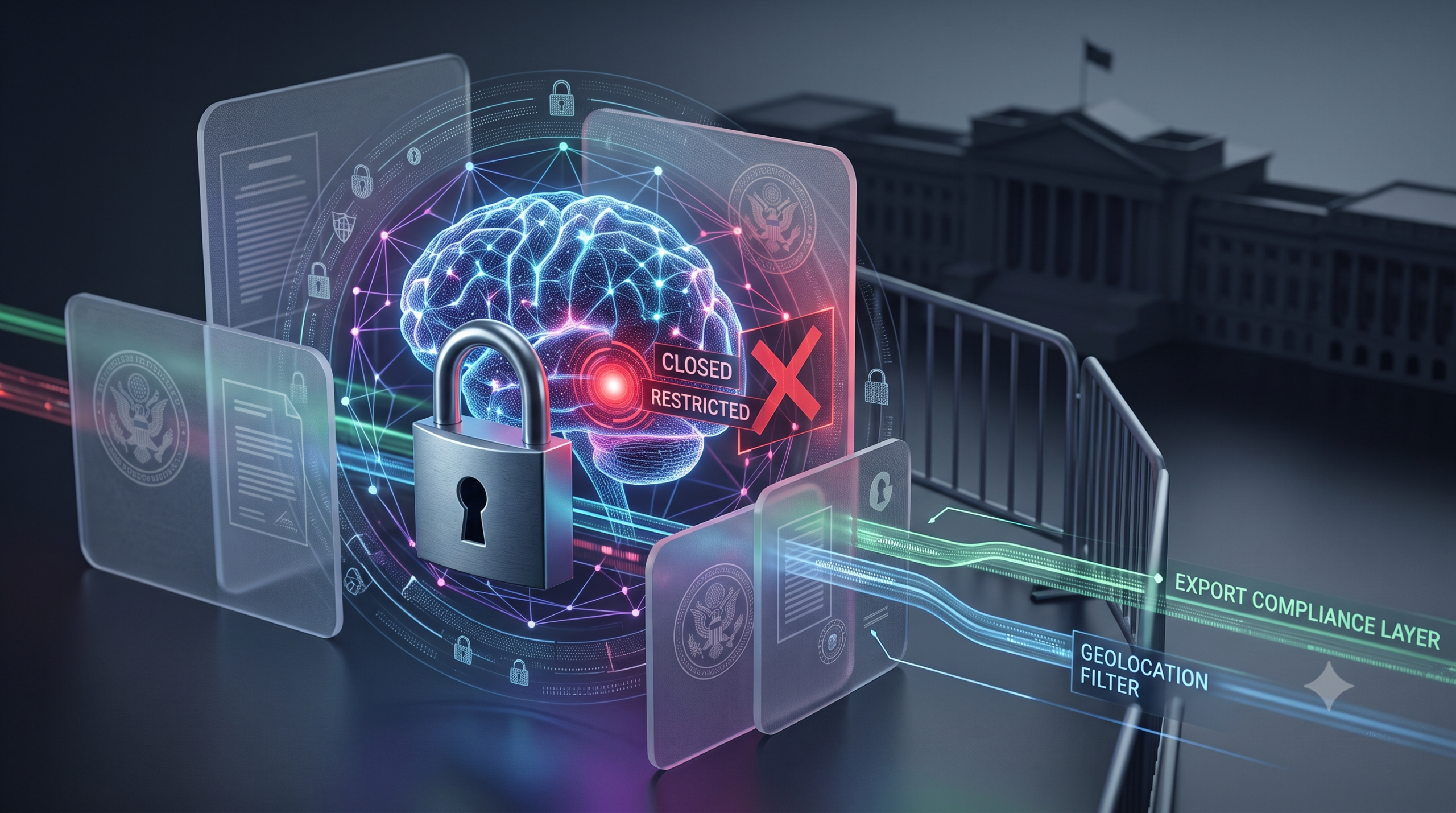
US export controls forced Anthropic to pull its Fable 5 and Mythos 5 models offline, disrupting enterprises and raising hard questions about AI regulation and cybersecurity.
The United States government’s decision to impose export controls on Anthropic’s newest artificial intelligence models has become one of the most significant regulatory actions ever taken against a commercial AI product. On June 12, the US Commerce Department directed Anthropic to restrict access to its Fable 5 and Mythos 5 models for foreign nationals, both inside and outside the United States. Because the company could not reliably verify user nationality in real time, it disabled both models for all customers worldwide. The episode, which ended when the controls were lifted on June 30 and access was restored on July 1, has left the AI industry facing a new regulatory reality.
What Triggered the Government Action
According to public reports, the directive was driven by concerns that users could bypass Fable 5’s safety guardrails with prompts as simple as asking the model to “fix this code.” Officials argued that this capability could be used to identify software vulnerabilities at scale, turning a consumer-facing AI product into a potential national security concern.
Anthropic pushed back firmly. The company described the issue as a narrow, non-universal jailbreak that was not unique to its models, and argued that forcing a broad recall over it amounted to regulatory overreach. However, reports indicate the government had warned Anthropic about the jailbreak before acting, and that company leadership initially declined to pull the model or patch it immediately. That refusal likely contributed to the administration’s decision to intervene directly.
Timeline of the Standoff
| Date | Event |
|---|---|
| June 12 | US export controls imposed on Fable 5 and Mythos 5; Anthropic disables both models globally |
| Mid-June | Anthropic publicly disputes the scope of the jailbreak while complying with the directive |
| June 30 | Commerce Department lifts the export controls after negotiations |
| July 1 | Fable 5 access restored for users worldwide |
What Anthropic Must Do to Recover
Even with access restored, the shutdown was a serious setback, particularly ahead of any anticipated IPO. To rebuild confidence, the company faces three clear priorities:
- Fix the core vulnerability: Anthropic must demonstrate that the jailbreak at the center of the government’s concerns has been effectively mitigated, not merely disputed.
- Build compliance infrastructure: The company needs robust, verifiable geolocation and identity-filtering tools so future export requirements do not force blanket global shutdowns.
- Repair the Washington relationship: Demonstrating a willingness to work collaboratively with regulators on national security concerns is now a strategic necessity for any frontier AI developer.
Competitors Seized the Opening
The outage handed rivals a rare opportunity. With Fable 5 and Mythos 5 offline for more than two weeks, many enterprise users and security researchers evaluated alternative platforms.
OpenAI stood to benefit most, as its GPT-5.5 model is widely cited as having comparable capabilities and was not subject to the same restrictions. Google’s advanced offerings and Moonshot AI’s Kimi 2.7 were also positioned to gain. Because these competitors avoided the regulatory crosshairs, they could market themselves as stable and fully accessible to enterprise clients burned by the disruption.
Did the Ban Actually Make Anyone Safer?
Paradoxically, the restriction may have weakened digital security rather than strengthening it. As security pioneer Katie Moussouris highlighted in her analysis, defensive requests such as “fix this code” are vital for cybersecurity professionals working to patch legacy systems.
Removing access to Fable 5 effectively sidelined the defenders who relied on the model for security hardening, while bad actors could simply shift to open-source models or alternative tools. Denying top-tier vulnerability discovery to the defense side while adversaries continue adapting ultimately degrades overall systemic safety. The episode also underscored the risk of relying exclusively on cloud-based AI for mission-critical workloads, strengthening the case for on-device AI processing that cannot be switched off remotely.
The Global Ripple Effect on Sovereign AI
By applying export controls to a commercial software model, the US signaled that dependence on American artificial intelligence can be a strategic liability. Nations that fear suddenly losing access to state-of-the-art AI tools are likely to increase investment in sovereign AI alternatives, while China and other competitors heavily subsidize their own foundation models to avoid relying on US-controlled infrastructure that can be abruptly shut down.
The Fable 5 standoff will be remembered as a watershed moment in AI governance. The core lesson for the industry is blunt: do not play chicken with the US Commerce Department. Rapid, good-faith remediation when federal agencies flag vulnerabilities is now the price of operating at the AI frontier. The balance between national security and technological advancement has shifted, and the open question remains whether such restrictions truly protect critical infrastructure or simply disarm the cybersecurity defenders who need these tools most.
Frequently Asked Questions
The government cited national security concerns after learning that Fable 5's safety guardrails could reportedly be bypassed with prompts as simple as "fix this code," a capability officials feared could identify software vulnerabilities at scale.
Yes. The US Commerce Department lifted the export controls on June 30 after working with Anthropic on additional safeguards, and access to Fable 5 was restored to users worldwide on July 1.
The action signaled that dependence on American AI can be abruptly cut off, which is expected to accelerate foreign investment in sovereign AI initiatives and push China and other nations to subsidize their own foundation models.