When disaster strikes — whether it is an earthquake, a building collapse, or a chemical fire — every second counts. Getting rescue teams into dangerous zones quickly and safely is one of the biggest challenges in emergency response. Swarm robotics is emerging as a powerful solution that could change how the world responds to disasters, making operations faster, safer, and more effective.
What Is Swarm Robotics?
Swarm robotics is a technology where a large number of small, simple robots work together as a coordinated group to complete complex tasks. Rather than relying on one large, expensive robot, swarm systems use many smaller robots that communicate with each other and follow basic shared rules.
The concept is inspired directly by nature. Think about how ants build complex colonies or how bees coordinate to protect their hive. No single ant or bee is in charge, yet the group achieves remarkable results. Swarm robots work on the same principle — collective intelligence without a central controller.
Key characteristics of swarm robotics include:
- Decentralised control: No single robot leads the group. Each unit operates independently while sharing data with nearby robots.
- Scalability: More robots can be added to the swarm depending on the size of the task.
- Fault tolerance: If one or several robots fail, the rest of the swarm continues working without interruption.
- Parallel operation: Multiple robots can cover different areas at the same time, speeding up the overall mission.
Why Swarm Robots Are Ideal for Disaster Zones
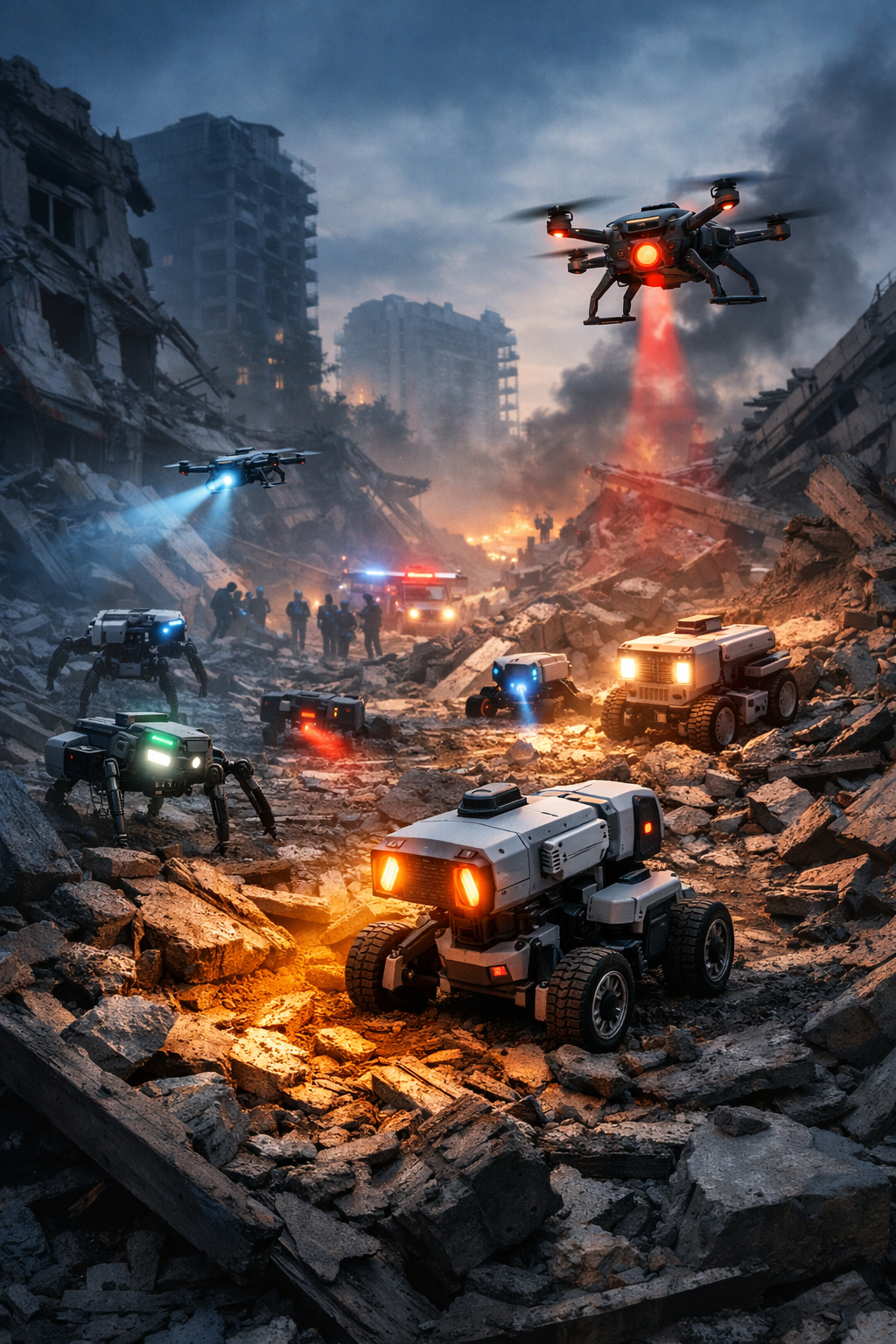
Disaster areas present extreme dangers — collapsed structures, toxic gases, raging fires, and unstable terrain. Sending human rescue workers into such environments puts lives at serious risk. Swarm robots can enter these hazardous zones and gather critical information without endangering any person.
Because the robots are small and numerous, they can navigate through tight spaces like rubble, narrow corridors, or flooded areas where larger machines or humans cannot easily go. Their ability to work as a team means they can cover vast areas in a fraction of the time it would take a single robot or a small human team.
This combination of safety, speed, and coverage makes swarm robotics particularly well-suited for disaster response scenarios.
Key Applications in Disaster Response
Swarm robotics has several practical uses during and after a disaster:
- Search and rescue: Swarm robots equipped with cameras, heat sensors, and sound detection devices can scan large disaster-affected areas to locate trapped or injured survivors. They relay real-time data to rescue teams, helping them prioritise where to send help first.
- Damage mapping: Robots work together to build detailed maps of affected zones. These maps give authorities a clear picture of the destruction and help them allocate resources more efficiently.
- Fire and hazard monitoring: In fire emergencies or chemical accidents, swarm robots can measure temperature levels, detect smoke, and identify harmful gases. Emergency teams receive this information remotely, allowing them to make informed decisions while staying at a safe distance.
- Supply delivery: Certain swarm robots and drones can carry food, medicine, water, and communication devices to survivors who are stranded in locations that are difficult or impossible to reach by road.
| Application | How Swarm Robots Help |
|---|---|
| Search and Rescue | Locate survivors using heat sensors, cameras, and sound detection |
| Damage Mapping | Create real-time maps of disaster zones for better resource planning |
| Hazard Monitoring | Detect fire, toxic gases, and unsafe structural conditions |
| Supply Delivery | Deliver essentials to survivors in hard-to-reach areas |
Benefits and Challenges of Swarm Robotics
The advantages of using swarm robotics in disaster management are significant:
- Fast response: Swarms can be deployed quickly and cover large areas simultaneously.
- High reliability: The system keeps functioning even when individual robots break down or lose power.
- Cost efficiency: Using many small, affordable robots can be more practical than deploying one large, expensive machine.
- Human safety: Rescue workers are kept away from immediate danger while robots gather essential information.
However, swarm robotics still faces real challenges that researchers and engineers are actively working to solve:
- Battery life: Small robots have limited power capacity, which restricts how long they can operate in the field.
- Communication reliability: In disaster zones, wireless signals can be disrupted by debris, water, or interference, affecting coordination between robots.
- Complex coordination: Programming hundreds of robots to work together efficiently without conflicts remains technically demanding.
The Road Ahead for Swarm Robotics in Emergency Management
Advances in artificial intelligence, wireless communication, and miniaturised sensors are steadily addressing the current limitations of swarm robotics. Researchers around the world are developing smarter algorithms that allow robots to make better decisions in unpredictable environments.
As battery technology improves and 5G networks expand, swarm robots will be able to operate longer and communicate more reliably in the field. Integration with satellite systems and drone networks could further extend their reach during large-scale disasters.
Governments and disaster management agencies are beginning to take notice. Pilot programmes and research projects are already exploring how swarm robotics can be incorporated into national emergency response frameworks, particularly in earthquake-prone and flood-affected regions.
In the coming years, swarm robotics is expected to become a standard tool in disaster preparedness and response, working alongside human teams to save more lives with less risk.
Swarm robotics represents a meaningful step forward in how humanity handles its most dangerous emergencies. By combining the strength of numbers with intelligent coordination, these robot teams offer a safer, faster, and more reliable path through disaster — one small robot at a time.
Frequently Asked Questions
Swarm robotics involves deploying a large group of small robots that communicate and cooperate with each other without a central controller. In disaster management, these robots work together to search for survivors, map damaged areas, monitor hazardous conditions, and deliver emergency supplies to affected zones.
Swarm robots offer several advantages including fast area coverage, high fault tolerance since the system keeps working even if some robots fail, reduced risk to human rescue workers, and the ability to operate in dangerous environments like collapsed buildings, fires, and toxic gas zones.
The main challenges include limited battery life in small robots, communication disruptions in disaster zones that can affect coordination, and the technical complexity of programming large numbers of robots to work together efficiently. Researchers are actively working on solutions through advances in AI, battery technology, and wireless communication.