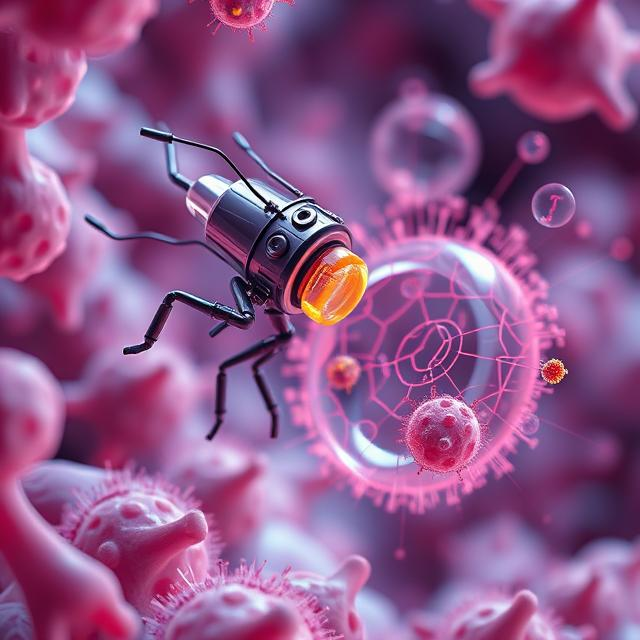
Nanorobotics is one of the most exciting frontiers in modern science. These incredibly small machines, known as nanobots, operate at a scale of one billionth of a meter — far too tiny to see with the naked eye. Yet, their potential to transform healthcare, industry, and environmental protection is enormous.
What Exactly Is a Nanobot?
To understand just how small nanobots are, consider a single strand of human hair. Now imagine a machine that is thousands of times thinner than that hair. That is the scale at which nanobots operate.
The word “nano” comes from the Greek word for dwarf and refers to one billionth of a unit. In this case, nanobots work at the nanometer scale — a level where individual atoms and molecules become relevant. Building machines at this scale requires extraordinary precision and advanced materials science.
Despite their size, these machines can be equipped with microscopic sensors, grippers, and even tiny lasers, allowing them to perform highly specific tasks with remarkable accuracy.
Key Applications of Nanorobotics
Nanobots are not just a scientific curiosity. Researchers across the world are actively exploring their use in several critical fields:
- Medicine: Nanobots could be injected into the human body to deliver drugs directly to diseased or cancerous cells. This targeted approach could significantly reduce side effects compared to traditional treatments like chemotherapy, where healthy cells are also affected.
- Manufacturing: At the atomic level, nanobots could assemble materials with a level of precision impossible by conventional methods. This could lead to the creation of ultra-strong, lightweight materials used in construction, aerospace, and electronics.
- Environmental Cleanup: Nanobots could be deployed to break down pollutants in water sources, contaminated soil, and even the air. This offers a promising long-term solution to some of the planet’s most pressing environmental challenges.
| Application Area | Potential Benefit | Current Status |
|---|---|---|
| Medicine | Targeted drug delivery, cancer treatment | Active research phase |
| Manufacturing | Atomic-level material assembly | Early-stage exploration |
| Environmental Cleanup | Pollutant removal from water, soil, air | Conceptual and lab testing |
How Do Nanobots Actually Work?
Understanding how nanobots function helps explain both their promise and the challenges scientists face in developing them.
Tools and Sensors: Nanobots can be designed with microscopic tools — sensors to detect specific biological markers, grippers to interact with cells, and lasers for precise cutting or treatment. These components allow them to identify problem areas and act on them with minimal disruption to surrounding tissue.
Power Sources: One of the biggest engineering challenges is powering these tiny machines. Researchers are exploring several options:
- Using the body’s own biochemical reactions as a fuel source
- Harnessing light energy through photovoltaic mechanisms
- Drawing power from ultrasound waves directed from outside the body
Navigation and Control: Getting nanobots to the right location inside the body or environment is another complex problem. Current approaches include:
- External magnetic fields that guide the bots along a specific path
- Ultrasound-based steering systems
- Programming nanobots to respond to specific chemical signals naturally present in the body
Challenges Facing Nanorobotics Today
Despite the exciting possibilities, nanorobotics still faces significant hurdles before it becomes a mainstream technology.
- Precision control: Steering nanobots accurately inside a living body without damaging healthy tissue remains a major technical challenge.
- Power limitations: Providing a consistent and safe energy supply to machines this small is still an unsolved problem in many applications.
- Biocompatibility: Any nanobot used inside the human body must be safe, non-toxic, and must not trigger an immune response.
- Manufacturing at scale: Producing nanobots in large enough quantities for practical use requires manufacturing techniques that are still being developed.
- Regulatory and ethical questions: As with any emerging medical technology, nanobots will need to pass rigorous safety testing and regulatory approval before clinical use.
The Road Ahead for Nanorobotics
Research in nanorobotics is progressing steadily. Scientists around the world are making incremental but meaningful advances in materials, control systems, and biocompatibility. Universities, technology companies, and medical research institutions are all investing in this field.
In healthcare, early-stage experiments have shown that nanoparticles — a simpler precursor to full nanobots — can already be used to deliver drugs more effectively in some cancer treatments. Full nanorobotic systems capable of autonomous action inside the body remain a future goal, but the building blocks are being laid today.
In environmental science, researchers are testing nano-scale materials that can absorb or neutralize specific pollutants, pointing toward a future where nanobots could actively clean contaminated ecosystems.
As the technology matures, nanorobotics has the potential to address some of humanity’s most difficult problems — from fighting disease at the cellular level to repairing environmental damage caused by decades of industrial activity.
The journey from concept to real-world application is long, but the direction is clear. Nanorobotics is not science fiction — it is an active and rapidly advancing field of science with very real implications for the future.
Frequently Asked Questions
Nanobots are tiny machines that operate at the nanometer scale, which is one billionth of a meter. To put it in perspective, they are thousands of times thinner than a single human hair. They are invisible to the naked eye and require advanced microscopy to observe.
In medicine, nanobots are being researched for targeted drug delivery, where they would carry medicine directly to diseased or cancerous cells. This approach could reduce side effects by avoiding damage to healthy tissue, making treatments more effective and precise.
The main challenges include powering the nanobots safely, steering them accurately inside the body without harming healthy cells, ensuring they are biocompatible and do not trigger immune reactions, and manufacturing them at a scale large enough for practical use.