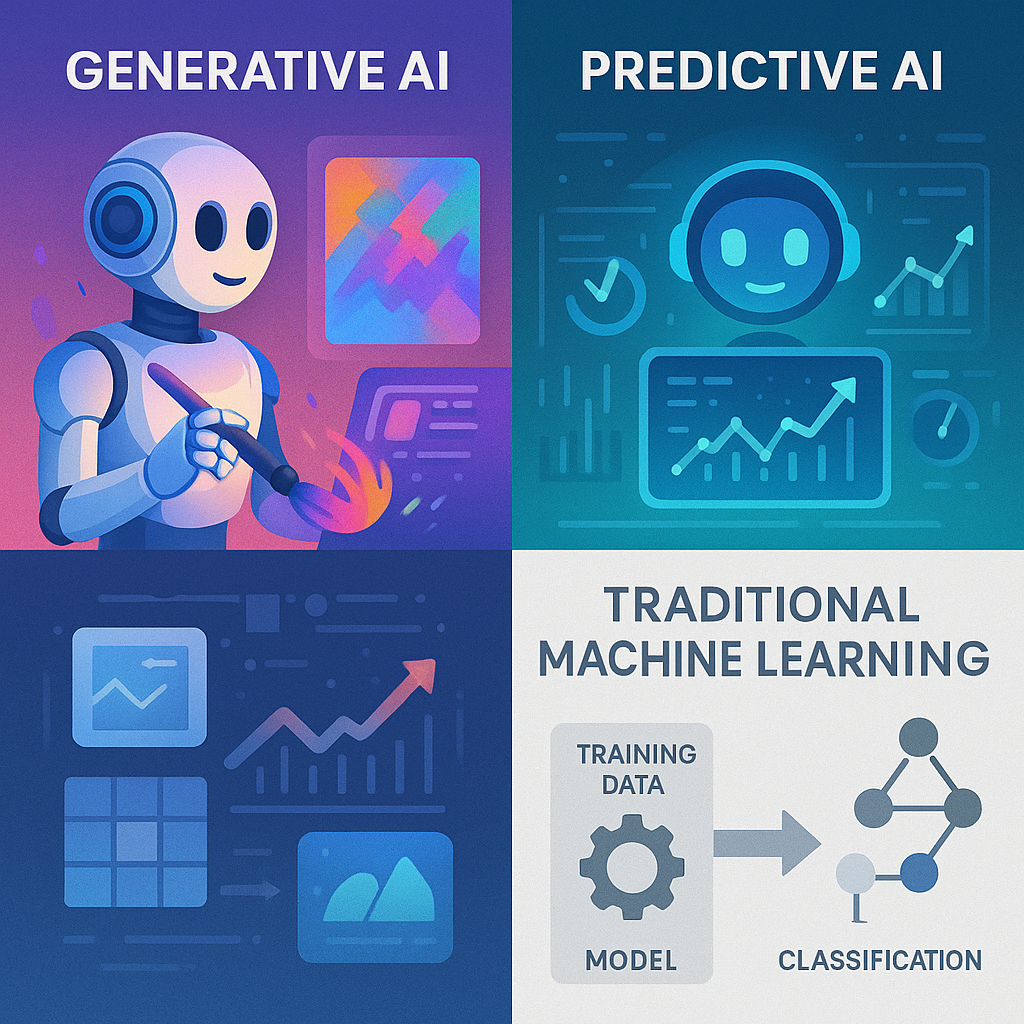
Artificial intelligence is no longer just a buzzword — it is actively reshaping how businesses operate, how content gets created, and how decisions get made. But not all AI works the same way. Three major types — Generative AI, Predictive AI, and Traditional Machine Learning — each serve very different purposes. Understanding the difference helps you choose the right tool for the right job.
What is Traditional Machine Learning?
Traditional Machine Learning (ML) is one of the oldest and most widely used forms of AI. It teaches computers to learn from data and improve over time — much like how humans learn from experience and repetition.
The process is straightforward: you feed the system large amounts of labeled data, and it begins to identify patterns. For example, if you show it thousands of images of cats and dogs, it learns to tell them apart on its own.
Traditional ML works best when you need a clear, definitive answer — like whether an email is spam or not, or whether a bank transaction looks suspicious.
Common uses of Traditional Machine Learning:
- Email spam filters
- Fraud detection in banking
- Voice assistants like Siri and Alexa
- Product recommendation engines on e-commerce platforms
- Document classification and sorting
Tools like Scikit-learn and XGBoost are widely used by developers to build traditional ML models.
What is Predictive AI?
Predictive AI is a specialized branch of machine learning focused entirely on forecasting future outcomes. It uses historical and real-time data to determine what is most likely to happen next.
Think of it this way: if you run an online store, Predictive AI can analyze past customer behavior and tell you which products are likely to sell out next week, or which customers are at risk of leaving your platform.
This type of AI does not just analyze what has already happened — it looks ahead and gives businesses a chance to act before problems arise.
Where Predictive AI is commonly applied:
- Sales forecasting and inventory management
- Customer churn prediction
- Early detection of health risks in medical settings
- Financial planning and risk assessment
- Weather and demand forecasting
Predictive AI helps organizations reduce risk, plan smarter, and improve customer satisfaction by staying one step ahead.
What is Generative AI?
Generative AI is the newest and fastest-growing category. Unlike Traditional ML or Predictive AI, it does not just analyze or forecast — it creates entirely new content from scratch. This includes text, images, music, video, and even computer code.
Generative AI is trained on massive, unstructured datasets. It learns the patterns and structure of human-created content and then produces original outputs based on a given prompt or instruction.
Popular tools include ChatGPT by OpenAI, which can write articles and answer complex questions, and DALL·E and Midjourney, which generate images from text descriptions.
How Generative AI is being used today:
- Writing blog posts, product descriptions, and marketing copy
- Creating digital artwork and visual content
- Developing characters and environments for video games
- Building personalized learning and training experiences
- Generating code for software development
Generative AI is having a major impact on creative industries by helping individuals and teams produce high-quality content much faster than before.
Side-by-Side Comparison: All Three AI Types
Here is a quick look at how these three types of AI differ from each other:
| Feature | Traditional ML | Predictive AI | Generative AI |
|---|---|---|---|
| Main Goal | Learn from data | Forecast the future | Create new content |
| Input Type | Labeled datasets | Past and real-time data | Large unstructured datasets |
| Output | Classifications, decisions | Predictions | Text, images, video, code |
| Common Tools | Scikit-learn, XGBoost | Forecasting models | ChatGPT, DALL·E, Midjourney |
Which Type of AI Should You Use?
Each type of AI has its own strengths, and the right choice depends entirely on what you are trying to achieve. Here is a simple way to think about it:
- Need to write product descriptions or marketing content quickly? Generative AI is your best option.
- Want to forecast how much inventory to stock next month? Predictive AI is built for that.
- Need to sort through thousands of documents or detect fraudulent transactions? Traditional Machine Learning handles this well.
Many modern businesses actually use all three types together. A retail company might use Traditional ML to classify customer data, Predictive AI to forecast demand, and Generative AI to create personalized marketing emails — all within the same workflow.
Understanding which AI type fits your problem is the first step toward using these technologies effectively. When applied correctly, they can speed up operations, reduce costs, and open up new possibilities that were not practical before.
As AI continues to grow, staying informed about these distinctions will give individuals and businesses a real advantage in making smarter, faster decisions.
Frequently Asked Questions
Generative AI creates new content such as text, images, or video, while Predictive AI uses historical data to forecast future outcomes like sales trends or customer behavior. They serve very different purposes in business and technology.
Yes, Predictive AI is a specialized branch of machine learning. It focuses specifically on using past and real-time data to make accurate forecasts about future events or trends.
Some of the most widely used Generative AI tools include ChatGPT by OpenAI for text generation, DALL·E for creating images from text descriptions, and Midjourney for digital artwork creation.