As climate change intensifies pressure on businesses and governments worldwide, the need for transparent, trustworthy systems to track emissions and clean energy has never been greater. Blockchain technology is stepping up as a practical solution — bringing accountability and efficiency to carbon credit markets and renewable energy trading.
What Are Carbon Credits and Green Energy Markets?
A carbon credit works like a permit that allows a business or organisation to emit a fixed amount of carbon dioxide. Companies that reduce their emissions below their limit can sell unused credits to others that need them. This market-based system is designed to push industries toward lower pollution levels.
Green energy markets focus on renewable sources such as solar, wind, and hydropower. Participants can buy and sell clean energy, earn certificates for producing or consuming it, and contribute to the global shift away from fossil fuels.
Despite their promise, both systems have long struggled with a common problem: lack of transparency and fraud. Fake credits, double-counting, and unclear energy sourcing have undermined trust in these markets for years.
Why Blockchain Is Well-Suited for Climate Markets
Blockchain is a secure digital ledger that records transactions in a way that cannot be altered or forged. Because it is decentralised, no single company or government controls it. Every entry is visible, permanent, and verifiable — making it a strong fit for systems where proof and trust are essential.
In the context of carbon credits and clean energy, blockchain allows every transaction to be recorded and independently verified in real time, reducing the risk of manipulation or error.
How Blockchain Strengthens Carbon Credit Verification
Here is how blockchain directly addresses the weaknesses in current carbon credit systems:
- Clear and tamper-proof records: Every credit issued or traded is visible on the blockchain. This eliminates double-selling and fake credits. Anyone can trace where a credit originated and who currently holds it.
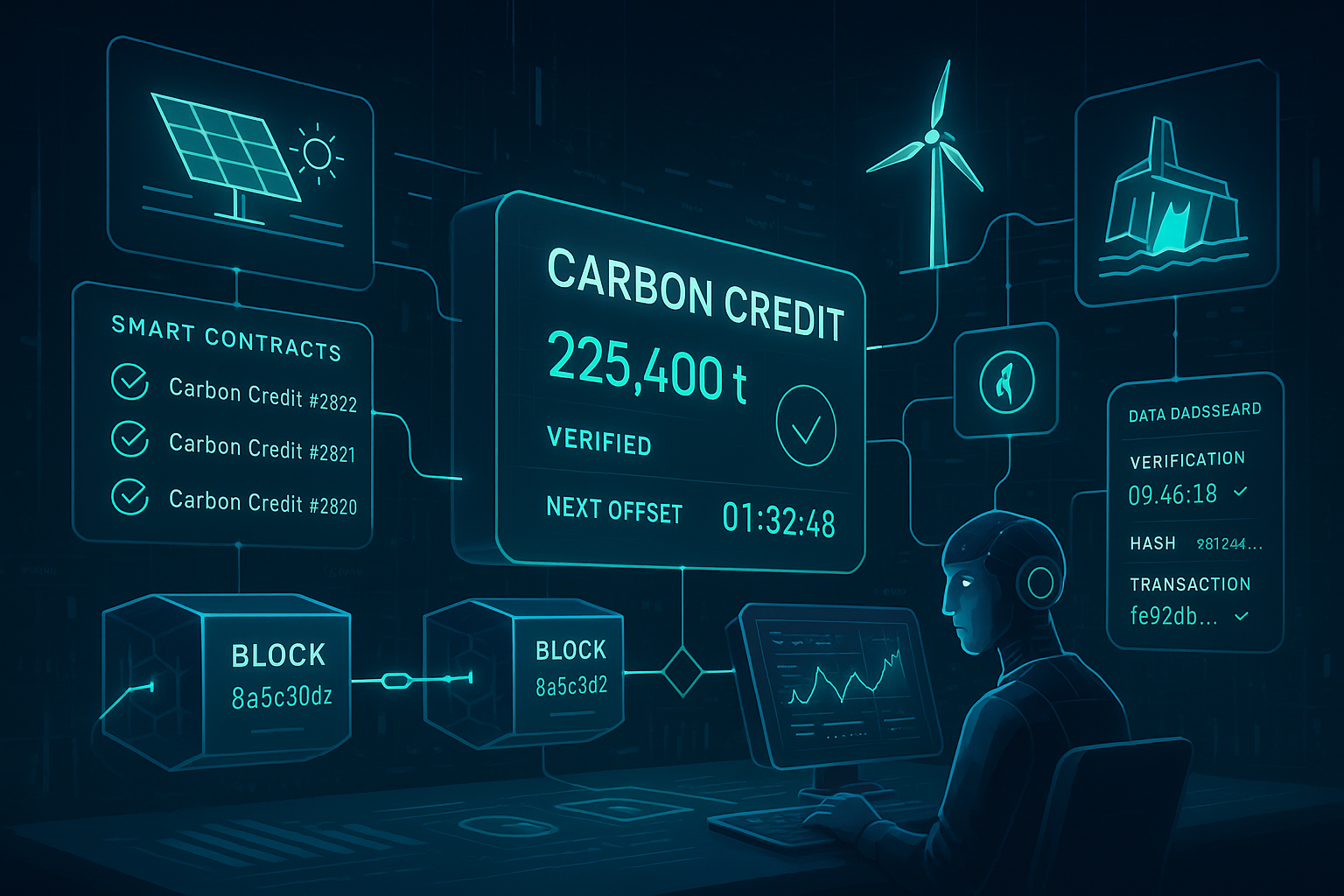
- Smart contracts for automation: Smart contracts are self-executing rules built into the blockchain. They can automatically issue, transfer, or retire carbon credits once specific conditions are met — removing human error and delays from the process.
- Cross-border verification: Blockchain works across national boundaries. A carbon credit issued in India can be verified instantly by a buyer in the United States or Europe, helping global climate commitments become more coordinated and effective.
Blockchain Applications in Renewable Energy Markets
Beyond carbon credits, blockchain is reshaping how clean energy is produced, traded, and tracked.
- Tracking energy sources: When a household generates electricity from rooftop solar panels, blockchain can certify that the energy is genuinely renewable and record who produced it.
- Peer-to-peer energy trading: Blockchain enables individuals to sell surplus solar power directly to neighbours without going through a large utility company. This model, known as peer-to-peer (P2P) energy trading, reduces costs and increases energy independence.
- Real-time energy data: Instant monitoring of clean energy production and consumption helps utilities, businesses, and consumers make better decisions, design custom energy plans, and earn rewards for green behaviour.
Real-World Examples Leading the Way
Several organisations are already using blockchain to support genuine climate action:
- Power Ledger (Australia) — Enables households and businesses to trade solar energy within their local communities.
- Verra and IBM — Have worked together to develop blockchain-based solutions that improve the reliability and integrity of carbon credits.
- Energy Web Foundation — Helps energy companies build cleaner, decentralised energy networks using blockchain infrastructure.
| Organisation | Location | Blockchain Use Case |
|---|---|---|
| Power Ledger | Australia | Local solar energy trading |
| Verra + IBM | Global | Carbon credit reliability |
| Energy Web Foundation | Global | Decentralised clean energy networks |
Challenges That Still Need to Be Addressed
Blockchain holds significant promise, but it is not without limitations. Key concerns include:
- Some blockchain networks consume large amounts of energy, though newer eco-friendly blockchains are addressing this issue directly.
- Carbon credit regulations vary widely across countries, and global standardisation is still a work in progress.
- Many businesses and governments still lack the technical knowledge needed to adopt and use blockchain tools effectively.
These are real obstacles, but they are being tackled as the technology matures and awareness spreads across industries and policymakers.
What the Future Looks Like for Blockchain-Powered Climate Action
As adoption grows, blockchain-powered platforms are expected to play a central role in how the world manages its climate commitments. Future applications could include systems that help governments track progress on emission targets, tools that allow companies to publicly prove their emission reductions, and consumer-facing platforms that reward individuals for choosing green energy.
The combination of transparency, automation through smart contracts, and cross-border accessibility makes blockchain one of the most practical technologies available for building credible, fraud-resistant climate markets.
For India and other fast-growing economies, this technology offers a path to participate meaningfully in global carbon and clean energy markets — with verifiable proof of every step taken toward a greener future.
Frequently Asked Questions
Blockchain records every carbon credit transaction on a tamper-proof digital ledger. This makes it impossible to alter records, sell the same credit twice, or create fake credits, as every entry is visible and permanently traceable.
Peer-to-peer energy trading allows individuals to sell surplus renewable energy, such as solar power, directly to neighbours without going through a utility company. Blockchain enables this by securely recording and verifying each transaction in real time.
Yes. Power Ledger in Australia enables local solar energy trading, Verra and IBM have developed blockchain tools to improve carbon credit reliability, and the Energy Web Foundation helps energy companies build decentralised clean energy networks.