Businesses today are using artificial intelligence in more ways than ever before. Chatbots have been around for years, helping companies handle customer queries and basic support tasks. But a newer and more capable technology — AI agents — is now changing what automation can actually do. Knowing the difference between the two can help businesses make smarter technology decisions.
What Are Traditional Chatbots and How Do They Work?
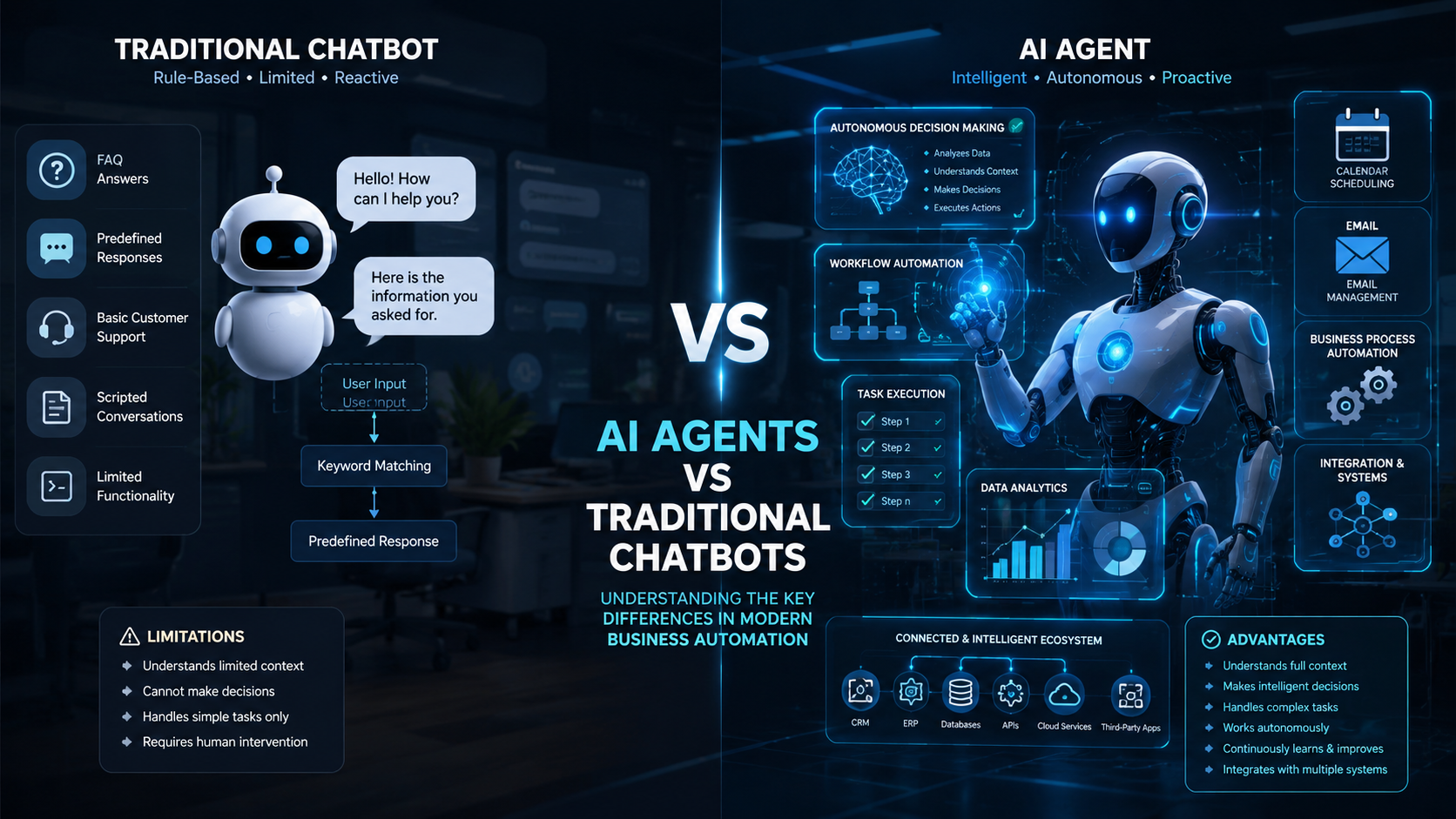
Traditional chatbots are software programs that communicate with users through text or voice on websites, mobile apps, and messaging platforms. They are built around predefined rules and conversation flows, meaning they can only respond to questions they have been specifically programmed to handle.
When a customer types a question, the chatbot matches keywords in the input with stored responses and delivers the closest answer. For example, if a customer asks about an order status, the chatbot requests an order number and displays available information — all within a fixed path created by developers.
This rule-based approach works well for simple, repetitive tasks but breaks down quickly when conversations become complex or go off-script.
Key advantages of traditional chatbots include:
- Low cost to implement and maintain
- Ability to handle many customer inquiries at the same time
- Instant answers to frequently asked questions
- Reduced workload for customer support teams
However, their limitations are equally clear. Traditional chatbots lack contextual understanding, cannot make independent decisions, and often frustrate users when questions fall outside their programmed scope.
What Are AI Agents and What Makes Them Different?
AI agents are advanced artificial intelligence systems that go far beyond answering questions. They can understand goals, analyze information, make decisions, and carry out multi-step tasks independently.
Think of an AI agent as a digital assistant that not only understands what you want but can also take the steps needed to get it done. If you ask an AI agent to schedule a meeting, it can check calendars, identify available time slots, send invitations, and confirm the appointment — all without human involvement.
AI agents rely on technologies such as Large Language Models (LLMs), machine learning, natural language processing, and workflow automation. When given a request, the agent understands the objective, builds a plan, gathers relevant information, and executes the required actions.
Key advantages of AI agents include:
- Ability to handle complex, multi-step tasks
- Contextual understanding and memory of past interactions
- Independent decision-making without human input
- Integration with multiple systems and platforms
- Higher productivity and reduced operational costs
Side-by-Side Comparison: AI Agents vs Traditional Chatbots
The table below highlights the core differences between the two technologies to help businesses evaluate which fits their needs.
| Feature | Traditional Chatbots | AI Agents |
|---|---|---|
| Core Function | Answer predefined questions | Understand goals and complete tasks |
| Decision Making | None — follows fixed rules | Independent, context-aware decisions |
| Task Complexity | Simple, single-step tasks | Complex, multi-step workflows |
| Technology Used | Rule-based or basic NLP | LLMs, machine learning, NLP, automation |
| Context Memory | Limited or none | Retains and uses context |
| Best Use Case | Basic customer support, FAQs | Business process automation, complex tasks |
| Implementation Cost | Lower | Higher but offers greater ROI |
Which Technology Is Right for Your Business?
The right choice depends entirely on what your business needs to accomplish.
If your primary goal is to answer customer questions, handle basic support requests, or automate simple and repetitive interactions, a traditional chatbot is a cost-effective and practical option — especially for small businesses or teams with straightforward requirements.
But if you want to automate entire business processes, improve team productivity, and handle tasks that require judgment and multiple steps, AI agents offer capabilities that chatbots simply cannot match.
Many organizations are now adopting a hybrid approach — using traditional chatbots for front-line customer interactions and deploying AI agents for back-end process automation and complex workflows. This combination allows businesses to get the best of both technologies without overspending.
Where Is AI Agent Technology Headed?
The direction of artificial intelligence is clearly moving toward systems that can think, plan, and act with greater independence. Industries including healthcare, finance, software development, manufacturing, and customer service are already exploring how AI agents can replace time-consuming manual processes.
As AI models become more capable and accessible, AI agents are expected to take on increasingly important roles in enterprise operations. Traditional chatbots will continue to serve specific, limited purposes, but organizations looking for smarter and more efficient automation are likely to shift toward agent-based systems over time.
Businesses that understand this shift early will be better positioned to adopt the right tools, train their teams, and stay competitive as automation becomes a standard part of operations across every sector.
In short, a chatbot can tell you what to do — an AI agent can actually do it for you. That distinction is becoming more important every day.
Frequently Asked Questions
Traditional chatbots follow predefined rules and can only respond to questions they have been programmed to handle. AI agents, on the other hand, can understand goals, make independent decisions, and complete complex multi-step tasks without human involvement.
Yes. Many organizations adopt a hybrid approach, using traditional chatbots for basic customer interactions and front-line support, while deploying AI agents for back-end process automation and more complex workflows.
AI agents generally require a higher initial investment compared to traditional chatbots due to the advanced technologies involved, such as Large Language Models and workflow automation. However, they often deliver a greater return on investment by automating complex processes that previously required human effort.