
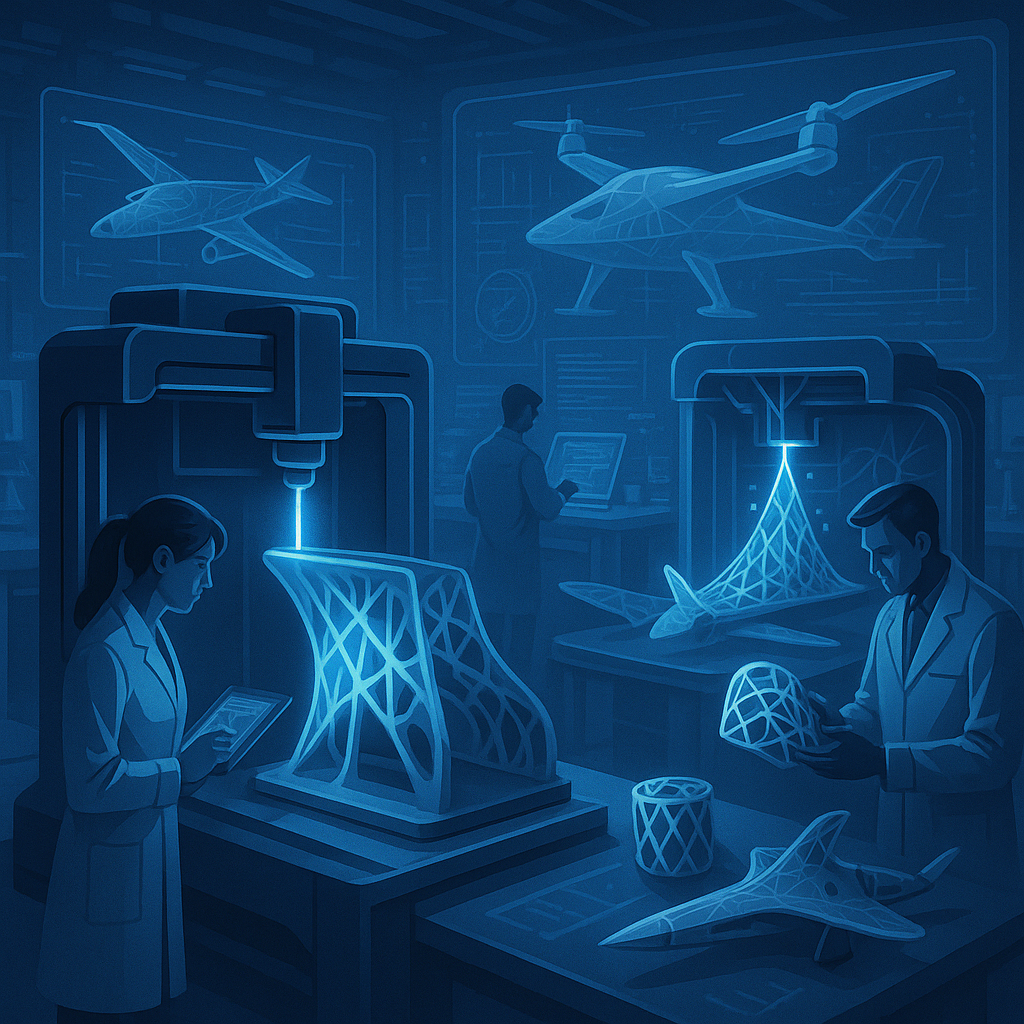
Additive manufacturing — widely known as 3D printing — is reshaping how the aerospace industry builds aircraft and spacecraft. From lighter engine parts to complex structural components, this technology is helping companies design faster, spend less, and waste far fewer materials than ever before.
What Is Additive Manufacturing?
Additive manufacturing is a production process where a machine builds an object layer by layer, using only the material needed for the final shape. This is fundamentally different from traditional subtractive manufacturing, where engineers cut or drill away material from a larger block to create a part.
Because additive manufacturing adds material rather than removing it, the process generates significantly less waste. For industries like aerospace — where precision, weight, and cost all matter — this difference is enormous.
The most common materials used in aerospace 3D printing include:
- Titanium alloys — strong, lightweight, and heat-resistant
- Nickel superalloys — ideal for high-temperature engine components
- Carbon fiber composites — used for structural parts requiring high strength-to-weight ratios
- Aluminum alloys — widely used for brackets, housings, and supports
Why the Aerospace Industry Is Embracing 3D Printing
In aerospace engineering, every gram of weight directly affects fuel consumption, range, and operating costs. A lighter aircraft burns less fuel, travels farther, and produces fewer emissions. This is why additive manufacturing has become so attractive to aerospace companies worldwide.
Key advantages of 3D printing in aerospace include:
- Minimal material waste — Only the required material is used, reducing raw material costs significantly.
- Complex geometries — Engineers can now create internal channels, lattice structures, and organic shapes that are impossible to machine traditionally.
- Faster prototyping — New designs can be tested within days instead of weeks or months.
- Lower production costs — Fewer machining steps and less labor reduce the overall cost per part.
- On-demand manufacturing — Spare parts can be printed as needed, reducing the need for large inventories.
Real-World Applications in Aerospace
Additive manufacturing is already being used across major aerospace programs. Companies are producing a wide range of components using 3D printing technology, including:
- Engine components — Parts like fuel nozzles and turbine blades that must withstand extreme heat and pressure are now being 3D printed with superior performance characteristics.
- Structural brackets and supports — Lightweight brackets that maintain structural integrity while reducing overall aircraft weight.
- Cabin interior parts — Seat components, air ducts, and panels that benefit from custom shapes and reduced weight.
- Prototypes and test models — Engineers use 3D-printed prototypes to validate designs quickly before committing to full-scale production.
These improvements translate directly into real-world benefits. Lighter and more aerodynamic components allow commercial aircraft to fly longer distances on less fuel, which also reduces carbon emissions — a growing priority for the global aviation industry.
| Feature | Traditional Manufacturing | Additive Manufacturing |
|---|---|---|
| Material Waste | High — material is cut away | Low — only needed material is used |
| Design Complexity | Limited by tooling | Highly complex shapes possible |
| Prototype Speed | Weeks to months | Days to weeks |
| Production Cost | Higher for complex parts | Lower for small batches |
| Part Weight | Heavier due to design limits | Lighter with optimized structures |
Challenges That Still Need to Be Addressed
Despite its many benefits, additive manufacturing in aerospace is not without challenges. The technology must meet extremely strict safety and certification standards before any 3D-printed part can fly on a commercial aircraft.
Some of the key challenges include:
- Certification and regulation — Aviation authorities like the FAA and EASA require rigorous testing and documentation for every component used in flight.
- Material consistency — Ensuring that every printed part has uniform material properties across large production runs remains a technical challenge.
- Post-processing requirements — Many 3D-printed parts still require finishing, heat treatment, or surface smoothing after printing.
- Scalability — Printing large structural components at scale is still more expensive and time-consuming compared to traditional methods.
The Future of Aerospace Design With 3D Printing
As additive manufacturing technology continues to advance, the aerospace industry is expected to see even greater changes. Faster printers, new high-performance materials, and improved software for generative design will give engineers the tools to create aircraft and spacecraft that are safer, more efficient, and more sustainable.
Next-generation aircraft programs are already incorporating 3D-printed components at the design stage rather than as an afterthought. This shift means that future planes and rockets could be built with structures that are fundamentally optimized for performance — something that was simply not achievable with older manufacturing methods.
In conclusion, additive manufacturing is not just a trend in aerospace — it is becoming a core part of how the industry designs and builds the vehicles of the future. Companies that invest in this technology today are positioning themselves to lead the next era of aviation and space exploration.
Frequently Asked Questions
Additive manufacturing in aerospace refers to the use of 3D printing technology to build aircraft and spacecraft components layer by layer. This process allows engineers to create complex, lightweight parts with less material waste compared to traditional manufacturing methods.
The main benefits include reduced material waste, the ability to create complex geometries, faster prototype development, lower production costs for small batches, and the ability to produce lighter components that improve fuel efficiency and reduce emissions.
Yes, but only after passing strict certification processes. Aviation authorities like the FAA and EASA require extensive testing and documentation before any 3D-printed component can be approved for use in commercial or military aircraft.