
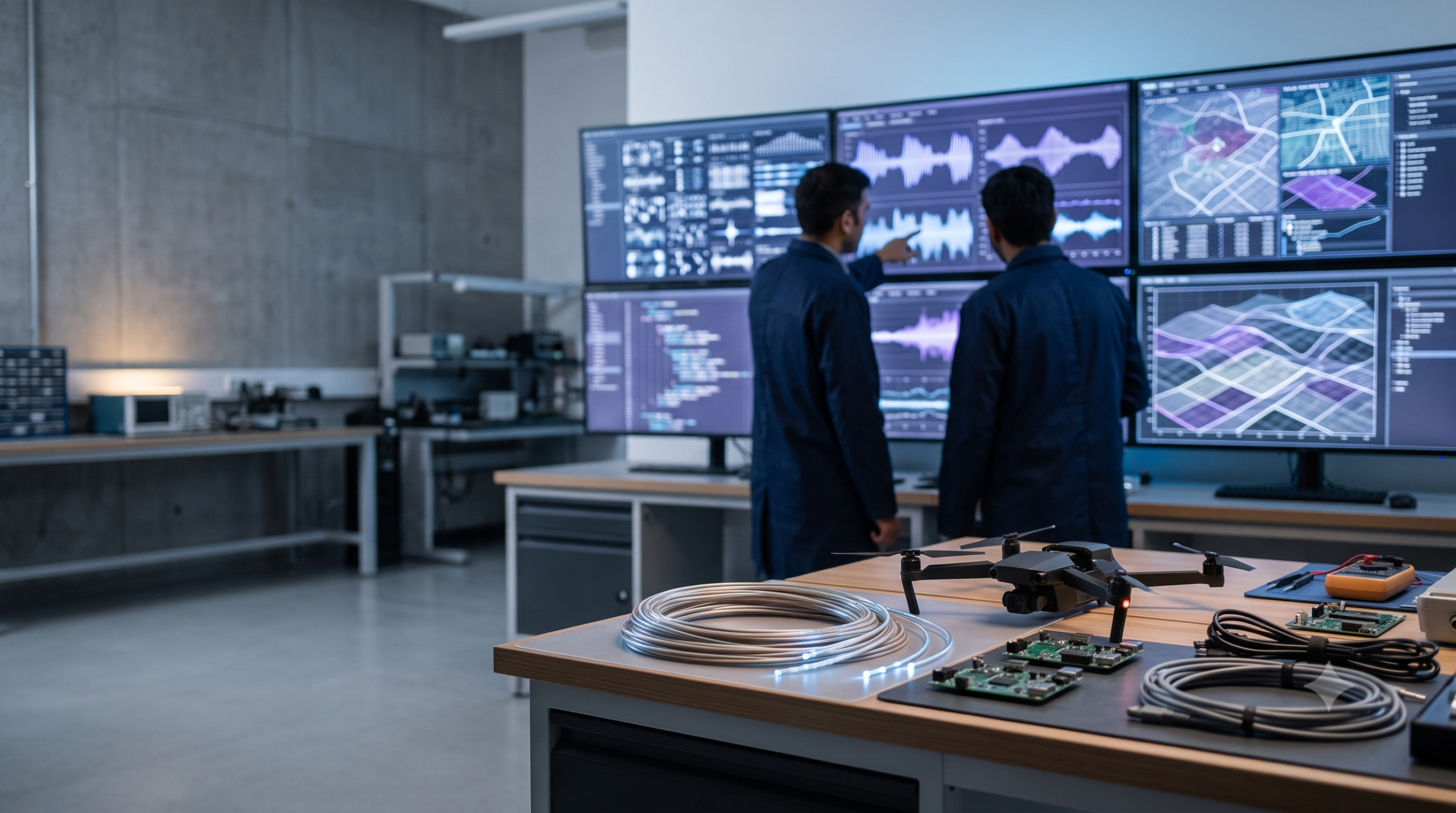
Britain has become the first international partner to access Ukraine’s Avengers AI Labs under a new defence agreement covering fibre-optic sensing, low-power AI chips and joint research.
Britain has signed a partnership with Ukraine to jointly develop artificial intelligence tools for defence and security, in an agreement that gives British researchers access to a Ukrainian battlefield data platform used to train military AI systems.
What the Agreement Covers
Prime Minister Andy Burnham and President Volodymyr Zelenskiy signed the agreement in Kyiv, according to a government statement. The deal makes Britain the first international partner to gain access to Ukraine’s Avengers AI Labs.
The British government said the partnership would initially concentrate on defence and national security projects, bringing together researchers, engineers, technology companies and military experts from both countries.
Two pilot projects were named at the outset:
- Fibre-optic sensing: technology that turns fibre-optic cables into AI-enabled sensors to help protect military facilities.
- Low-power AI chips: research into processors designed for drones and other autonomous systems, where energy and weight budgets are tight.
Both areas point in the same direction. Each is about processing information closer to where it is collected, rather than relying entirely on distant computing power.
Inside Avengers AI Labs
Ukraine’s Defence Ministry said earlier in August that Avengers Labs was built around an annotated dataset of 5 million battlefield images. That material was drawn largely from DELTA, a domestically developed battlefield management and situational-awareness system.
The platform draws on data collected from cameras and sensors across Ukraine’s battlefield. That includes information on tanks, artillery systems, drones and other military targets.
Annotated data is the part that makes such a dataset valuable. Raw footage on its own has limited use for training. Images that have been labelled — marking what appears in each frame — are what allow a model to learn to recognise the same categories in new material.
How the Data Is Already Being Used
The Ukrainian ministry said AI models trained on the dataset were already in service. They support an automated target-detection system that analyses more than 100,000 drone video feeds each month and can identify about 70 per cent of enemy targets in real time.
That figure is worth reading carefully. It describes a system that handles a large volume of footage automatically and flags a majority of what it is looking for as it happens, rather than one that operates without human involvement or with complete accuracy.
| Element | Detail |
|---|---|
| Platform | Avengers AI Labs |
| Core dataset | 5 million annotated battlefield images |
| Primary source | DELTA battlefield management system |
| Monthly video feeds analysed | More than 100,000 |
| Real-time target identification rate | About 70 per cent |
| First international partner | Britain |
Why Access to Real Data Matters
Defence research programmes in most countries rely heavily on simulation, exercises and archived material. Ukraine’s dataset is different in one respect: it was gathered from current operating conditions rather than assembled in a training environment.
For engineers, that distinction affects the difficult part of the work. Systems that perform well on clean test material often struggle with poor weather, obscured views, damaged equipment and unfamiliar configurations. Data captured under those conditions is what exposes those weaknesses.
The exchange is designed to run in both directions. Britain contributes research capacity, engineering expertise and industrial partners. Ukraine contributes operational data and experience of deploying systems at scale under pressure.
Burnham’s Visit to Kyiv
Burnham travelled to Ukraine on Monday for his first trip abroad since becoming prime minister. During the visit he held talks with Zelenskiy and co-chaired a meeting of the “Coalition of the Willing”.
His office had announced separately that Britain would allow missile maker MBDA to release classified information on British-made components used in the SCALP long-range cruise missile, in order to help establish assembly lines in Ukraine.
Taken together, the two announcements follow a similar pattern. Both involve sharing knowledge and technical detail so that capability can be developed within Ukraine, rather than supplying finished equipment alone.
What Comes Next
The agreement sets a direction rather than a finished programme. Several things remain to be worked out in practice:
- How the pilot projects on fibre-optic sensing and low-power chips move from research to deployment.
- Which British companies and institutions take part alongside government researchers.
- Whether the arrangement extends beyond defence and national security into wider applications.
- Whether other countries follow Britain in seeking access to the platform.
Ukraine has described Britain as its first international partner on Avengers AI Labs, which leaves open the possibility of further agreements later.
Conclusion
The partnership marks a shift in how defence technology cooperation is being structured. Instead of hardware moving in one direction, the arrangement centres on data, research access and joint engineering. For Britain, it offers exposure to material gathered under real operating conditions. For Ukraine, it brings additional research capacity to systems already in daily use. Whether that combination produces working technology will depend on how the pilot projects progress in the months ahead.
Frequently Asked Questions
Avengers AI Labs is a Ukrainian platform built around an annotated dataset of 5 million battlefield images, drawn largely from the domestically developed DELTA combat system. Britain is the first international partner to access it.
The partnership will initially focus on defence and national security projects, including pilot work using fibre-optic cables as AI-enabled sensors to protect military facilities, and research into low-power AI chips for drones and autonomous systems.
Ukraine's Defence Ministry said the models are used in an automated target-detection system that analyses more than 100,000 drone video feeds each month and can identify about 70 per cent of enemy targets in real time.