
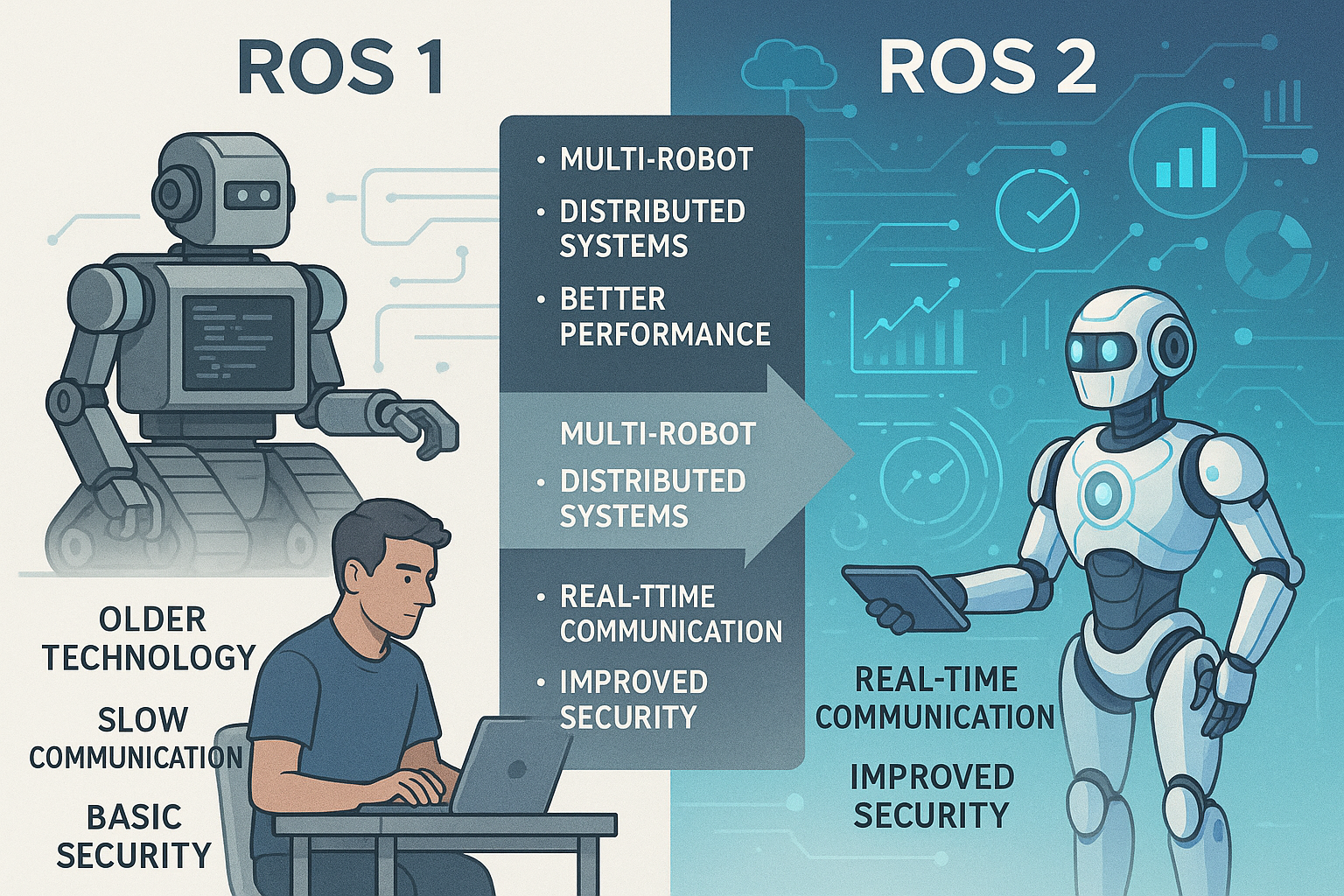
The Robot Operating System, better known as ROS, has been the backbone of robotics development for over a decade. With ROS 2 now firmly established as the modern standard, developers and researchers are asking a simple question: what exactly changed, and does it matter for their work? The short answer is yes — it matters quite a lot.
What Is ROS and Why Does It Exist?
ROS is an open-source platform that gives robotics developers a ready-made set of tools, libraries, and software components. Instead of writing every function from scratch, developers can use ROS to focus on building robot behaviors and capabilities.
Think of it as a shared foundation that the global robotics community builds on together. Whether you are working on a university research project or an industrial automation system, ROS saves enormous amounts of development time.
- ROS 1 launched over ten years ago and quickly became the go-to choice for researchers, students, and hobbyists.
- ROS 2 is a complete architectural overhaul designed for reliability, security, and real-world industrial deployment.
The Limitations That Held ROS 1 Back
ROS 1 played a vital role in shaping modern robotics, but it was built for a different era. As robots moved from research labs into factories, hospitals, and public spaces, its weaknesses became harder to ignore.
- No real-time support: ROS 1 cannot guarantee fast, time-critical responses — a serious problem for safety-sensitive applications.
- Weak security: It was not designed with network security in mind, making internet-connected robots vulnerable.
- Limited multi-robot coordination: Running multiple robots together required complex workarounds rather than native support.
- Linux only: ROS 1 was largely restricted to Linux, leaving out developers working on Windows or macOS.
- No long-term future: Active development on ROS 1 is winding down, meaning no new updates or security patches going forward.
What Makes ROS 2 a Stronger Choice
ROS 2 was built from the ground up to address every major shortcoming of its predecessor. It is designed to support advanced use cases like autonomous vehicles, warehouse automation, surgical robots, and multi-robot systems.
Here is what sets ROS 2 apart:
- Real-time communication via DDS: ROS 2 uses Data Distribution Service (DDS) as its communication backbone, enabling fast and reliable messaging even in time-critical scenarios.
- Built-in security: Encryption and authentication are included from the start, so developers can build safer robots without adding security as an afterthought.
- Native multi-robot support: ROS 2 handles communication between multiple robots natively, which is essential for automation in factories, hospitals, and logistics centres.
- Cross-platform compatibility: ROS 2 runs on Windows, Linux, and macOS, giving a much wider range of developers access to the platform.
- Better scalability: Improved architecture makes it easier to manage large, complex robotics systems as they grow.
ROS 1 vs ROS 2: A Direct Comparison
The table below summarises the key differences between the two versions at a glance:
| Feature | ROS 1 | ROS 2 |
|---|---|---|
| Real-Time Support | Not available | Yes, via DDS |
| Security Features | Basic or none | Built-in encryption and authentication |
| Multi-Robot Support | Limited workarounds | Native support |
| Platform Support | Mainly Linux | Windows, Linux, macOS |
| Industry Readiness | Limited | Designed for industry |
| Long-Term Support | Ending | Actively developed |
Should You Switch to ROS 2 Now?
If you are starting a new robotics project, ROS 2 is the clear choice. It offers better reliability, stronger security, and is built to handle the demands of real-world deployment — not just lab experiments.
For developers still working with ROS 1, the transition is worth planning sooner rather than later. The robotics industry has already shifted toward ROS 2, and as ROS 1 stops receiving updates, staying on the older version will mean falling behind on both security and functionality.
The good news is that ROS 2 has a growing community, extensive documentation, and strong support from major robotics companies and research institutions worldwide. Making the switch now puts you in a much stronger position for the future of robotics development.
Whether you are building autonomous delivery robots, industrial arms, or research platforms, ROS 2 gives you the tools to do it more safely, efficiently, and at scale.
Frequently Asked Questions
ROS 2 is a complete rebuild of ROS 1 with added support for real-time systems, built-in security, native multi-robot coordination, and cross-platform compatibility across Windows, Linux, and macOS. ROS 1 lacks these features and was primarily designed for research environments.
ROS 1 is in the process of winding down. Active development has largely shifted to ROS 2, and ROS 1 will eventually stop receiving updates and security patches. Developers are encouraged to migrate to ROS 2 for long-term support.
ROS 2 uses Data Distribution Service (DDS) as its communication layer because it enables fast, reliable, and real-time messaging between robot components. This is critical for applications where timing and responsiveness are essential, such as autonomous vehicles and industrial robots.