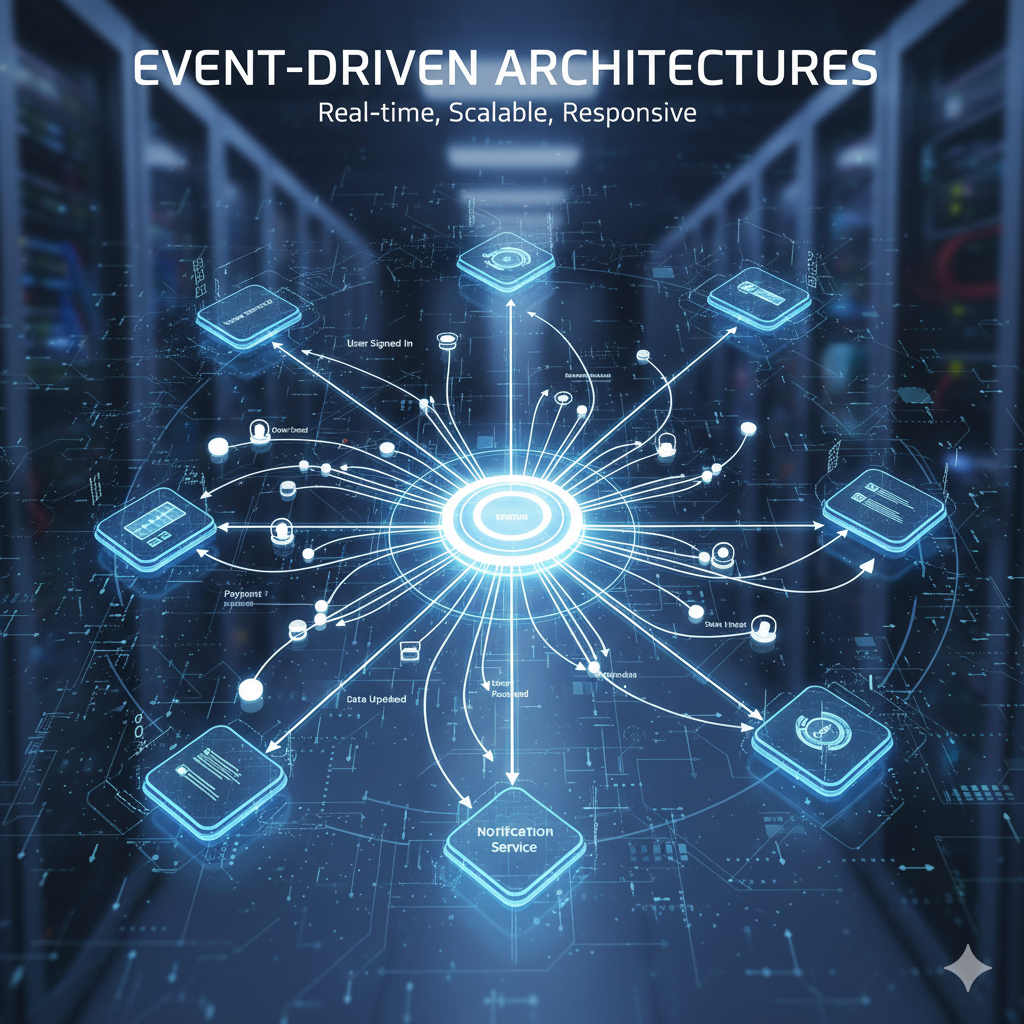
Event-Driven Architecture, commonly known as EDA, is a software design approach where systems respond to actions the moment they happen. Whether it is a customer placing an order, a payment going through, or a smart device sending data — the system reacts instantly. This approach powers some of the most widely used apps in the world today, from Amazon and Flipkart to Uber, Ola, and UPI payment platforms.
Understanding Event-Driven Architecture
At its core, EDA works on a simple principle: something happens, and the system reacts immediately.
An event is any action or change in a system. It could be a user clicking a button, a sensor recording a temperature change, or a bank transaction completing. Instead of the system constantly checking whether something has changed, it simply waits and responds when an event occurs.
This is very different from traditional request-response models, where one part of the system has to wait for another to finish before moving forward. In EDA, multiple services can react to the same event at the same time, independently.
How Event-Driven Architecture Works
EDA has three main building blocks:
- Event Producers: These are the components that generate events. For example, a customer clicking “Buy Now” on an e-commerce site, a user logging into an app, or a connected device sending sensor data.
- Event Brokers: These are tools that carry events from producers to consumers. Think of them as delivery services that route events to the right place. Popular event brokers include Apache Kafka, RabbitMQ, and AWS EventBridge.
- Event Consumers: These are the services or systems that act on the events. They may send confirmation emails, update inventory, process payments, or store logs — each working independently of the others.
This separation of responsibilities makes the system more flexible and easier to scale.
Real-World Examples of Event-Driven Architecture
EDA is not just a theoretical concept. It is actively used by major platforms across industries.
- E-Commerce (Amazon, Flipkart): When you place an order, one service updates the stock, another verifies the payment, and another triggers the shipping process — all at the same time, without waiting for each other.
- Ride-Hailing Apps (Uber, Ola): Driver location updates, ride requests, trip start and end events, and fare calculations all happen in real time through an event-driven system.
- Banking and Fintech: UPI payments, fraud detection alerts, and transaction notifications are all powered by events. This ensures users get instant responses and the system stays reliable even under heavy load.
- IoT and Smart Devices: Smart home devices, industrial sensors, and connected gadgets continuously generate events that need immediate processing.
Key Benefits of Event-Driven Architecture
| Benefit | What It Means |
|---|---|
| Real-Time Response | The system reacts to changes instantly without any delay |
| High Scalability | Handles millions of events without slowing down |
| Better Performance | Reacts only when needed, avoiding unnecessary processing |
| Independent Services | If one service fails, others continue working normally |
| Cost Efficiency | Cloud resources are used only when an event is triggered |
Where EDA Is Used and Its Challenges
EDA is widely adopted across many sectors:
- E-commerce order management systems
- Banking, fintech, and UPI payment platforms
- IoT and smart-home device networks
- Real-time dashboards and analytics
- Logistics and delivery tracking
- Push notifications and alert systems
- Automation workflows in enterprise software
However, EDA does come with its own set of challenges that teams must plan for:
- Complex debugging: Tracing the flow of events across multiple services can be difficult.
- Hard-to-track event flow: Without proper tools, understanding what triggered what becomes confusing.
- Need for strong monitoring: Teams need dedicated observability tools to keep track of events in real time.
- Skilled developers required: Building and maintaining EDA systems needs experienced engineers familiar with distributed systems.
These challenges are manageable with the right planning, tooling, and team expertise. Tools like Apache Kafka’s built-in monitoring, AWS CloudWatch for EventBridge, and distributed tracing platforms help teams stay on top of event flows.
Event-Driven Architecture has become a foundational approach for building fast, reliable, and scalable software. As user expectations for instant experiences grow, more businesses across India and globally are adopting EDA to stay competitive. Whether you are building a startup app or scaling an enterprise platform, understanding EDA gives you a strong advantage in modern software development.
Frequently Asked Questions
Event-Driven Architecture (EDA) is a software design approach where different parts of a system communicate by producing and reacting to events. An event is any action or change — like a user placing an order or a payment completing. When an event occurs, the system reacts to it immediately without waiting for a manual request.
The most widely used event brokers in EDA are Apache Kafka, RabbitMQ, and AWS EventBridge. These tools transfer events from producers to consumers and are used by major companies to handle millions of events per second reliably.
EDA can be complex to debug because events flow across multiple independent services. Tracking the full event flow requires strong monitoring tools. It also needs skilled developers who understand distributed systems. With proper planning and observability tools, these challenges can be managed effectively.