Artificial intelligence has moved well beyond chatbots and text generators. A new class of AI systems called Vision-Language-Action (VLA) models is now enabling robots to watch their surroundings, understand human instructions, and physically carry out tasks — all without manual programming. Here is a clear breakdown of what VLA models are, how they work, and why they matter for the future of robotics and automation.
What Are Vision-Language-Action (VLA) Models?
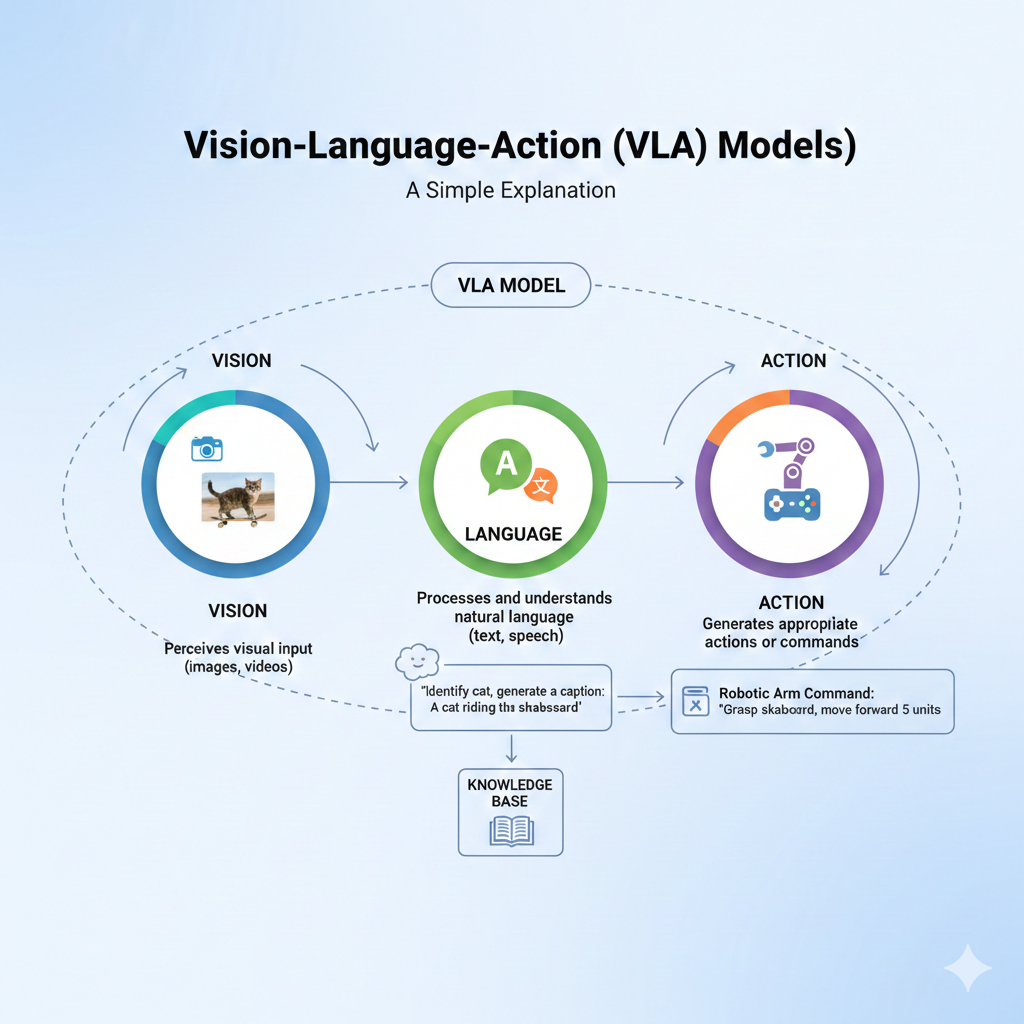
VLA models are advanced AI systems that combine three core capabilities: visual perception, natural language understanding, and physical action execution. Think of them as the brain of a smart robot — one that can see what is around it, understand what you say, and then do the task you asked for.
Unlike traditional AI models that only answer questions or generate text, VLA models are built to interact with the physical world. They can pick up objects, navigate rooms, open doors, and respond to spoken or written commands in plain everyday language.
This makes them fundamentally different from earlier robotic systems that required precise programming for every single action. A VLA-powered robot can handle new situations on its own by combining what it sees with what it hears or reads.
How VLA Models Work: Vision, Language, and Action
VLA models operate through three tightly connected components. Each one plays a specific role in helping the robot make smart decisions in real time.
- Vision: Using cameras and sensors, the model identifies objects, people, shapes, distances, and spatial layouts. For example, it can scan a table, spot a cup, and determine exactly where the cup is placed.
- Language: The model processes spoken or written instructions in natural human language — such as “Pick up the cup,” “Go to the kitchen,” or “Help me clean the table.” No technical commands or coding is needed.
- Action: After interpreting the scene and the instruction, the model decides the right physical movement, executes it safely, and adjusts if something unexpected happens — like an obstacle appearing in its path.
The combination of these three abilities allows VLA models to handle complex, unpredictable tasks that older robotic systems simply could not manage.
Real-World Applications of VLA Models
VLA models are already finding practical use across several industries. Their ability to understand both the environment and human instructions makes them suitable for a wide range of settings.
| Sector | Use Case |
|---|---|
| Home | Cleaning, sorting items, carrying heavy objects |
| Warehouses and Factories | Moving goods, managing shelves, handling repetitive tasks |
| Healthcare | Assisting elderly patients, delivering items, supporting staff |
| Navigation and Drones | Obstacle detection, safe movement in dynamic environments |
| Smart Cities | Autonomous delivery systems, self-driving support |
In homes, VLA-powered robots can assist with daily chores. In hospitals, they can safely deliver medicines or help elderly patients with routine tasks. In warehouses, they reduce the burden on human workers by handling repetitive and physically demanding jobs.
Why VLA Models Are Important for the Future of AI and Robotics
VLA models represent a major step forward in making AI genuinely useful in the physical world. Here is why they stand out:
- They remove the need for technical expertise — anyone can give instructions in plain language.
- They make automation safer by adapting to unpredictable environments in real time.
- A single VLA system can handle many different tasks, making it cost-effective for homes, hospitals, and industries.
- They bring humans and robots closer together through natural, conversational interaction.
- They lay the groundwork for general-purpose robots that can learn new tasks quickly.
As these models improve, they are expected to power the next generation of home robots, fully autonomous service robots, advanced drone navigation systems, and even self-driving vehicles.
What the Future Holds for VLA Models
Researchers and companies are actively working to make VLA models faster, more accurate, and capable of learning new tasks with minimal training. The goal is to build robots that can adapt to thousands of different situations — from helping an elderly person at home to managing complex logistics in a factory.
Their impact will also extend to delivery systems, smart city infrastructure, and collaborative work environments where humans and robots share the same space. As VLA models become more capable, the line between a robot assistant and a human helper will continue to narrow.
In short, VLA models are not just a technical milestone — they are a practical step toward making robots genuinely useful in everyday life, across every sector of society.
The development of VLA models signals that AI is no longer just about processing information. It is about taking meaningful action in the real world — and that changes everything about how we think about automation and human-robot collaboration.
Frequently Asked Questions
A Vision-Language-Action (VLA) model is an AI system that combines three abilities — seeing the environment through cameras, understanding natural human language instructions, and physically executing tasks. It allows robots to act intelligently in the real world without needing manual programming.
VLA models are used in homes for cleaning and sorting, in warehouses for moving goods and managing shelves, in hospitals for assisting patients and staff, and in navigation systems for drones and autonomous vehicles. They are designed to work across many different environments and tasks.
Regular AI chatbots only process and generate text. VLA models go further by also perceiving the physical environment through vision and executing real-world physical actions. This makes them suitable for robotics and automation, not just conversation.