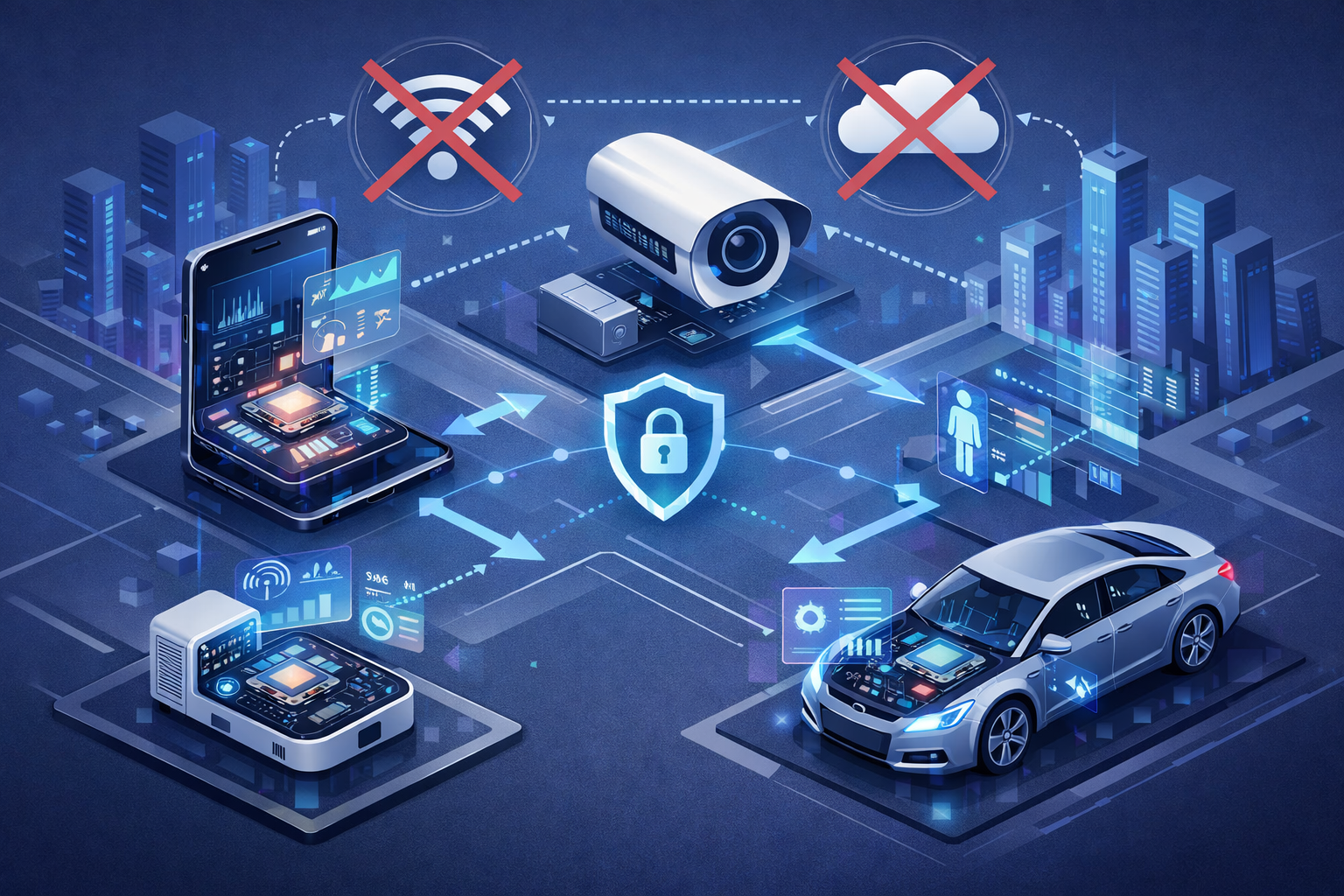
Most people assume artificial intelligence needs a constant internet connection to work. Edge AI breaks that assumption entirely. By running AI models directly on devices like smartphones, cameras, and industrial machines, Edge AI delivers fast, private, and reliable intelligence — even without internet access.
What Is Edge AI and Why Does It Matter?
Edge AI refers to running artificial intelligence models directly on a device rather than sending data to remote cloud servers for processing. These devices can include mobile phones, smart cameras, wearables, factory machines, or medical sensors.
Because the AI model lives inside the device itself, it can analyze data and make decisions locally and instantly. There is no need to wait for data to travel to a server and come back. This makes Edge AI faster, more secure, and far more reliable in situations where internet connectivity is limited or unavailable.
As smart devices become part of everyday life — from fitness bands to self-driving cars — Edge AI is quickly becoming one of the most important technologies shaping the future.
Edge AI vs Cloud AI: Key Differences
Understanding how Edge AI differs from traditional Cloud AI helps explain why it is gaining so much attention across industries.
| Feature | Edge AI | Cloud AI |
|---|---|---|
| Processing Location | On the device itself | On remote servers |
| Internet Required | No | Yes |
| Response Speed | Instant (low latency) | Slower (depends on network) |
| Data Privacy | High (data stays on device) | Lower (data sent online) |
| Best For | Real-time, offline tasks | Large-scale data processing |
Many modern systems combine both approaches — using Edge AI for real-time tasks and Cloud AI for deeper analysis when connectivity is available.
How Edge AI Actually Works Offline
The process behind Edge AI involves several steps that happen before the device ever reaches your hands.
- Model Training: A powerful AI model is first trained on large datasets using high-performance computers or cloud infrastructure.
- Model Optimization: The trained model is compressed and optimized — a process called model quantization or pruning — so it can run efficiently on low-power hardware.
- On-Device Deployment: The optimized model is installed directly onto the device’s chip or processor.
- Local Inference: When the device collects data — such as a camera capturing an image — the AI model processes it entirely on the device without any internet connection.
A simple example: when you unlock your smartphone using face recognition in airplane mode, the AI model stored inside your phone’s processor is doing all the work locally. No data is sent anywhere.
Real-World Applications of Edge AI
Edge AI is already active across many sectors. Here are some of the most common and impactful use cases:
- Smartphones and Wearables: Face unlock, voice assistants, fitness tracking, and real-time language translation all rely on on-device AI processing.
- Smart Security Cameras: These cameras detect motion, identify faces, and flag unusual activity in real time without uploading footage to the cloud.
- Healthcare Devices: Wearable health monitors and bedside diagnostic tools use Edge AI to track patient vitals and detect anomalies instantly, keeping sensitive medical data private.
- Industrial Machines: Factories deploy Edge AI to predict equipment failures before they happen, reducing downtime and improving operational efficiency.
- Self-Driving Vehicles: Autonomous cars process data from cameras, radar, and sensors in real time to detect objects, read traffic signs, and avoid obstacles — all without waiting for cloud instructions.
- Agriculture and Remote Monitoring: Sensors in remote fields use Edge AI to monitor crop conditions and soil data where internet connectivity is poor or nonexistent.
Benefits and Challenges of Edge AI
Edge AI brings clear advantages, but it also comes with real technical challenges that engineers and manufacturers are actively working to solve.
Key Benefits:
- Faster response times with near-zero latency for real-time tasks
- Works reliably without internet access, even in remote or moving environments
- Stronger data privacy since personal information never leaves the device
- Reduced cloud storage and data transmission costs for businesses
- Greater system reliability with fewer points of failure
Current Challenges:
- Limited processing power and memory on small devices
- Battery life constraints when running complex AI models continuously
- Difficulty updating AI models on deployed devices at scale
- Higher upfront hardware costs for AI-capable chips
New dedicated AI chips — such as Neural Processing Units (NPUs) found in modern smartphones — are rapidly addressing these limitations, making Edge AI more capable and energy-efficient with each generation.
The Future of Edge AI in a Connected World
The growth of the Internet of Things (IoT), the rollout of 5G networks, and the increasing demand for real-time intelligence are all pushing Edge AI into the mainstream. Analysts expect billions of devices to run on-device AI within the next few years.
From smart homes and connected hospitals to autonomous drones and smart city infrastructure, Edge AI will be the backbone of systems that need to think and act instantly. As AI chips become smaller, cheaper, and more powerful, even the most basic devices will carry meaningful intelligence built right in.
In conclusion, Edge AI represents a significant shift in how artificial intelligence is deployed and used. By processing data directly on devices — offline, instantly, and securely — it removes the bottlenecks of cloud dependency and opens up new possibilities across healthcare, industry, transportation, and everyday consumer technology. As hardware and software continue to improve, Edge AI will only grow more capable and more central to the smart systems we rely on daily.
Frequently Asked Questions
Edge AI means running an artificial intelligence model directly on a device — like a smartphone or smart camera — instead of sending data to cloud servers. This allows the device to make decisions instantly and without needing an internet connection.
Yes. Edge AI is specifically designed to work offline. The AI model is stored and runs on the device itself, so it does not need to connect to the internet to process data or make decisions.
Edge AI offers faster response times with very low latency, stronger data privacy since information stays on the device, and reliable performance even without internet access. Cloud AI, on the other hand, is better suited for processing very large datasets that require more computing power than a single device can provide.